Christmas markets are not just festive attractions: they are a powerful winter tourism engine for many destinations across Central Europe.
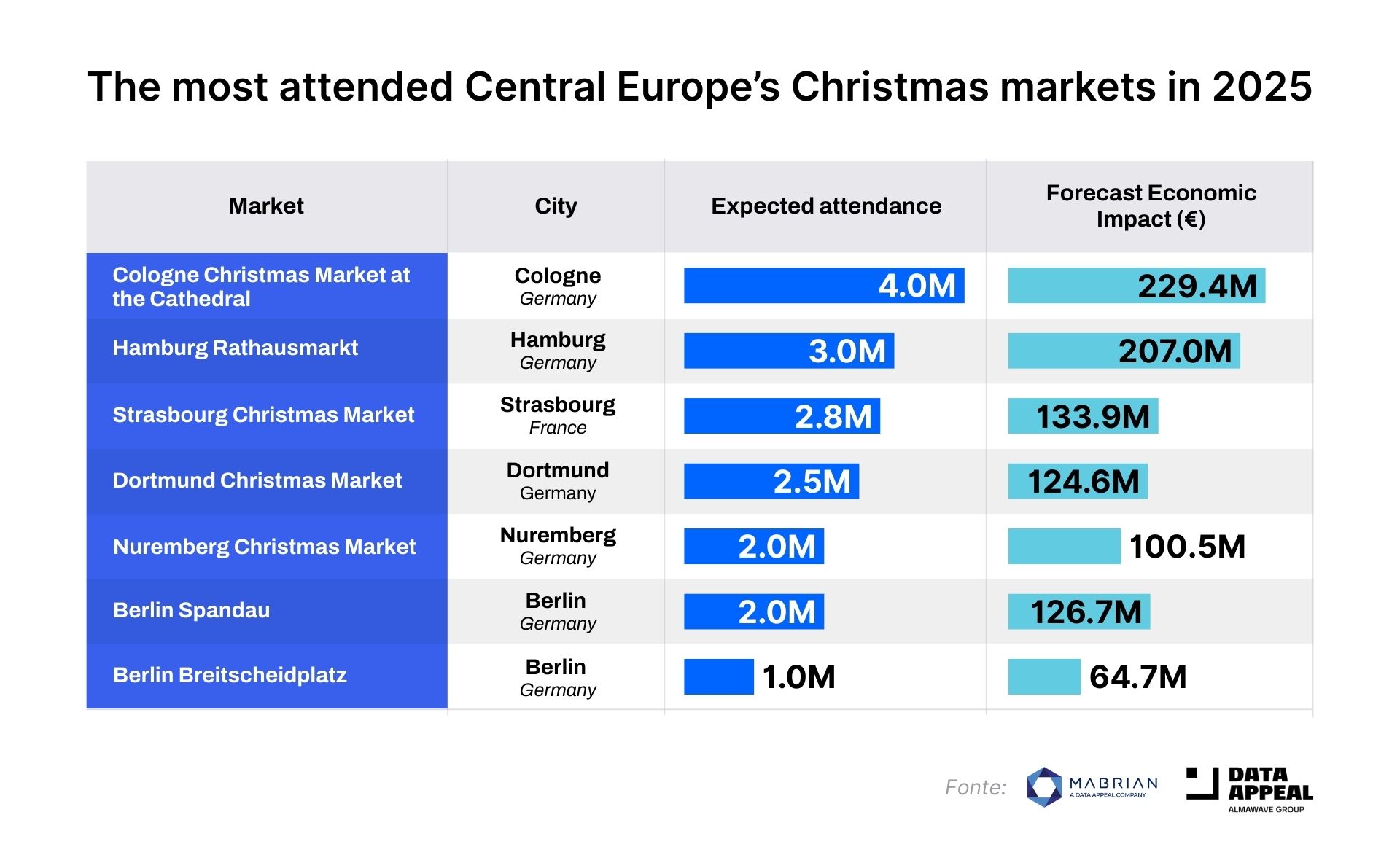
According to a recent analysis conducted by The Data Appeal Company and Mabrian, part of the Almawave Group, the region’s most attended Christmas markets are forecast to welcome 17.3 million visitors and generate an estimated €986.8 million in economic impact in 2025.
These seven markets — located almost entirely in Germany, with the exception of Strasbourg in France — stand out for their ability to attract high visitor volumes and sustain significant local economic activity during the low season.
Let’s dive deep into the report’s highlights.
1. Germany: The undisputed leader of Europe’s Christmas economy
Germany hosts six of the seven most visited Christmas markets in this analysis, confirming its position as the leading country for Christmas tourism in Central Europe.
This dominance is not coincidental: Germany hosts thousands of Christmas markets each year, and historic events, such as Nuremberg’s market, have helped shape the modern image of Christmas markets worldwide. Combined with excellent rail connections, cross-border accessibility and a strong gastronomic identity, German cities are uniquely positioned to attract both domestic and international visitors.
Cologne and Hamburg illustrate this leadership well: they will attract the highest visitor numbers and account for 44% of total spending, reaching €229.4M and €207M respectively.
2. Cologne leads in visitor numbers and economic impact
Among all markets analysed, the Cologne Christmas Market at the Cathedral stands out as the top performer in Central Europe.
With 4 million visitors expected and a forecast economic impact of €229.4M, it tops the ranking in both attendance and spending. Its strong appeal reflects Cologne’s accessibility, visibility and established reputation as one of Germany’s most iconic festive destinations.
3. Food & Beverage as the leading spending category
One of the clearest trends emerging from the analysis concerns spending behaviour: Food & Beverage is the leading spending category, accounting for 58% of total visitor expenditure.
Transport follows with 28%, while Accommodation represents 14%: this breakdown underscores the strong gastronomic and experiential appeal of Christmas markets, and the importance of local flavours and conviviality in shaping visitor experiences.
4. Berlin: Two high-spending markets in a city with 90+ Christmas events
Berlin is a unique case within the ranking: it is the only city with two markets included in the top seven (Spandau and Breitscheidplatz) which together generate an estimated €191.4M in economic impact. Both markets also record some of the highest levels of average spending per visitor, despite welcoming fewer visitors overall.
Beyond these two major markets, Berlin’s official tourism website lists 95 Christmas markets across the city, confirming their central role in Berlin’s winter tourism landscape.
5. Visitor profile: Day-trippers and experience-seekers
The spending profile, with only 14% devoted to hospitality and 28% to transport, indicates that these Christmas markets are primarily frequented by local residents and regional day-trippers, rather than traditional overnight tourists.
Visitors allocate most of their budget to food and beverages, transforming markets into vibrant open-air dining spaces where socialising and seasonal traditions take centre stage.
What this means for DMOs and tourism organisations
For destination management organisations (DMOs), municipalities and tourism offices, these findings highlight the strategic value of Christmas markets as:
- anchors for winter tourism programming,
- drivers of local business activity,
- catalysts for city branding,
- and opportunities to extend visitor stays beyond the event itself.
Christmas markets can act as gateways to a broader range of experiences that encourage travellers to stay longer, spend more, and return beyond the holiday season.
The insights presented here confirm that Christmas markets remain one of the most effective levers destinations can activate during the low season — combining tradition, cultural appeal and strong economic performance.