
The international fashion event dedicated to Women’s S/S 2027 will draw almost 150,000 attendees to Milan, driving a +1.7% increase in tourist spending compared to last year, according to The Data Appeal Company. Food and beverage records the strongest growth of all spending categories.
FLORENCE (Italy) September 17, 2026 — Milano Fashion Week continues to strengthen its role as a tourism catalyst for high-spending travellers. A recent analysis conducted by The Data Appeal Company / Almaviva Group with the travel intelligence platform Data Appeal Mabrian shows growth in flight bookings, high-end hotel rates and incremental tourist spending ahead of the Women’s Collection S/S 2027.
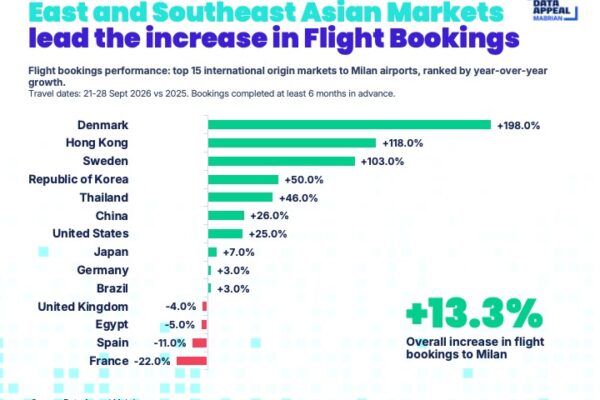
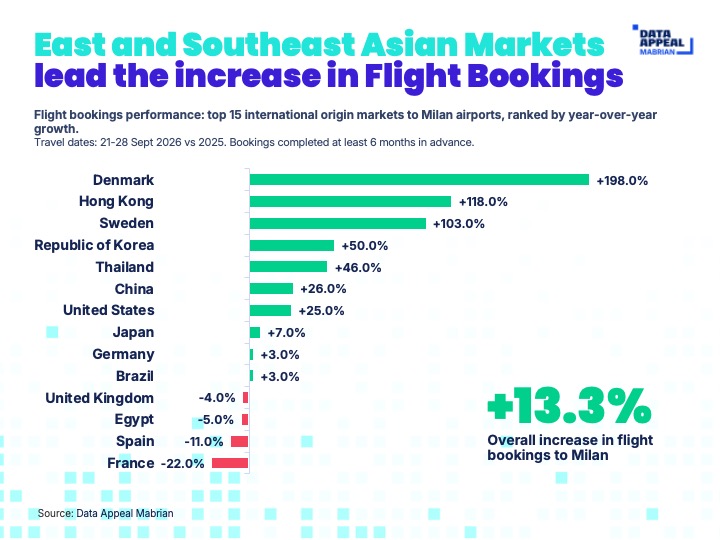
Flight bookings for travel to Milan during the event days (21–28 September) are up +13.3% year on year, with a clear redistribution of flows across source markets.
East and Southeast Asia destinations experience the highest growth driven by South Korea (+50%), Hong Kong (+118%), China (+26%), and Japan (+7%). The growth in arrivals and engagement with Milano Fashion Week from these markets coincides with improved air connectivity, particularly from South Korea and China, where new direct routes operated by Asiana Airlines and Air China have recently launched.
The United States remains the top source market by number of flight bookings, up +25%, while in Europe, growth was concentrated in northern countries: Denmark (+198%) and Sweden (+103%).
Hotel prices show a divergent trend across categories. 3- and 4-star rates fall 9.4% and 3.5% year on year respectively, largely due to an exceptionally busy events calendar during last year’s edition, which drove higher accommodation demand across the city. On the other hand, 5-star rates rise +19% year on year, reflecting sustained interest from high-spending travellers during the event.
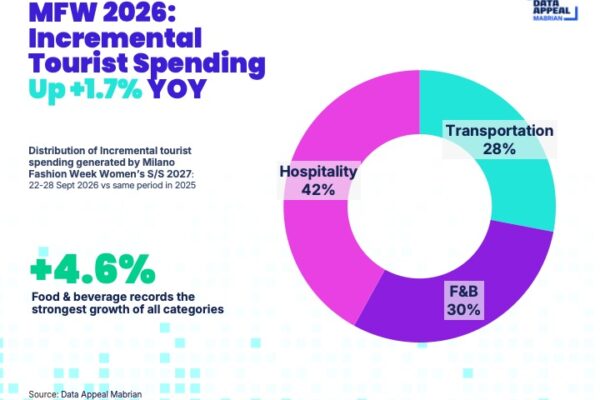
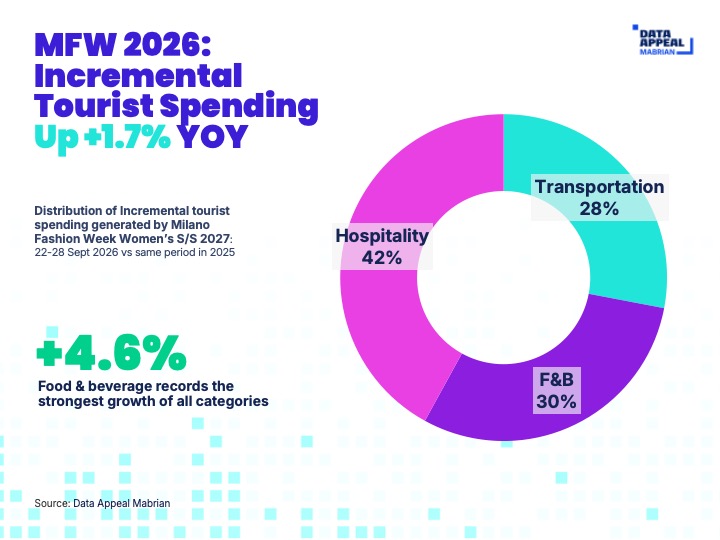
Incremental tourist spending — generated by visitors travelling to the destination specifically to attend the event, across hospitality, food & beverage and transportation — rises +1.7% compared to last year’s edition. Hospitality accounts for the largest share of spending (42%), followed by food & beverage (30%) and transportation (28%). Among these categories, food and beverage records the strongest growth, up +4.6% year on year, underscoring the growing role of dining and gastronomy in the overall experience for high-spending international travellers.
“Milano Fashion Week’s numbers confirm how fashion events are among the most resilient drivers of high-value tourism. Flight bookings from international markets are growing well ahead of the event’s stable attendance, and spending on dining and premium hospitality continues to rise. This is a positive signal despite a global scenario marked by economic volatility and geopolitical tensions that are also testing the luxury world,” says Carlos Cendra, Chief Marketing & Communications Officer at Data Appeal. “Destinations aiming to capture this value need to clearly identify the target markets for these events and measure the impact and the ROI of them, as part of a broader destination’s brand positioning strategy. Milano is a great example of that.”