

Estonia and Lithuania recorded the strongest overall growth in air connectivity in the last 12 months (+11.2% YoY), driven by Poland and other regional markets attracted by a wide variety of experiences, highlighting new opportunities for higher-value tourism beyond the peak season.
Florence, 29 October 2026 – Baltic Countries – Estonia, Latvia and Lithuania – have an opportunity to shift from volume growth to value growth, according to a new study by The Data Appeal Company – Almaviva Group.
Data collected through the travel intelligence platform Data Appeal Mabrian shows that travel demand across the Baltics remains concentrated in the summer season (July-August), while the average length of stay is relatively short at around 2.2 days.
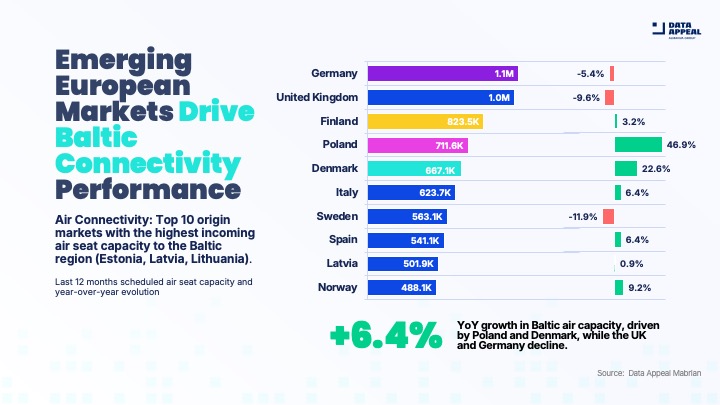
At the same time, air connectivity to the Baltics is gaining momentum, with an overall increase of +6.4% in available airline seats in the last 12 months, mainly driven by Poland (+46.9% YoY) and Denmark (+22.6%). Air connectivity trends at country level confirm the region’s growth trajectory while revealing a more nuanced picture: available inbound seats to Estonia and Lithuania increased at the same pace (+11.2% YoY), while Latvia stayed stable (-0.3%).
Neighbouring European countries remain the key growth drivers: Poland and Latvia for Estonia; Finland and Denmark for Latvia; Spain, Italy and Denmark for Lithuania.
“The Baltics are poised for growth, offering substantial opportunities to attract more visitors and encourage longer stays throughout the year,” explains Carlos Cendra, Chief Marketing and Communications Officer at Data Appeal. “Expanding accessibility through stronger air connectivity and the unique peculiarities of each destination provide a solid foundation to broaden their attractiveness during low season, especially in Central and Northern Europe.”
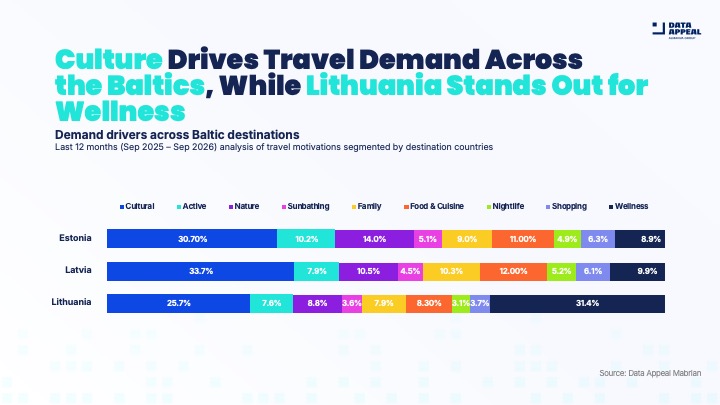
Analysis of demand drivers highlights distinct positioning opportunities for each Baltic destination. Lithuania stands out for its wellness and spa offering, accounting for 31.4% of all travellers’ demand drivers over the last 12 months. Estonia distinguishes itself through cultural (30%) and nature-based experiences (14%), while Latvia shows strong appeal for culture (33.7%) and gastronomy (12%).
Hotel supply analysis across major online travel agencies (OTAs) also highlights distinct accommodation patterns across the Baltics. Lithuania stands out for its premium profile, with 5-star hotels accounting for 6.3% of total supply and commanding the highest average rates among the three countries. Latvia combines the most competitive prices with the highest share of 4-star properties (51%), while Estonia offers a balanced mix of 3- and 4-star hotels, with the highest average rates in both categories.
“The next growth opportunity for the Baltics,” adds Cendra, “is not necessarily attracting more visitors, but crafting a more tailored product mix to better target those markets that are more likely to stay longer, spend more and appreciate the distinctive experiences each destination can offer beyond the peak summer season.”