

A recent analysis by The Data Appeal Company – Almaviva Group shows the Southern European countries analysed achieve similar overall sustainability levels, but the benchmark reveals different tourism models and three common opportunities for improvement.
FLORENCE, November 19, 2026 – A new analysis powered by the Data Appeal Mabrian travel intelligence platform was developed ahead of the Spain Talks event in Milan on November 19 to assess tourism sustainability performance across four Southern Eurpean destinations: Spain, Italy, Greece, and Portugal.
All four countries record a positive Tourism Sustainability Global Index
Data Appeal Mabrian’s proprietary framework assessed the countries’ tourism sustainability through one overall score, seven sub-indices and multiple data sources, including visitor spending, carbon footprint, lodging density, traveller perception and destination imbalances.
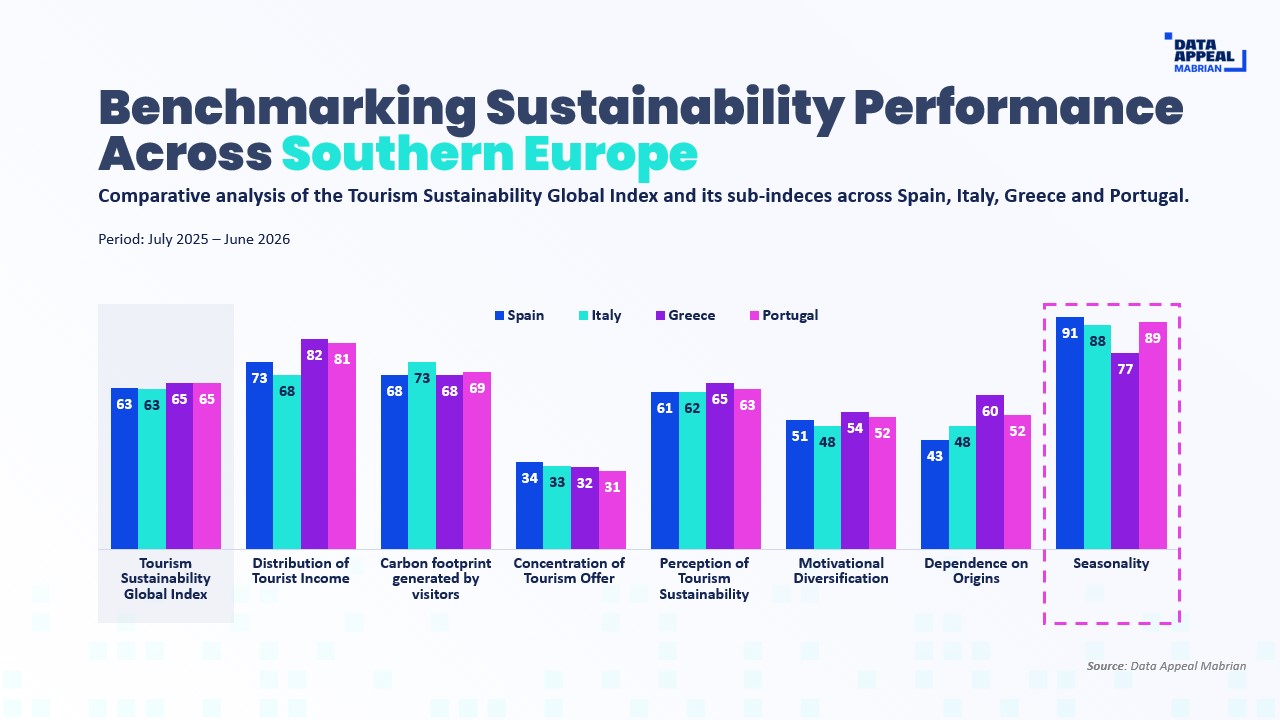
The findings show that the overall Tourism Sustainability Global Index is closely aligned across the four countries, with Spain and Italy scoring 63/100 and Greece and Portugal reaching 65/100. Yet similar overall scores reflect slightly different sustainability profiles.
Spain excels at spreading demand throughout the year, achieving the highest Seasonality Index (91/100) among the countries analysed, while Italy records the strongest performance in air transport tourism-related carbon footprint (73/100).
Greece and Portugal lead in the geographic Distribution of Tourist Income Index, scoring 82/100 and 81/100 respectively, indicating a more balanced distribution of tourism-generated economic benefits across their territories.
“Looking at tourism sustainability only through the lens of environmental impact would be reductive,” explains Carlos Cendra, Chief Marketing and Communications Officer at Data Appeal. “That’s why we developed a multidimensional framework with standard data sources and methodology, to monitor different aspects of sustainability and identify where destinations are performing well and where the greatest opportunities for improvement lie.”
 Three main areas for improvement identified
The comparative analysis highlights three key areas for further progress in sustainability.
The Concentration of Tourism Offer Index, which measures the level of saturation of accommodation and tourism activities across a destination, emerges as the weakest indicator among the countries analysed, with scores ranging from 31/100 in Portugal to 34/100 in Spain.
The Dependence on Origins Index, based on travel demand, also reveals room for improvement. Greece achieves the strongest performance (60/100), while Spain (43/100) and Italy (48/100) could further strengthen their resilience through a more diversified mix of source markets.
Further opportunities emerge from the Motivational Diversification Index, where all four countries score within a relatively narrow range, from 48/100 in Italy to 54/100 in Greece. The results highlight the need to amplify diversified tourism offering and experiences to attract a broader range of traveller profiles.
“What clearly emerges from the data,” says Carlos Cendra, “is that the future of sustainable tourism can be summarised in two words: diversification and distribution. Destinations have significant opportunities to strengthen their sustainability performance by spreading their tourism offering more evenly across their territory and throughout the year, relying on a wider base of source markets, and broadening the range of experiences available to visitors.”