With the strong rebound of international tourism in recent years, culture and nature have become two essential pillars of leisure travel—not only in Europe, but also in the United States.
A recent analysis by Data Appeal and Mabrian of the U.S. market for online experiences and activities highlights the key role that cultural activities and outdoor adventures play in shaping destination positioning and driving travel across different states.

Not only culture: Nature complements museums in both Europe and the U.S.
The growth of the travel experiences market shows no signs of slowing down. Travellers look for more than simple sightseeing when choosing a destination to visit. They want to taste local cuisine, join alternative tours, meet local producers, go cycling or kayaking—anything that can make their stay more memorable and immersive.
This so-called “experience economy”, built around the desire to create lasting memories rather than purchase physical goods, is thriving—driven especially by younger generations such as Millennials and Gen Z (source: WTM).
Museums and iconic historical landmarks remain the cornerstone of many international destinations’ travel offering. Yet alongside these traditional attractions, nature-based experiences are increasingly gaining momentum: scenic trails, parks and gardens, and a wide range of outdoor adventures.
This trend gained significant traction during the pandemic, when travellers sought to avoid crowds and reconnect with nature—and it has remained strong ever since. As a result, culture and nature have become two fundamental components of travel experiences worldwide.
Similarly, research on German travellers by Data Appeal and Mabrian shows that this market strongly favours cultural experiences (45.2%), with nature-based activities ranking second (22.1%).
The United States is no exception.

From Florida to Hawaii: Five states dominate the U.S. experiences market
Over the past six months, Florida, California, New York, Hawaii, and Nevada have accounted for more than 50% of all experiences and leisure activities sold through Civitatis and GetYourGuide, two of the leading online platforms operating in the U.S. market.
At the top of the ranking of online travel experiences are Florida (14.9%), California (13.1%), and New York State (12.9%).
Completing the top ten—with significantly smaller shares—are Hawaii (7.3%), Nevada (4.5%), Texas (4%), Colorado and Virginia (3.3% each), Arizona (3%), and Utah (2.9%).

The remaining 30.7% of available activities are distributed across the other forty U.S. states.
This indicates that the U.S. experiences market still offers considerable growth potential, particularly in encouraging both domestic and international travel beyond the most well-known tourist destinations.
Diversifying the range of experiences available can help destinations attract different traveller segments by promoting lesser-known locations capable of offering unique, authentically American experiences.
40.7% of available experiences are related to art and culture
What types of travel experiences are most widely offered in the United States?
Cultural experiences account for 40.7% of the available supply, followed by active tourism activities (27%), nature-based experiences (15.3%), gastronomy (10%), and sun-related activities (3.2%).

Other types of experiences represent only a small portion of the overall offer: nightlife (1.5%), family activities (1.1%), and wellness and shopping (1%).
These smaller segments still represent valuable niche opportunities to broaden the tourism offer and better cater to travellers of different ages and profiles.
Interestingly, the composition of the experience supply in the U.S. closely mirrors the level of engagement expressed through online reviews.
Cultural experiences generate over half of all reviews (50.9%), highlighting travellers’ strong interest in local heritage, art, and traditions.
At the same time, the balance between active tourism (20% of reviews) and nature-based activities (20.6%) reflects a growing enthusiasm for outdoor experiences—both adventurous and more relaxed—allowing travellers to explore the diverse and striking natural landscapes of the United States.
This suggests that every state has the opportunity to develop and promote experiences aligned with these preferences. The most effective strategy is often to focus on destinations that offer a balanced combination of cultural and nature-based attractions—two elements that consistently prove to be powerful tourism drivers.
”The strong engagement generated by cultural experiences is a strategy worth exploring for US destinations—not only to connect with domestic travellers but also to attract international visitors eager to enrich their stays with activities rooted in local culture and heritage.
The 250th anniversary of the United States in 2026 presents a unique opportunity for destinations to showcase their cultural and historic assets, while promoting multi-state itineraries grounded in heritage and identity. It’s a moment to encourage travellers to go beyond iconic landmarks and connect more deeply with the stories that define the nation.
Maria PradissittoNorth America Market Manager at Data Appeal

Data and AI: investing where it matters most
Leveraging the travel experiences market to strengthen destination attractiveness, refine positioning, and differentiate globally is possible—but only if destinations develop a deep understanding of visitor behaviour and what truly generates economic value.
Where do visitors come from?
Who do they travel with?
What experiences do they purchase?
Obtaining these insights is far from straightforward—especially as traveller habits and preferences evolve at a speed never seen before.
Relying on outdated statistics or purely quantitative data is no longer enough to understand markets. Destinations need access to new, constantly updated datasets.
To truly understand travellers’ perceptions, qualitative data becomes essential—for example, analysing the sentiment expressed in online content, segmented by traveller origin and profile. These insights reveal what people talk about, what matters most to them, and which issues emerge most frequently.
When this information is combined with data on air connectivity, hotel bookings, travel searches, and local events, destinations can build a far more reliable traveller profile—not only for today’s visitors, but also for those of tomorrow.
When such data is available through platforms that update in real time, it becomes possible to track how behaviours and preferences evolve over time.
Understanding one’s target audience in depth is the first essential step toward building a strong tourism offering, refining positioning, and developing truly effective destination marketing strategies.
For example, destinations can:
- Identify markets where latent demand is growing
- Detect shifts in travel drivers before they impact arrivals
- Spot product gaps compared to competing destinations
With the spread of new technologies, accessing these insights has become increasingly straightforward.
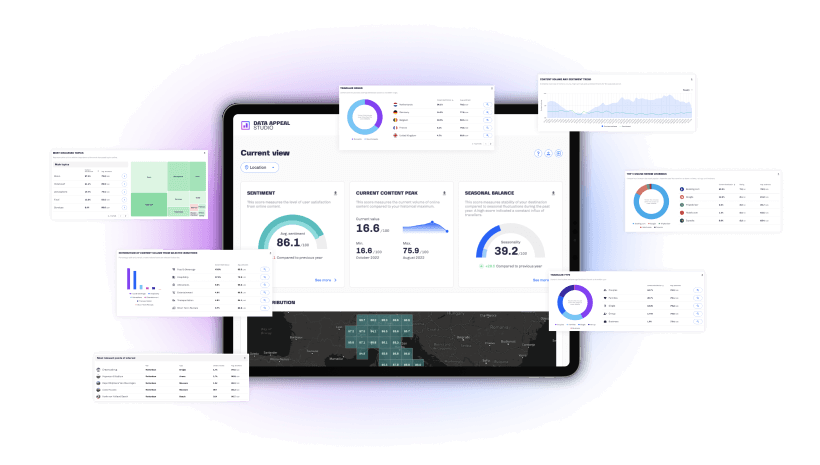
For instance, Data Appeal’s new DMO platform integrates an innovative generative-AI tool called Smart Insights.
The system can analyse thousands of online reviews about a destination in just a few minutes, extracting actionable insights for destination managers. By simply interacting with the tool in natural language, users can obtain detailed information about visitors, their preferences, and their behaviour.
This makes it possible to answer strategic questions such as:
Which locations are most visited by French travellers, and why?
What aspects of hotels are most frequently criticised by Asian visitors?
Which areas of the city attract the highest number of German tourists?
Insights like these—both for one’s own destination and for competitors—are extremely valuable for understanding:
- Which travel experiences visitors prefer and which attractions generate the highest satisfaction
- What makes an experience memorable, thanks to semantic analysis of online reviews
- Where high-value experiences are concentrated, and which areas lack tourism offerings
- Whether new experiences can be developed without increasing pressure on overcrowded areas
- How to allocate marketing budgets effectively, reducing the risk of misallocation and supporting decisions with integrated data
Ultimately, this type of analysis saves time, generates actionable insights, and enables the creation of reliable reports and forecasts.

(Source: Data Appeal Smart Insights – real-time recommendations to promote the city of Miami, Florida)
This analytical approach brings multiple benefits: from enhancing lesser-known areas and distributing visitor flows more evenly during peak periods, to creating increasingly diverse tourism experiences and strengthening competitive differentiation.
With integrated data and platforms designed for analysis and reporting, DMOs can:
- Demonstrate the effectiveness of campaigns with clear metrics
- Justify budget decisions to boards and political stakeholders
- Monitor key KPIs such as arrivals, visitor spending, sentiment, and competitive share
- React quickly if a market slows down or a competitor accelerates
In a context where traveller preferences evolve rapidly and budgets are under increasing pressure, the ability to transform trends into timely, measurable decisions becomes essential.