
Travel intelligence analysis by The Data Appeal Company finds that, while the February escalation triggered an immediate shock to travel sentiment and hotel demand across the GCC, travellers have progressively become less reactive to renewed tensions—pointing to strong recovery potential if disruption does not become prolonged.
FLORENCE, September 8, 2026 – Travel demand across the Gulf Cooperation Council (GCC) has shown a notable capacity to adapt to the Iran-US conflict, with recent data from The Data Appeal Company / Almaviva Group suggesting that international travellers are becoming less reactive to successive geopolitical developments and increasingly responsive to tangible improvements in stability, connectivity, and perceived safety.
This analysis, performed with Data Appeal Mabrian’s travel intelligence ecosystem, reveals a growing capacity among GCC tourism markets to adapt to geopolitical uncertainty ahead of a crucial edition of Arabian Travel Market (ATM), to be held next week in Dubai (UAE).
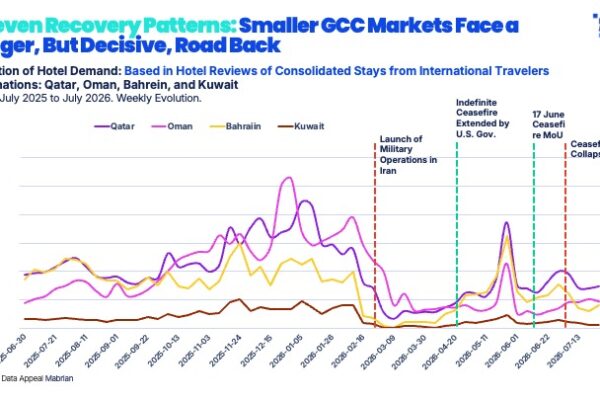
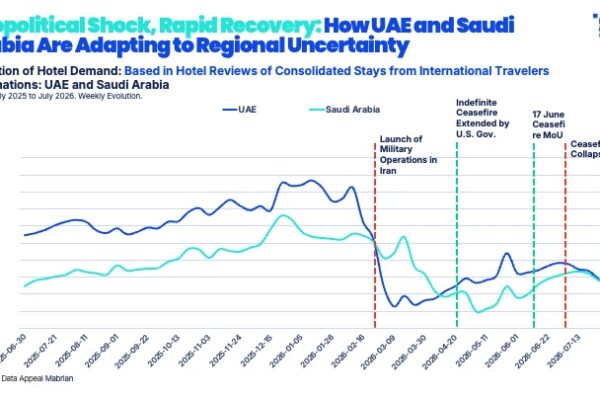
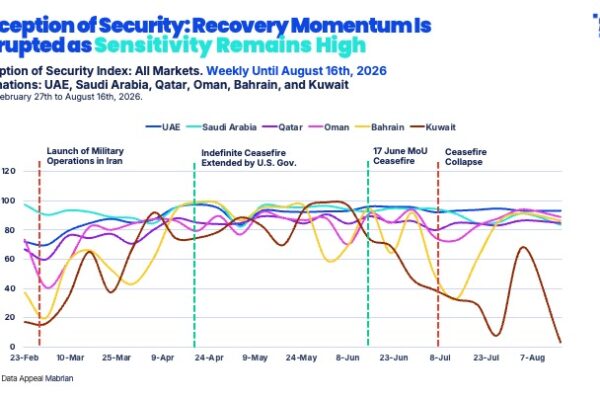
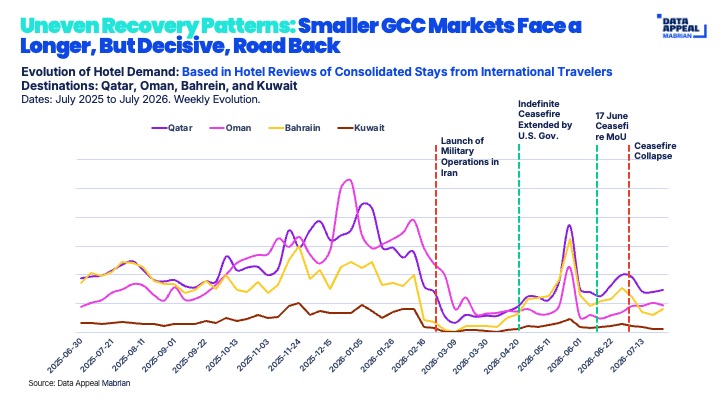
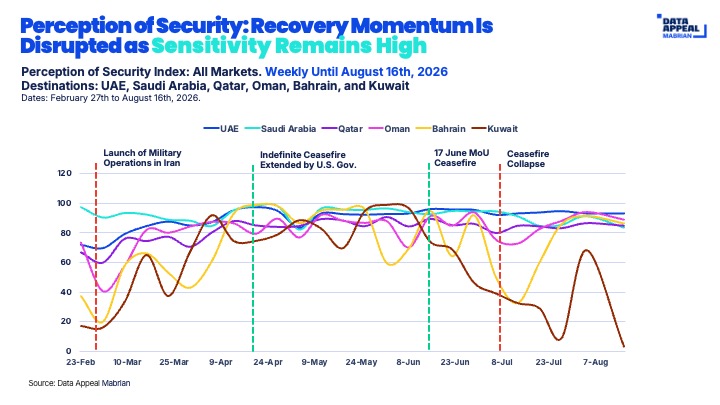
Data on the evolution of the Perception of Security Index (PSI), international hotel demand and global travel intent indicates that, while the February 2026 escalation triggered an immediate deterioration in perceptions of safety and a sharp contraction in international hotel stays, subsequent periods of de-escalation prompted visible rebounds—highlighting the resilience of GCC destinations and their capacity to recover as conditions stabilise. Importantly, the collapse of the ceasefire on 8 July produced a much more limited impact on hotel demand than the initial escalation, indicating that travelers may be progressively recalibrating their perception of regional risk.
How Risk-Adjusted Travel Behaviour is Shaping Global Demand
The evolution of the PSI across GCC destinations indicates that the impact of the conflict has been closely tied to geopolitical exposure, aviation disruption and uncertainty, rather than by direct damage to tourism attractions or infrastructure, a crucial consideration for any post-conflict recovery efforts. Bahrain and Kuwait experienced some of the strongest deterioration in security perception, reflecting their exposure to the regional escalation, while Oman was affected by concerns surrounding the Strait of Hormuz and regional connectivity. Qatar demonstrated greater capacity to cushion the initial shock, while the UAE and Saudi Arabia showed comparatively resilient PSI trajectories as tensions eased.
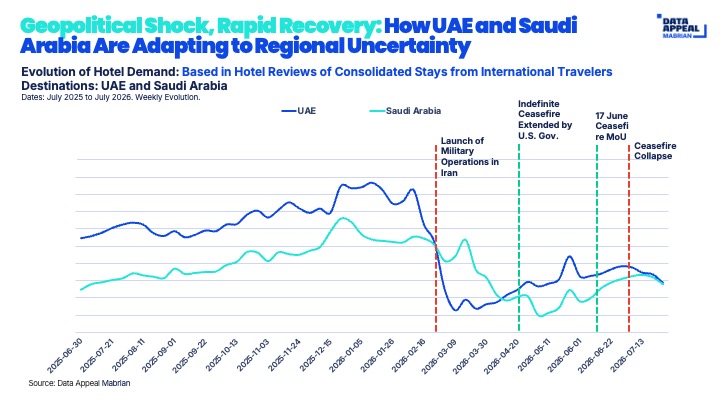
The hotel demand data tells a similar story. International hotel stays contracted sharply across GCC destinations following the launch of military operations on 28 February, with the decline intensifying through March. Yet, as tensions eased and a ceasefire window emerged, demand began to recover across the region. The UAE recorded the strongest rebound among the two major hubs analysed, while Saudi Arabia followed a more moderate but consistent recovery path.
The most significant signal, however, came in July, as the collapse of the ceasefire did not produce a second contraction comparable to the initial shock. Across several GCC markets, travelers appeared less reactive to the renewed escalation, suggesting that both consumers and the tourism ecosystem had begun adapting to a more uncertain geopolitical environment. “This adaptive behaviour is particularly relevant for GCC destinations because strong air connectivity, diversified source markets and established tourism ecosystems provide structural foundations for recovery,” explains Carlos Cendra, Director of Marketing and Communications at Data Appeal.
Leveraging Asia’s Rising Demand to Support Tourism Recovery
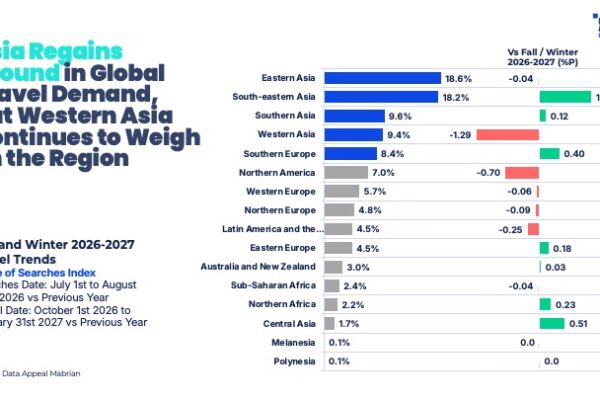
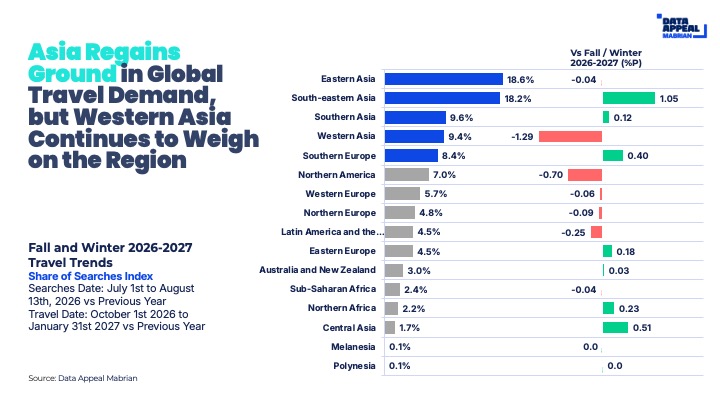
The recovery opportunity also needs to be considered against the wider global travel landscape. Data Appeal and Mabrian’s Share of Searches Index shows Asia regaining momentum in international travel intent for Fall/Winter 2026 and early 2027. Western Asia remains the world’s fourth most attractive region by international travel intent, but its share has fallen to 9.4% for October 2026–January 2027, down -1.29 percentage points year on year.
As major gateways between Europe, Asia and Africa, GCC destinations “are structurally positioned to capture growing Asia-bound flows,” says Cendra. “Maintaining seamless connectivity and reinforcing perceptions of safety could allow the region to regain market share as confidence improves.”
As Data Appeal CMO states: “For destinations that can maintain connectivity, communicate stability and protect the visitor experience, that distinction could make the difference between prolonged demand loss and a rapid recovery, provided the disruption is not prolonged to the point of affecting destination connectivity, tourism infrastructure, or the availability of tourism products and services.”