

Can a football match give a tourism destination enough visibility to produce an immediate impact on air bookings?
That is what happened to Cabo Verde. According to an analysis by The Data Appeal Company, around the country’s FIFA World Cup matches, flight bookings to the archipelago rose against the previous year for travel in both the winter and the summer season.
The FIFA World Cup was always going to raise the profile of the competing nations’ destinations. What was less expected is that this visibility would translate into immediate, concrete bookings.
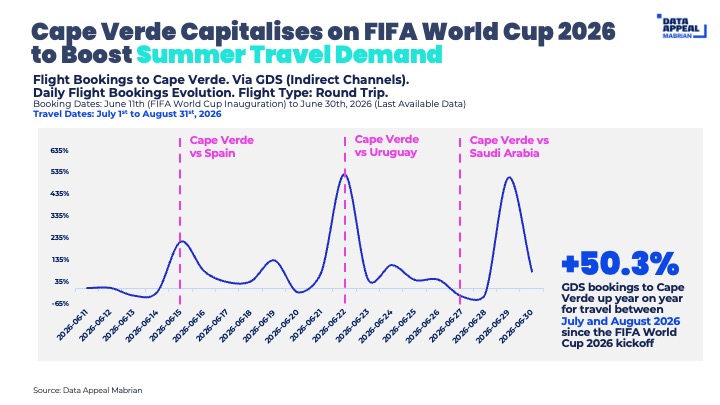
This is what the data processed with the Data Appeal Mabrian travel intelligence solution shows: around Cabo Verde’s three group-stage matches, flight bookings to the destination rose significantly against the same period the previous year. The correlation is observed both for autumn-winter, the destination’s high season, and even more sharply for summer, usually a quieter period, where flight bookings rose +50.3% overall.
A result that underlines the strategic value the World Cup generated for the sustainable management of the destination’s visitor flows.
Cabo Verde: a debut that won over a global audience
Cabo Verde’s World Cup 2026 story drew the attention and the affection of the global media from the outset. With a population of 527,000, it is the least populous nation ever to reach the knockout stage of a World Cup.
The “Blue Sharks” arrived at the tournament ranked 67th by FIFA, yet came through the group stage unbeaten, drawing with Spain, Uruguay and Saudi Arabia. They then pushed Lionel Messi’s Argentina to the limit, going out only after extra time, 3-2.
Over three weeks, the courage, determination and results of Cabo Verde’s 26 players turned the spotlight on the archipelago, with an immediate and concrete effect on the destination’s tourism.
The World Cup effect: air bookings for summer 2026 up more than 50%
To understand whether Cabo Verde’s World Cup run had produced real effects on the country’s tourism, we analysed the trend in flight bookings through the GDS (Global Distribution System), the indirect bookings made through travel agencies and online travel agencies (OTAs).
All analysis was carried out with the integrated Data Appeal Mabrian tourism intelligence platform.
The results were striking. The sustained growth in air booking volumes, both short and long-term, with clear peaks around Cabo Verde’s matches, shows that the media exposure of the games translated into greater travel demand.
The correlation covers both the autumn-winter season, the destination’s high season, and above all the summer, the period that usually attracts more modest visitor flows and which recorded the sharpest increase in air bookings.
According to an analysis of official 2025 data from the Instituto Nacional de Estatística de Cabo Verde (INE), the number of guests in hotel establishments is historically highest in October-December (32.1%) and January-March (26.1%).
This means the visibility generated by the World Cup is concretely helping Cabo Verde to distribute its flows more evenly across the short and medium term.
The effects of the World Cup on summer 2026 in detail:
- Bookings overall rise: GDS air bookings to Cabo Verde for travel between 1 July and 31 August 2026, made within the group stage of the World Cup, rose by +50.3% year on year.
- Daily air bookings up to six times higher year on year: for the first match, against Spain, bookings rose +214.8% year on year. The match against Uruguay marked the peak: +524.3%. A few days after the match against Saudi Arabia the pattern repeated, with a +508.9% rise against the same day the previous year.
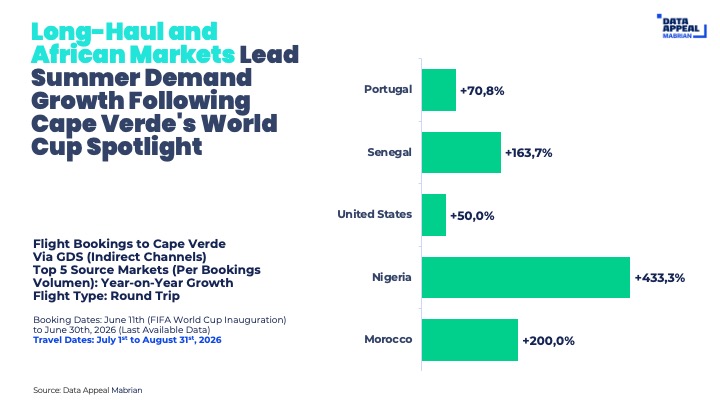
- Short and long-haul markets both growing: the rise in summer bookings involved not only Cabo Verde’s most established markets, Portugal (+70.8%) and the United States (+50.0%), but also Senegal (+163.7%), Nigeria (+433.3%) and Morocco (+200%), a sign that the exposure created by the World Cup had a broad reach, both short and long-haul.
Booking patterns hold for the winter season too
The data clearly show that the booking patterns seen for the summer holidays also apply to autumn-winter:
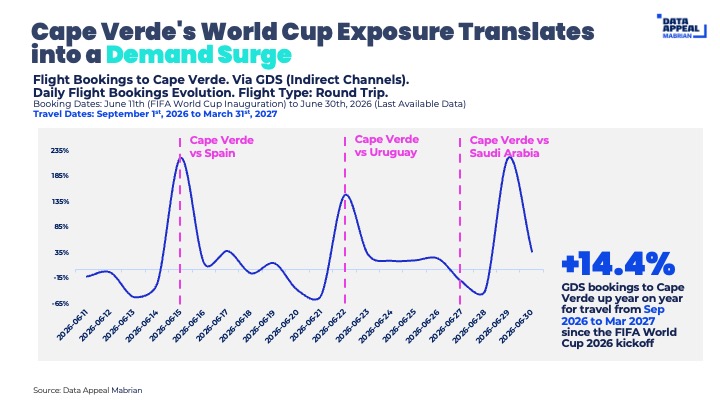
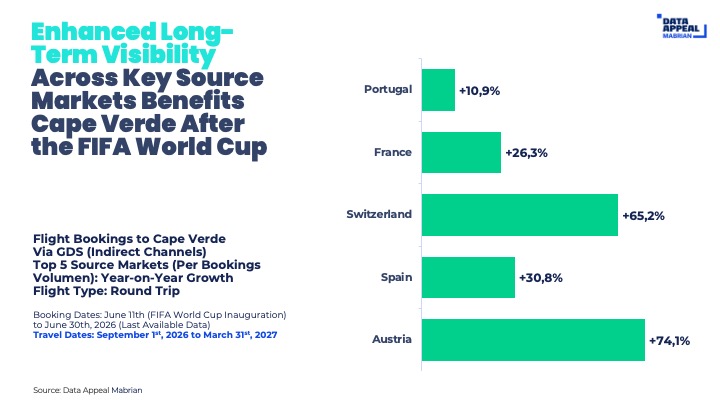
- Autumn-winter bookings growing: GDS air bookings to Cabo Verde made during the group stage of the FIFA World Cup 2026, for travel between 1 September 2026 and 31 March 2027, rose by +14.4% year on year.
- Flight bookings peak around the matches: +219.7% year on year for the match against Spain, +146.7% for the match against Uruguay, +220.5% two days after the match against Saudi Arabia.
- European markets on the rise: for the winter, the sharpest year-on-year growth involves some of Cabo Verde’s main European markets: Austria (+74.1%), Switzerland (+65.2%), Spain (+30.8%), France (+26.3%) and Portugal (+10.9%)
Major events and data analysis: the right combination for capitalising on the visibility they generate
The Cabo Verde analysis clearly shows that major international sporting events can generate or boost visitor flows from a more diverse range of markets. They can also help shifting seasonality, driving up arrivals during the low season.
For Cabo Verde, this is a significant opportunity. By pursuing targeted promotional campaigns in specific markets, supporting an increase in air capacity and continuing to monitor tourism performance closely, the destination can make the most of the media exposure the World Cup generates.
In this way, the event’s effects will not remain a passing trend but will help Cabo Verde become part, over the long term, of travellers’ “consideration set” of destinations across every season of the year.
Stay in the know
Stay up-to-date with the latest news tailored to your industry!
Subscribe to our newsletter to receive monthly research, eBooks, industry updates, data-driven reports and more.