

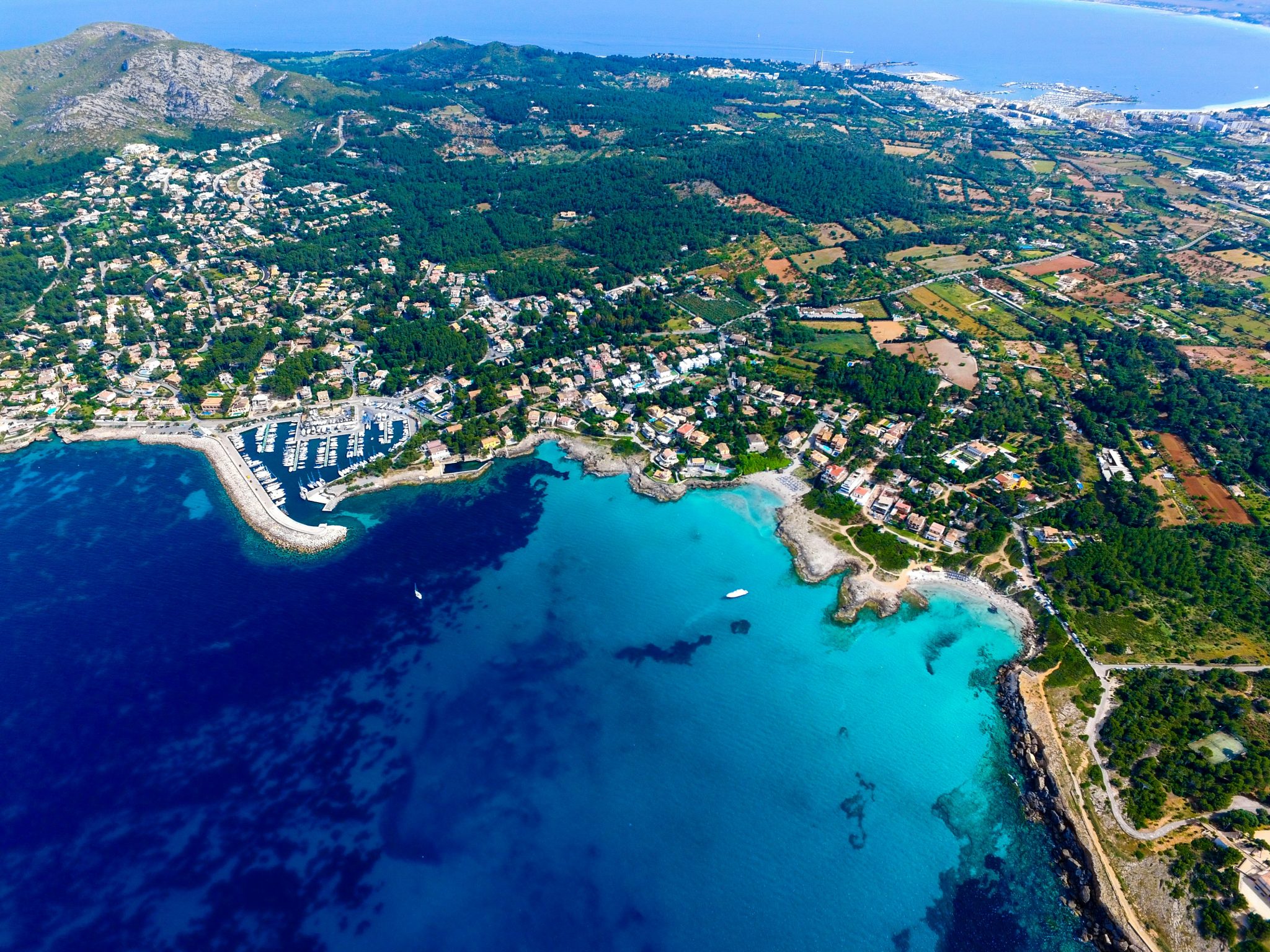
Mallorca continues to consolidate its position as a top Mediterranean destination, attracting global interest during and beyond summer season. Its strong air connectivity, growing appeal in experiential travel, and balanced demand drivers support a more diversified, year-long tourism model that also benefits summer season. However, pressure on hotel satisfaction during peak months pose challenges for perceived value. Sustaining competitiveness will depend on quality, innovation, and the ability to meet evolving traveller expectations.
Mallorca is proving its strength as a year-round destination by balancing international appeal, experiential travel and lodging offerings. While the island is able to attract demand from both mature and emerging markets—particularly thanks to active tourism and cultural experiences growth—its summer season dynamics reveals key pressures on guest satisfaction. Amid rising hotel prices, especially in the 3-star segment, Mallorca faces a pivotal opportunity: to reinforce competitiveness by delivering value, ensuring service quality, and strategically managing demand throughout the year.
We shared its conclusions during “Mallorca: A Destination for All Travellers”, an event organised by Expedia Group, in a round table that included contributions from José Marcial Rodríguez, Executive Secretary of Tourism at Consell de Mallorca; María José Aguiló, Executive Vice President of Mallorca’s Hotel Federation; Fernando Ramino, Senior Director Spain & Portugal at Expedia Group, and Cristina Panizo, Head of Insights & Tourism Advisory at Mabrian.
The debate addressed Mallorca’s evolution as tourism destination, particularly during its peak summer season, and how a mature destination can stay in tune with market trends to remain appealing to all types of travellers, in a highly competitive tourism market. Cristina Panizo, Head of Insights & Tourism Advisory at Mabrian pointed out key insights aimed at harnessing opportunities for summer and off-season beyond traditional motivations and markets.
Mabrian supported its insights with cross-analysing forecast data on summer 2025 (June to September 2025) on hotel prices, travel intent and planning, with consolidated data to unveil trends on demand drivers and hotel satisfaction, in order to identify potential opportunities for this Balearic destination.
Strong summer outlook supports off-season growth
Mallorca’s performance during the summer season demonstrates both stability in market share and sustained relevance, indicating that consistent growth is paving the way for more structured development aimed at protecting the destination’s quality standards.
According to our Share of Searches Index for summer 2025, 77% of travel intent to Mallorca originates from international markets. The island captures 4% of inspirational demand for Southern Europe and 13% of travel intent to Spain overall. Travellers are planning trips an average of over four months in advance, with expected stays averaging 6.9 days—2.5% shorter than in 2024.
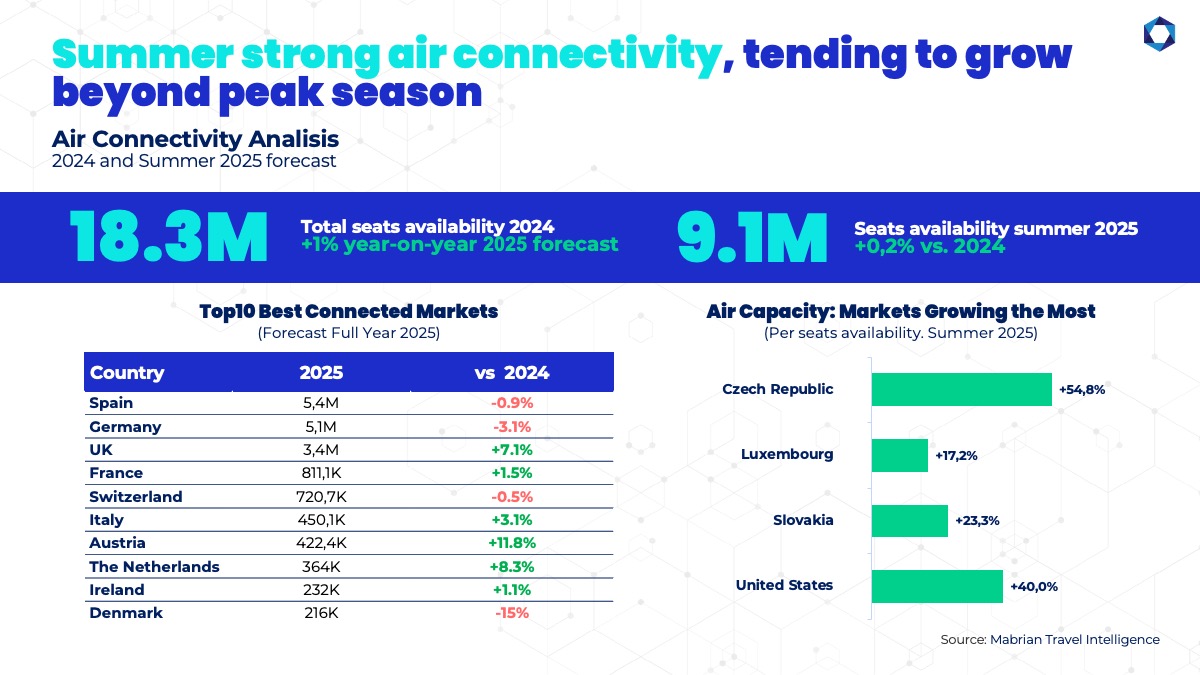
Mallorca’s international appeal is also reflected in its air connectivity mix: 18.3 million seats are scheduled for 2025, with approximately half (9.1 million) concentrated in the summer season. Interestingly, while summer seat availability sees minimal year-over-year growth (+0.2% from June to September), annual capacity increases by +1%, pointing to a strategic shift toward strengthening year-round connectivity to encourage off-season arrivals.
As for source markets, key contributors like the domestic market (-0.9% YoY), Germany (-3.1%), and Switzerland (-0.5%) are seeing slight adjustments in connectivity. Meanwhile, emerging markets such as the Czech Republic (+54.8%), the United States (+40%), and Luxembourg (+17.2%) are significantly increasing seat availability to Mallorca this summer.
Active Tourism to Diversify Demand and Consolidate Emerging Markets
An analysis of demand drivers for the full years 2023 and 2024, as well as for the summer 2024 season, reveals that Mallorca is already in a strong and stable position in terms of its tourism offer. This is the result of years of strategic planning to reposition the island as a year-round destination. Data shows that, while sunbathing remains the primary tourism driver, experiences related to active tourism, nature and the outdoors, arts and culture, and gastronomy now play a significant role in the overall visitor experience.
In fact, when breaking down demand drivers for emerging inbound markets—those showing consistent growth in arrivals since 2023—active, outdoor and gastronomic experiences gain significant importance. For example, active tourism is the leading demand driver for Dutch (31.5% of drivers’ share), Austrian (27.1%), and Polish (24.6%) travellers. Among American visitors, culture and gastronomy are the two most important motivators, while Swedish travellers also show strong interest in gastronomy, ranking it as the second most relevant driver after sunbathing.
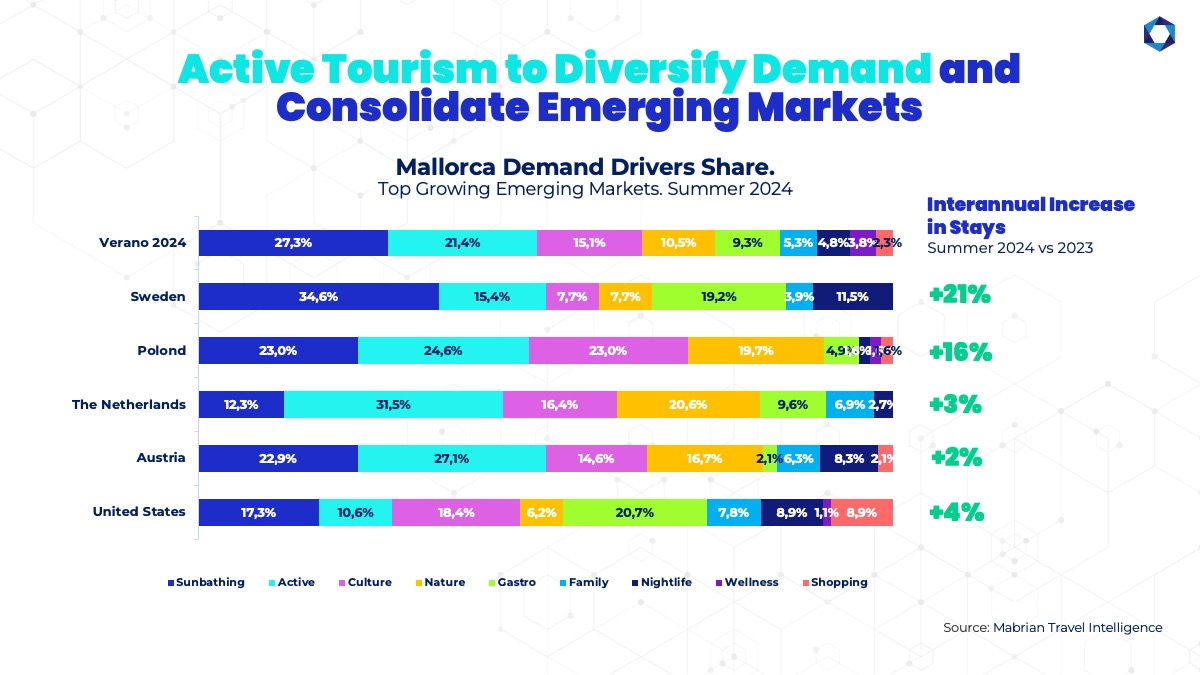
The more Mallorca strengthens and promotes these complementary experiences, the better positioned it will be to extend demand into the shoulder and low seasons, while also attracting visitors from alternative and emerging markets.
Addressing Guest Satisfaction to Enhance Hotel Competitiveness and Profitability
Accommodation quality is a central element in shaping the overall visitor experience, and in this regard, Mallorca demonstrates solid performance. Year-round Hotel Satisfaction Index (HSI) scores—both globally and by category—are generally aligned with national and Balearic Islands averages. Notably, the island’s 5-star hotels outperform both the Spanish and Balearic averages, providing a strong advantage in attracting high-value travellers.
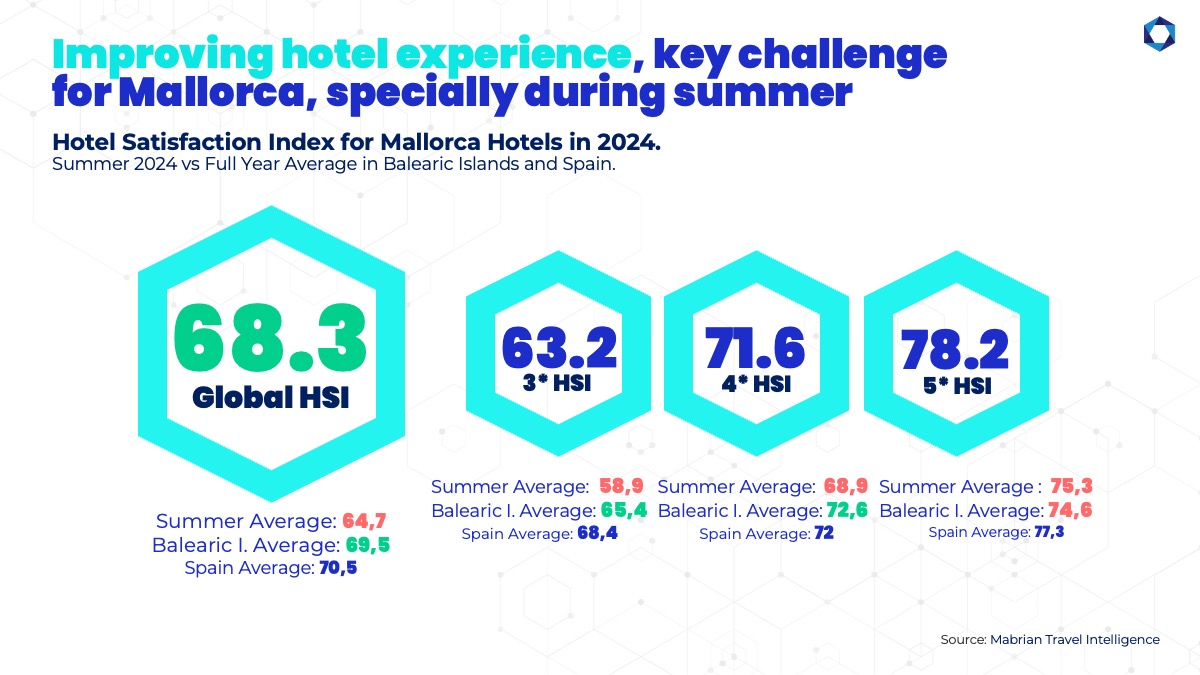
However, summer season data reveals a noticeable dip in guest satisfaction across hotel categories, highlighting the pressure peak demand places on service quality. Compared to year-round performance, HSI scores for 4- and 5-star hotels decline by 2.7 and 2.9 points, respectively. Although they remain competitive within the regional and national context, 3-star hotels are more significantly impacted: their summer HSI drops to 58.9 out of 100, down 4.3 points from the annual average for Mallorca, and 6.5 and 9.5 points below the Balearic and national averages, respectively.
Guests’ satisfaction with the hotel experience is at the core of price elasticity strategies. That is why this decline in satisfaction during summer season is particularly relevant, as Mallorca hotel prices are projected to rise by +7.8% year-over-year between June and September 2025. In this context, revenue management strategies must go beyond Mediterranean competitor price benchmarking and consider the perceived value of the guest experience—especially during the highly competitive peak season. For example, 3-star hotels in Mallorca are expected to increase rates by +8.7%, +0.8 percentage points above the Balearic average for the same category, despite lower satisfaction levels, indicating a potential mismatch in perceived value-for-money.
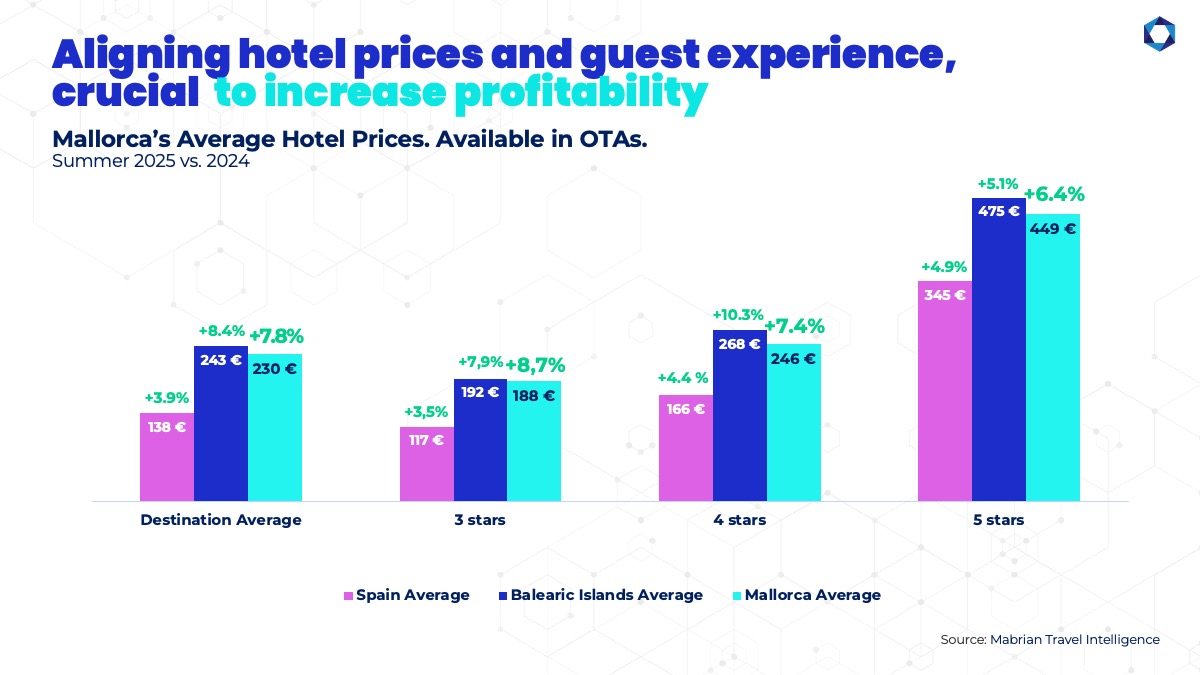
Conversely, 4- and 5-star hotels, with forecasted price increases of +7.4% and +6.4%, are better positioned to justify higher rates given their stronger experiential appeal. Ensuring high satisfaction not only supports profitability during the high season but also contributes to year-round destination competitiveness and sustained demand.