


Tourspain
Spain
January 2024
Reducing tourism’s carbon footprint while boosting economic impact through data-driven promotional campaigns
Context
As the second most visited destination in the world in 2023, Spain faces the challenge of balancing its thriving tourism industry with sustainable practices. The global travel and tourism sector, while a major driver of economic growth, has become increasingly scrutinized for its contribution to carbon emissions. According to the World Travel & Tourism Council (WTTC), the tourism industry accounted for approximately 8% of global greenhouse gas emissions prior to the pandemic, with transportation—particularly air travel—being the largest contributor.
The need to address the environmental impacts of tourism has become more urgent, in an ever growing environment of travel growth. Such a surge places immense pressure on natural resources and infrastructure, contributing to higher CO2 emissions and threatening the sustainability of these regions, and the whole world.
Popular destinations, like Spain, are at the forefront of this challenge, and are approaching such concerns with a data-led perspective. Tourspain, Spain’s tourism and promotion board, has taken a proactive approach by integrating data intelligence into its decision-making processes. By leveraging data-driven insights, Spain aims to make more informed and targeted decisions on all fronts, optimizing resource allocation and improving the overall sustainability of its tourism sector, balancing profitability and environmental protection.
Key goals
The primary goal of this initiative is to approach sustainability management with a broader focus on resource efficiency. Ultimately, the aim for Turespaña is to create a more sustainable tourism model that balances economic growth with environmental responsibility.
Given that the majority of international arrivals to Spain depend on air travel, the objective is to reduce the carbon footprint associated with each visitor while attracting travellers who tend to spend more at the destination, generating a higher positive impact on the local economies.
Approach
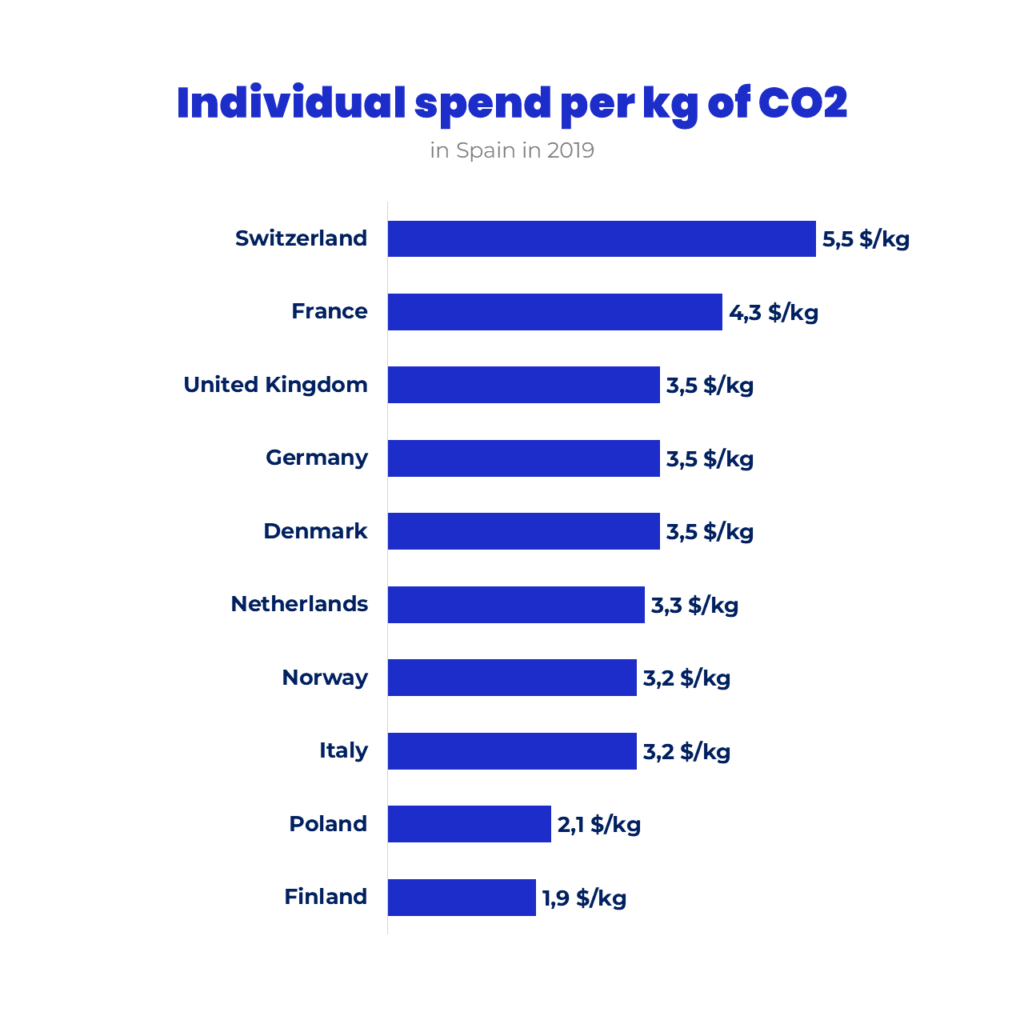
With this goal in mind, Mabrian’s team developed for Tourspain sustainability KPIs based on indicators such as CO2 emissions and the spending ratio per traveller segment and source market.
The Income / Carbon Footprint Index help destinations to identify the most efficient target markets in terms of a balance between the pollution generated and the wealth generated at the destination. This index cross-analyses the carbon footprint generated by a visitor when using air transportation (distance, cabin type, etc.), the length of stay and the spend behaviour (quantitave and qualitative), to identify the most balanced visitor segments to the destination.
These metrics provided valuable insights to direct promotional efforts toward the most carbon-efficient demand groups, ensuring that Spain attracts visitors who contribute positively to both the economy and the environment. The measurement system was rolled out in 2023, using 2022 as the benchmark for comparison.
Results
Spain achieved significant progress in 2023. Compared to the previous year, the country successfully reduced the carbon footprint per visitor by 4.9% while increased the income per visitor by 5,1%.
These results reflects the effectiveness of Tourspain’s targeted promotional efforts, which prioritized attracting travellers from the most carbon-efficient segments and source markets, also enhancing the economic impact of tourism arrivals.
With this, Tourspain underscores the success of the approach in balancing environmental sustainability with economic growth.