
With the appointment of Mexico’s new Secretary of Tourism, Josefina Rodríguez Zamora, the country enters a new stage, full of opportunities and challenges to relaunch its image and value proposition, taking advantage of the capital of its destination brand, as shown by Mabrian’s data.
On the verge of surpassing international tourist arrivals and spending prior to the pandemic, and in light of the appointment of its new Secretary of Tourism, Mexico is experiencing a great moment, which opens up opportunities to reposition, realign, and relaunch its value proposition as a destination with a long-term vision. As shown by data from the global tourism intelligence platform, Mabrian, part of The Data Appeal Company, Mexico is in a position to lay the foundations for sustainable and profitable growth, addressing the revamp of its hospitality and tourism products and services based on experiential-led models, reinforcing the destination’s image of security and international air connectivity, and boosting its global promotion campaigns.
According to data from UN Tourism and official sources, on average and since 2020, Mexico has experienced an average annual growth of 20.9%, reaching 42.14 million international tourists in 2023, only 6.4% below the figures for 2019.
The potential of this country, the sixth most visited in the world, is enormous, as Mabrian’s data intelligence points out, based on the analysis of various cyclical and conjunctural indicators (corresponding to the first half of this year) of demand, perception and behaviour of travellers.
Opportunity #1: Investing in experiential tourism products
After the pandemic, travellers’ interests have evolved, and the tourism industry has had to adapt to respond to a more experiential demand. This process has not advanced at the same speed in all destinations, which affects travellers’ expectations and satisfaction.
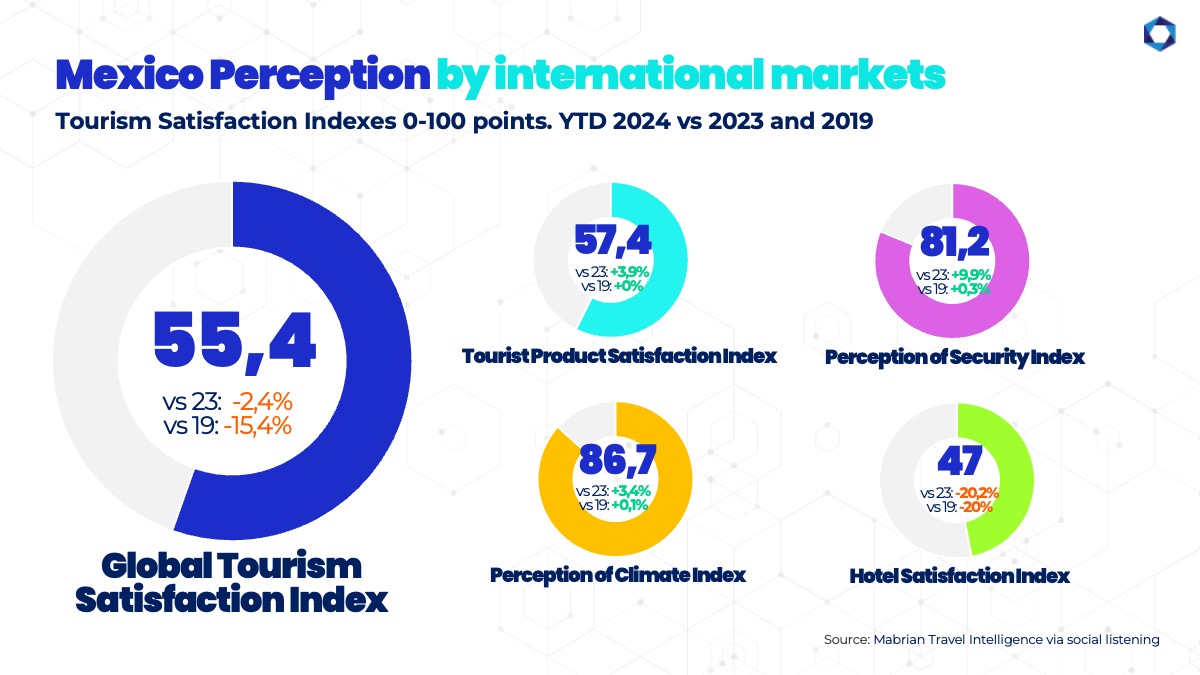
In the case of Mexico, Mabrian’s data shows that the destination follows the global trend and the demand for tourist experiences related to active, natural, gastronomic or wellness tourism has increased by more than 2 percentage points since 2019, although the Tourist Product Satisfaction Index of international markets still shows some room for improvement (70.3 points out of 100).
For this reason, as explained by Mabrian’s partner and director of Marketing and Communication, Carlos Cendra, “it is vital to promote and develop an authentic and relevant tourist offer, which highlights the natural wealth and cultural heritage of the destination, which will attract segments with greater spending capacity and willing to enjoy longer stays.”
Opportunity #2: Renew and update the hotel offer
The hotel offer is a very relevant part of the tourist offer of any destination, and in the case of Mexico, even more so, given the notoriety of its holiday offer, and its important urban tourism market.
Since 2019, and also compared to last year, the Hotel Satisfaction Index for Mexican accommodations has dropped in all categories (3, 4 and 5 stars) from 11 to 13.5 points, which gives signals about how dissociated the expectations of travelers are with the hotel experience, especially among international visitors, in a context in which the quality of the experience can make the difference.
“Mid-range hotels are a very important link in the configuration of tourist packages, and 5-star hotels are the reference for the high-impact market; therefore, having a solid hotel offer is an essential condition for consolidating mature markets and for opening new markets,” says Cendra.
Opportunity #3: Boosting the destination’s global image
As previously mentioned, the motivations of international travellers to visit Mexico reflect the rise of experiential travel, which drives interest in nature, gastronomy and active tourism, segments that have gained prominence since 2019. On the other hand, and although sun & beach tourism continues to represent 13% of the motivations for international travellers visiting Mexico, it moves into fourth place after losing -4 percentage points compared to the same period in 2019.
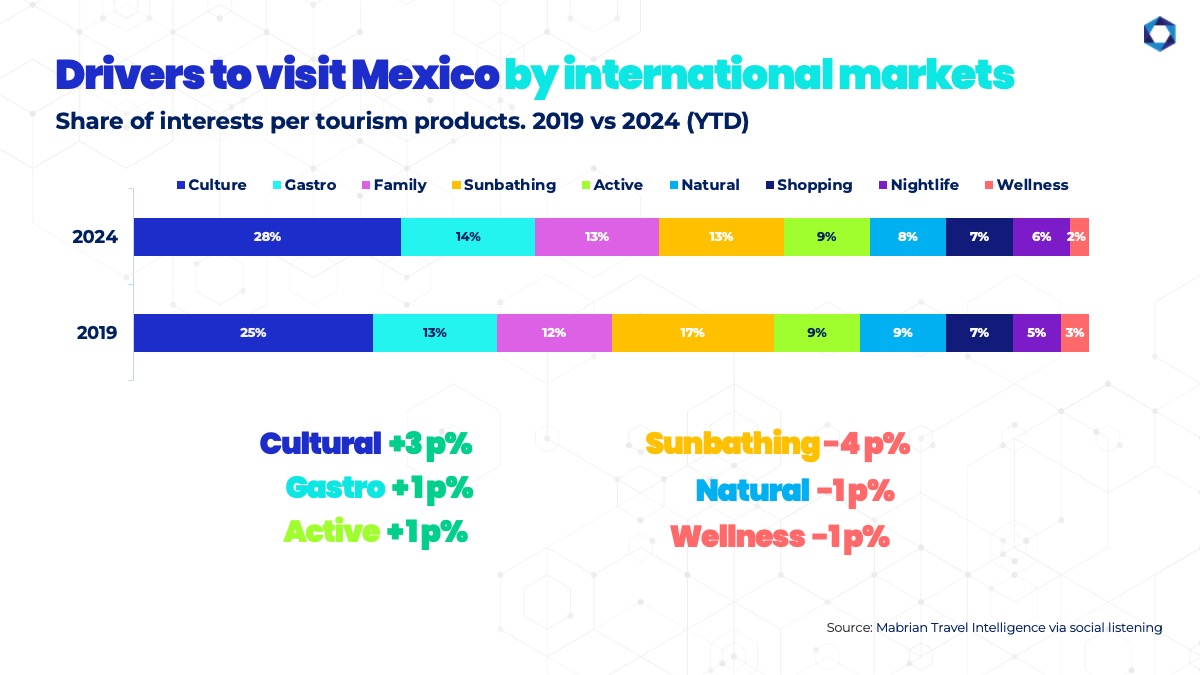
“Travel motivations to Mexico are diversifying, which is positive for the destination and contributes to beat seasonality,” explains Cendra. “Mexico has a unique opportunity to relaunch the promotion of the destination by focusing on these segments, developing more complete and combined experiences; a strategy that, in the long run, will improve income per tourist and the rates of satisfaction with the tourist product,” says the spokesperson for Mabrian.
According to Cendra, initiatives such as the Mayan Train could not come “at a better time”, since it is not only an infrastructure that structures the southeastern region of the country, it also connects with “tourist demand phase in which travellers are eager for new experiences, especially in very renonwed destinations, such as Mexico.”
Other very relevant aspects analysed regarding the image of the destination Mexico are the Security Perception Index and the Climate Perception Index. In both cases, the data show a drop in perception in recent years, especially among international markets. This poses one of the great challenges for the country when it comes to proposing a communication strategy that allows it to recover the perception of the destination. “Identifying the sensitivity of the different markets with respect to these issues is key to knowing how and when to communicate to prevent an isolated security event or extreme weather event from generating a constant drop in perception of the destination,” says Cendra.
Opportunity #4: Strengthening air connectivity
The combined effort to update the tourism and hotel offering must be accompanied by a solid air connectivity and international promotion strategy that will make these investments profitable.
Mabrian’s data on air programming for the second half of 2024 indicate that Mexico is relying on its most loyal international source markets, increasing seat availability on connections to other countries by 0.8% year-on-year thanks to the strengthening of air connectivity with the United States (+3.2%), Spain (+1.5%) and the international hub that Panama represents (+14.8%). However, seats are being lost on direct flights with France, the United Kingdom and Colombia, among others, and in particular with Canada (-10.8% year-on-year).
The weight of the domestic air market, which fell by -5.5% compared to the same period in 2023, results in a slight overall decrease in available seats in the Mexican market (-3.6%), although it is +13% above the 2019 figures. “This is also a very interesting moment for Mexico, to leverage the opportunity to align tourism products design, international promotion and its connectivity strategy, which can contribute to further diversifying its source markets,” proposes the Mabrian expert.