

Fundació Foment del Turisme de Menorca
Menorca, Spain
June, 2024
An Integral Plan to Promote Nine-Months Season Model
Context
As Menorca reached stable arrivals figures after the pandemic by end of 2023 and 2024, statistics showed a strong performance from key markets like Spain and the UK; a notable rise in French visitors, now the third-largest market; and an unsteady recovery of the German demand, requiring better marketing and flight connections. Moreover, while summer tourism is thriving, winter tourism (November to March) has potential and can contribute to beat seasonality and extend tourist activity. But limited direct flight connections make it difficult to attain this goal.
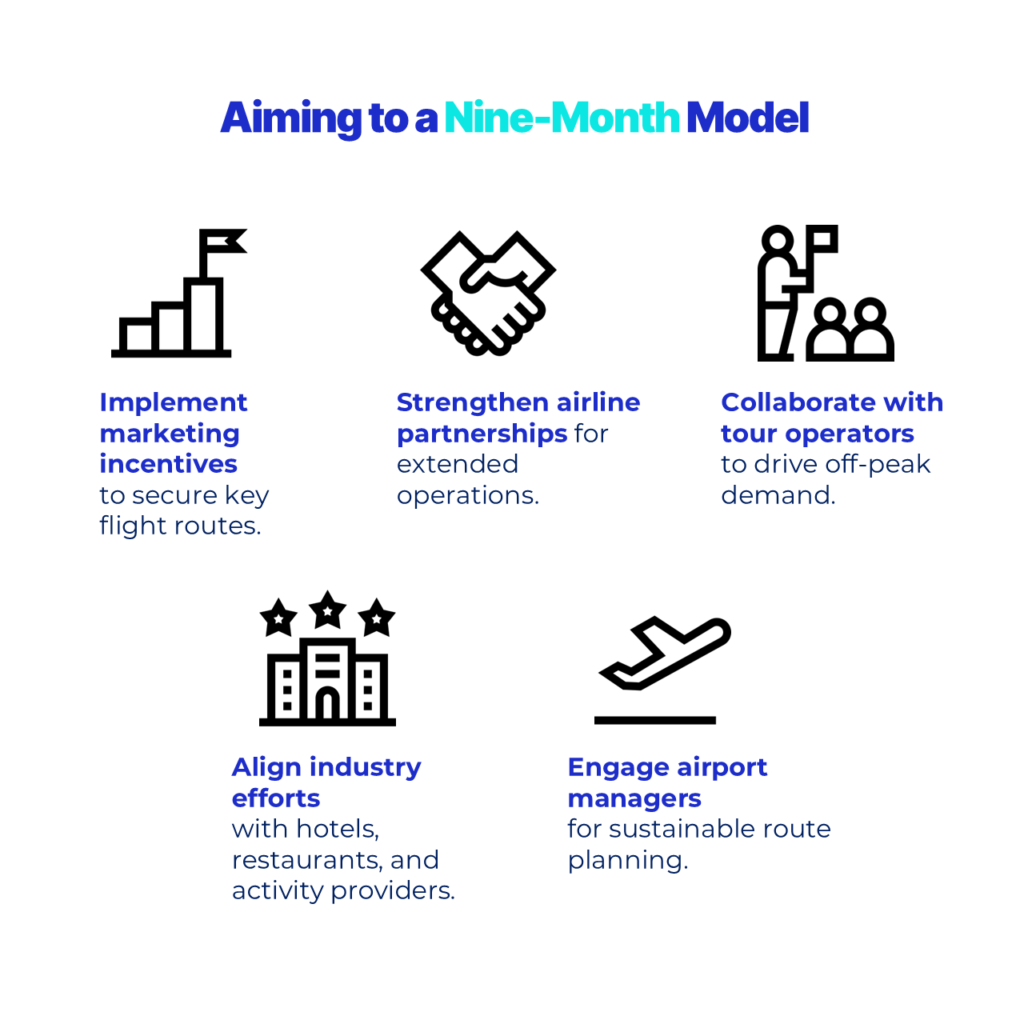
The island’s tourism infrastructure has traditionally been geared toward a six-month season (May–October). However, there is growing interest in expanding to a nine-month model (March–November). Achieving this requires improved air connectivity as well as extending tourist services available during summer by one to two months in order to develop a shoulder season tourism offer that reflects the priorities of key international markets, second-home owners, independent travellers, and new attractions.
Key goals
To support this shift to a nine-month model, Menorca needed to explore and expand its airline partnership and route development strategy, working with carriers to extend operations and collaborating with tour operators for shoulder season tourism development. This involved three key factors: first, aligning the destination’s strategy with that of the sector’s key players (accommodation, restaurants, ancillaries, etc.); second, securing the support of airport managers; and finally, considering marketing incentive programs to reinforce or establish new routes, strengthen existing connections, and position Menorca as a year-round destination.
Mabrian supported the decision-making process of Menorca’s tourism authorities by providing a comprehensive data intelligence framework and the support of a consultancy specialising in air connectivity, to achieve the ultimate goal: to make the best use of their resources in pushing a tourism model that contributes to appeal travellers in the 9-month season, harnessing resources in place and exploring potential strategies to boost demand during autumn and spring, relying on data intelligence to identify the most adequate markets, routes, and partner airlines for result-oriented decisions.
In order to address this challenge, Mabrian proposed to elaborate a Shoulder Season Development Plan, outlining priority markets to build up connectivity and, consequently, products and services aimed at these travellers, as well as a roadmap to put in place by local authorities for the next two winter seasons. This plan was elaborated in collaboration with aviation strategic consultant Gavin Eccles, part of Mabrian’s network of independent specialist consultants for strategic projects.
Approach
The methodology involved a complex cross-analysis of a series of variables, including existing connectivity networks and evolution of seat availability in peak, shoulder, and low seasons; travellers’ arrivals and demand trends, as well as lodging alternatives and availability across seasons. The resulting Shoulder Season Development Plan unveiled potential off-season opportunities that Menorca could leverage to pursue the desired nine-month model, suggesting specific action plans to tap into key source market pulls.
The report found that, even though there is a latent market pull to travel to Menorca in shoulder season, the lack of proper air capacity connecting to key source markets was hindering its development. In fact, flights scheduled during winter (November to March) represented only 12% of total year seats availability, and 95% of them were connections with the Spanish mainland.
- Although 90% of arrivals to Menorca take place from April to September, winter months (October to March) experienced a +36% surge in demand compared to 2019, contributing to extending the vision to a longer season, beyond September. October is the strongest month in terms of autumn arrivals, while the rest of the winter season is still low: interestingly, Spanish domestic demand increases precisely during these months as the result of residents’ trips (business, sports, students, etc.); whereas UK, France, Germany, and Italy arrivals, rising by +5% more than the same pre-pandemic winter, accounted for 86% of the total visits to Menorca from October to March.
- Putting these figures into actual arrivals context show that UK travellers are still the most important source market for Menorca, but France is the one growing the most (becoming the second), Italy is the third, and Germany dropped significantly. These data insights indicate that routes with France and the UK are worth to be developed and enhanced, while frequencies with Italy and particularly Germany should be optimised.
- Lodging availability and ancillaries around active tourism are a crucial aspect to implement an effective Menorca’s winter tourism development plan. Data showed October was consistent in terms of hotel availability, whereas November to March was not. Even though occupancy remained low during winter, this flexible availability might become an opportunity to boost winter demand. In fact, compared to 2019, hotel availability during the 2024-2025 shoulder season (November to March, both included) increased by +7% in the 3-stars category, +45% in the 4-stars, and doubled in the 5-stars category.
- The analysis conducted and the outcome of meetings held with local trade associations (lodging, hospitality, restaurants, and ancillaries & activities) showed that the travel & tourism industry was committed to delivering high-quality service during the shoulder season.
Results
The outcome of this analysis was a set of scenarios, oriented to beat seasonality and to enhance market opportunities that the most convenient airlines, willing to join this extended season program, could assess. As per the scenarios to beat seasonality, the plan considered to progressively reinforce routes in all winter frequencies from UK, France, and Spain from 2024 to 2028; as well as growing shoulder season routes with UK, France, Germany, Switzerland, and Spain, in a two-year period up to 2027, by either bridging summer with early Spring (March and April), or by extending late summer through November.
As per scenarios to enhance market opportunities, the roadmap proposes to consolidate demand interested in nature & outdoors, active tourism and gastronomy, all offering great opportunities for the island. Moreover, the roadmap suggests to build back the German market, amplifying existing connectivity with Berlin and Hamburg with carriers such as Eurowings and Condor; re-thinking Scandinavia connectivity with Norwegian or SAS in weekly frequencies; and implementing marketing incentive campaigns with tour operators, and international airlines, particularly pushing extended routes serving beyond peak season or frequencies in shoulder season.
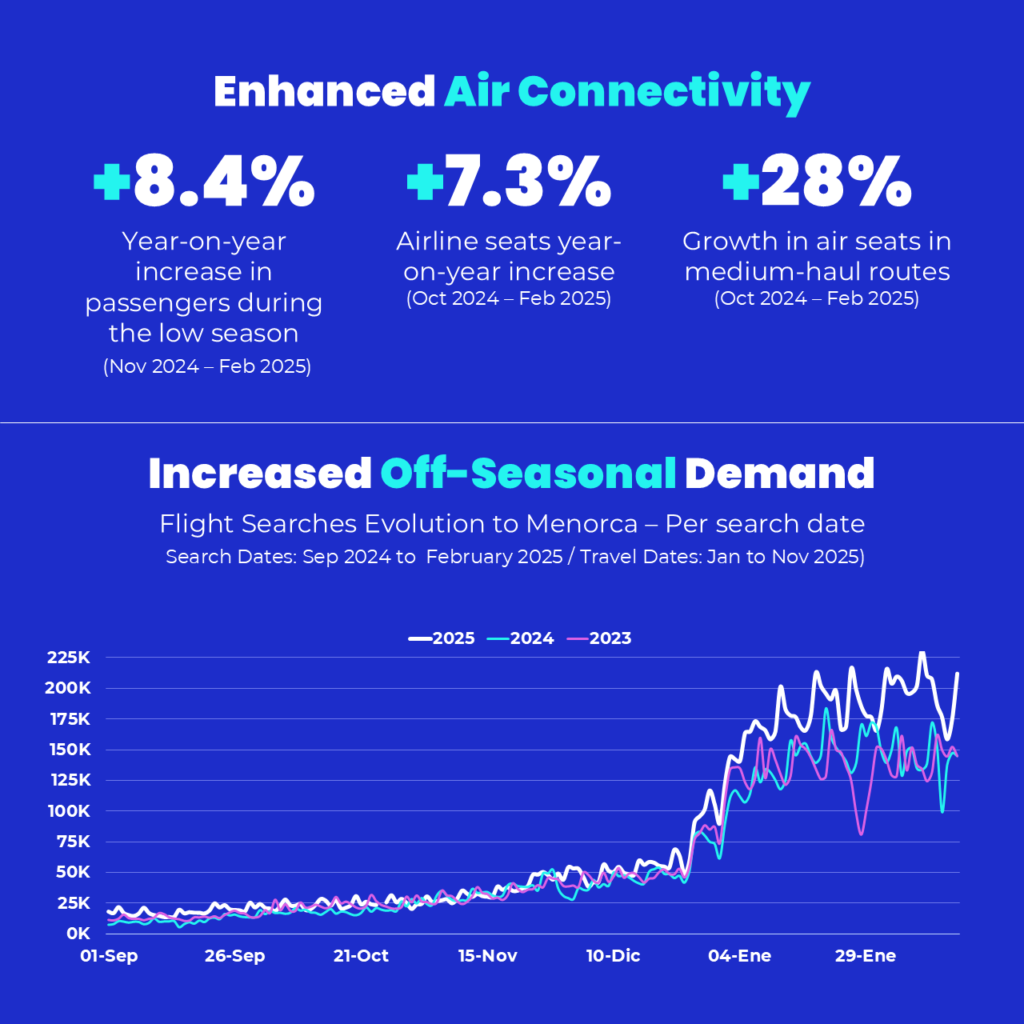
As early as January 2025, Fundació Foment del Turisme de Menorca, the island’s Destination Management Organization (DMO), announced new connectivity agreements with key airlines, based on insights from the Shoulder Season Development Plan aiming to promote a nine-month tourism season. This strategy has also attracted interest from other carriers, tour operators, and source markets, such as the US. The new routes, which will operate between 2025 and 2027, will connect Menorca with Italy via Milan-Malpensa airport (April to October); and will improve connectivity with France (Lyon, Nantes, Brest, Marseille) and the UK (Belfast and Bournemouth). Key routes connecting Menorca with London (Easyjet), Paris (Transavia), as well as Valencia (Iberia) and Bilbao (Vueling) have also been recovered, resulting in an 8.4% year-on-year increase in passengers in the traditional low-season months of November 2024 and February 2025.
Since the plan’s implementation in June 2024, available airline seats between October 2024 and February 2025 have increased by +7.3% compared to the same period last year, especially on medium-haul routes (with a +28% growth in air seats).
The growth in international airline seats to Menorca between October 2024 and February 2025 is distributed as indicated in the chart.