


Hurricane Beryl demonstrates the weight of extreme weather in travellers’ choices, in light of its impact on Caribbean destinations, which are observing its effects in the climate perception and in this season’s tourist demand forecast.
The effects of Hurricane Beryl are already being felt in the tourist demand for Caribbean destinations, an effect that is evident both in the climate perception and in the short-term demand to travel to these destinations, as per our data intelligence.
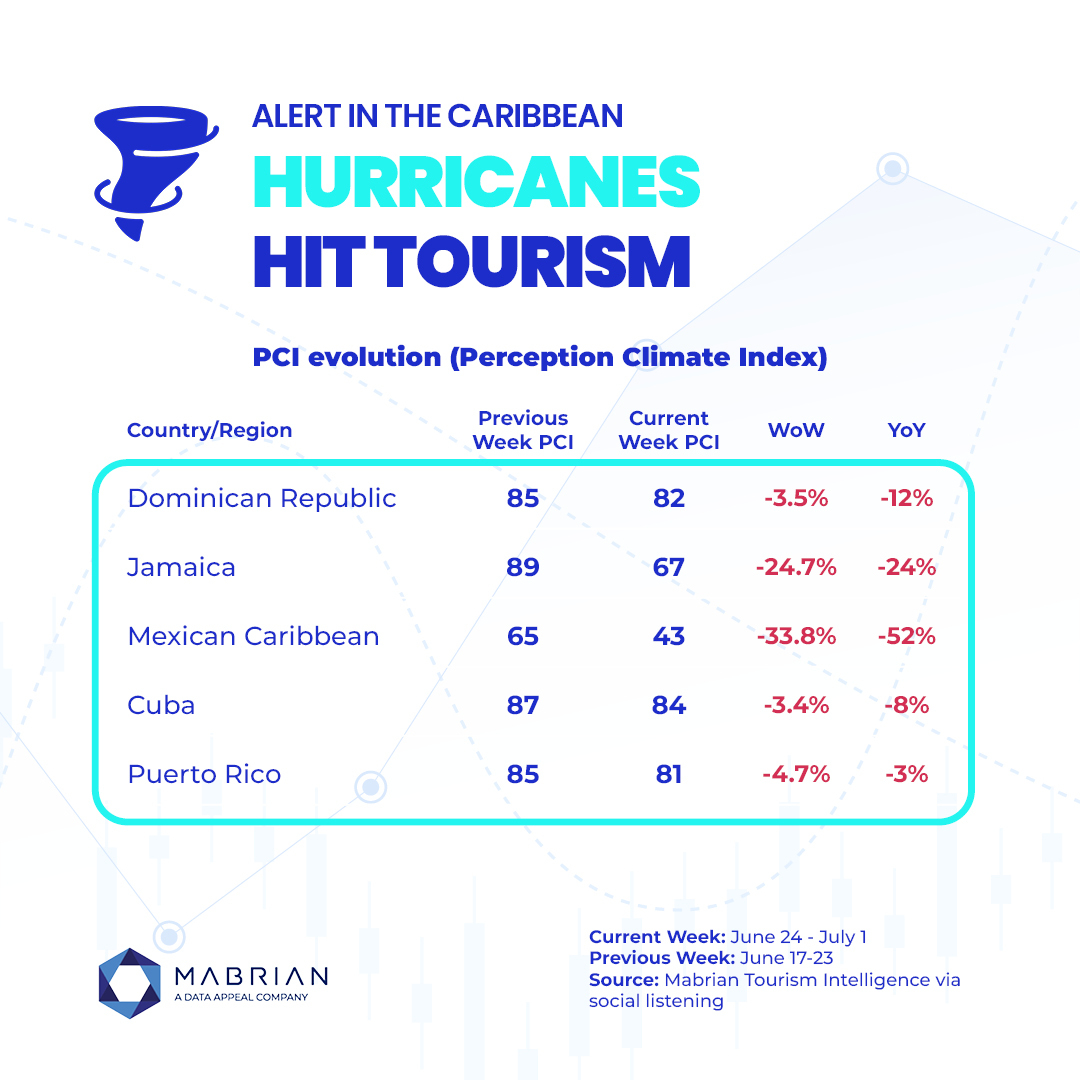
For this analysis, we focused on five destinations exposed to the impact of this and future hurricanes (Dominican Republic, Jamaica, Mexican Caribbean, Cuba and Puerto Rico, comparing how their Perception of Climate Index (PCI, for its acronym) varied in the last week, and in respect to the same week in 2023. This indicator measures the effect of the weather conditions on visitor satisfaction during their stay in a destination, based on expectations about their experience.
Mexican Caribbean suffers the mostshort-term impact
The data indicate that the Perception of Climate Index of the Mexican Caribbean is the most affected by the threat of Hurricane Beryl, reflecting the expected effects when passing through this territory. In fact, the index loses 33.8% in just one week, going from 65 points to 43, out of 100 possible.
This indicator also suffers in the case of Jamaica, which loses 24.7% since last week. last week, falling from 89 to 67 points out of 100 possible. Meanwhile, the Dominican Republic (-3.5%), Cuba (-3.4%) and Puerto Rico (-4.7%) also experienced less dramatic declines in their PCI since last week, given that the weather forecast does not estimate that Beryl will fully affect these destinations, although the weather will worsen.
As an example, Carlos Cendra, Partner and Director of Marketing and Communications at Mabrian, points out that “the drop in the climate perception is affecting flight searches from the United States to Cancun, falling by around 20% in the last four days, to travel from July 1st to July 7th”. Such trend could affect “other relevant markets for this destination, forcing to stay vigilant throughout the season, to protect demand forecasts in complex months to come, in terms of meteorology.”
Taking into account that hurricanes and other extreme phenomena generate concern among travellers due to their destructive and lethal potential, understanding this sensitivity in each key source market, from data intelligence perspective, is crucial for authorities. “With the data in hand, destinations can design outreach and emergency plans tailored to the sensitivity of the various source markets. It is about disseminating messages aimed at potential tourists, so that they do not rule out traveling to these destinations; and to those who are already visiting, addressing their expectations, concerns, and needs,” Cendra explains.
Preparing for hurricane season: monitoring the long-term effect
Our analysis also reflects on the impact on demand in the medium and long term, since this hurricane season in the Atlantic is expected to be extraordinary, according to the National Oceanic and Atmospheric Administration (NOAA). According to this entity, in 2024 there is an 85% probability of exceeding the average cyclonic activity.
In fact, the Perception of Climate Index of the destinations analysed also suffers falls in the indicator compared to the same week last year. In the case of the Mexican Caribbean, Beryl has a 52% drop in its PCI compared to the same period in 2023; Jamaica shows a year-on-year drop of 24%, and the Dominican Republic of 12%. Cuba (-8%) and Puerto Rico (-3%) are the destinations that are least affected by the impact of this hurricane on their PCI performance.
“The year-on-year variation in the Climate Perception Index shows how important it is to systematically measure this indicator for destinations exposed to large-scale inclement weather conditions, such as hurricanes,” says our spokesperson. “Climate change is a phenomenon that will continue to alter meteorology, and destinations must be prepared to face, tactically and strategically, one of the greatest challenges of our time.”