
Germans are travelling differently. New analysis from Data Appeal and Mabrian, both part of Almawave (Almaviva Group), on outbound demand shows they increasingly prioritise destinations that blend cultural heritage, natural beauty, and authentic local experiences. Europe remains the main focus, but rising costs are driving a hunt for alternatives in short, medium, and long haul.
As ITB Berlin brings the global tourism industry to Germany, new analysis from Data Appeal and Mabrian reveals a clear behavioural pattern shaping German outbound travel: travellers are prioritising destinations where cultural heritage and outdoor appeal go hand in hand.
“The German outbound market continues to be one of the most significant and influential in Europe,” states Carlos Cendra, Chief Marketing and Communications Officer at Mabrian. According to Eurostat’s most recent tourism trips statistics, in 2024, outbound trips by German residents accounted for 41.3% of the total — the highest share in the European Union.
“With Germans increasingly opting for domestic destinations, competition for international travellers’ share is intensifying. Understanding their preferences, behaviours and evolving expectations is therefore essential for international destinations that want to enhance their appeal and secure a top spot in German travellers’ choices.”
The insight from Data Appeal and Mabrian, both part of Almawave Group, cross-analyses, on the one hand, emerging destinations within German outbound travel demand in the last three years and, on the other hand, the experiences and tourist activities generating the greatest levels of interest and engagement among Germans when travelling abroad, based in consolidated data from the past six months sourced from two major online activities platforms, Civitatis and GetYourGuide.
Europe Remains the Core of German Outbound Travel — With Only Select Long-Haul Exceptions
Data collected from major online booking platforms shows German demand remains overwhelmingly Europe-driven, combining neighbouring getaways and Mediterranean classics with a selective set of long-haul hotspots.
Consolidated data from 2025 on stays based on accommodation reviews by Germans in online travel agencies highlights a strong preference for European regions. The German growing domestic market demand reflects in outbound travel as neighbouring destinations such as Austria’s Tyrol, Vienna and Salzburg, as well as Poland’s West Pomerania, maintain strong appeal.
Southern Europe reinforces its position through Andalusia, Catalonia, the Balearic and Canary Islands in Spain, alongside Provence-Alpes-Côte d’Azur and Île-de-France in France. Italy is represented across multiple tourism profiles: Veneto, Lombardy, Trentino-Alto Adige, Tuscany, Sicily and Lazio. Outside Europe, Thailand’s Bangkok Province stands out as the only long-haul destination among the Top 20 featuring the most German stays.
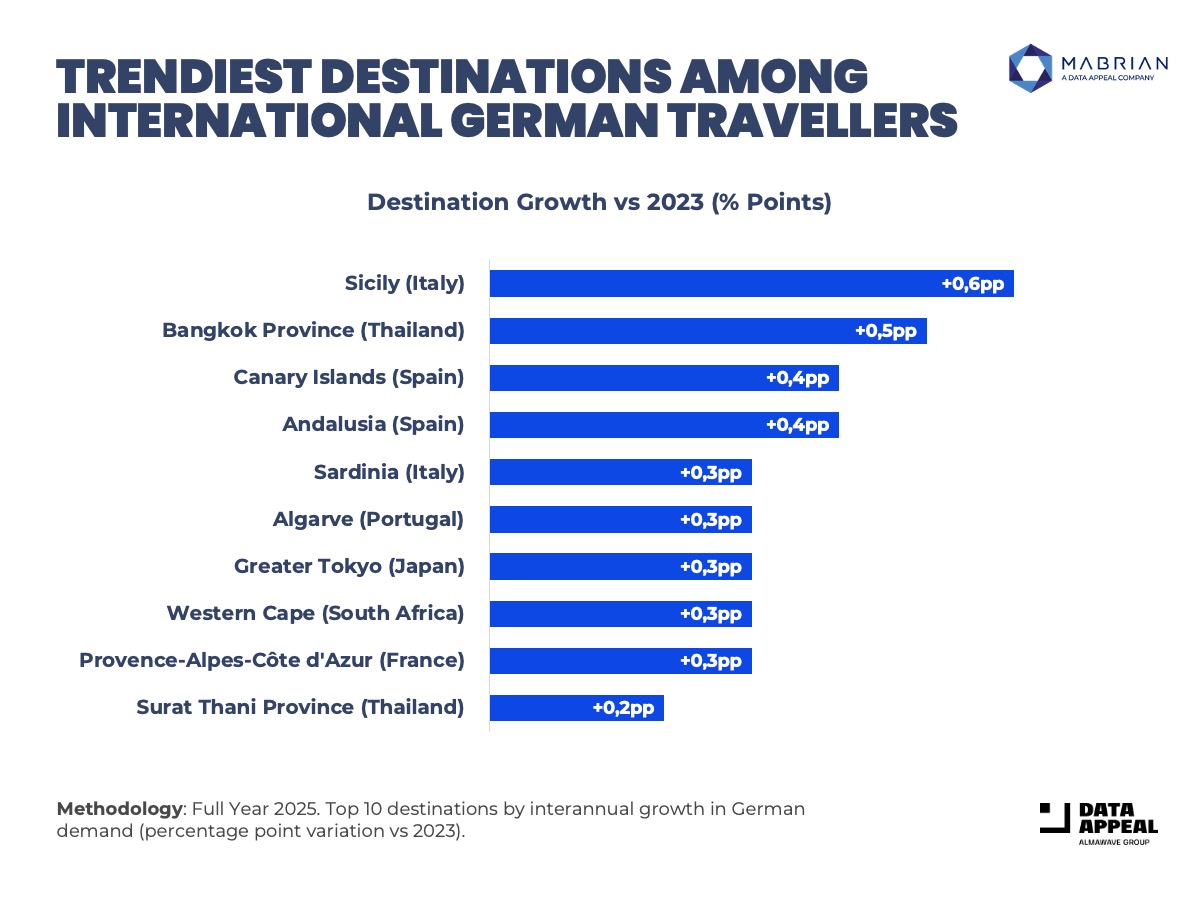
Five of the most sought-after destinations by Germans in 2025 are also among the trendiest, the ones showing a stronger upward trend over the last two years. Sicily records the strongest increase since 2023 at +0.6 percentage points, while long-haul momentum extends to Greater Tokyo, South Africa’s Western Cape and Thailand’s Surat Thani Province.
“Rising travel costs are reshaping German outbound behaviour,” says a Mabrian expert. “With flights to Spain and Italy — key destinations for German travellers — up around 40% since 2021, there is a growing appetite for destinations that offer memorable experiences at a fair price. As Germans increasingly seek value-for-money alternatives, competitive destinations have a real opportunity to stand out.”
The Winning Formula: Heritage, Nature and Local Cuisine Drive German Travel Demand
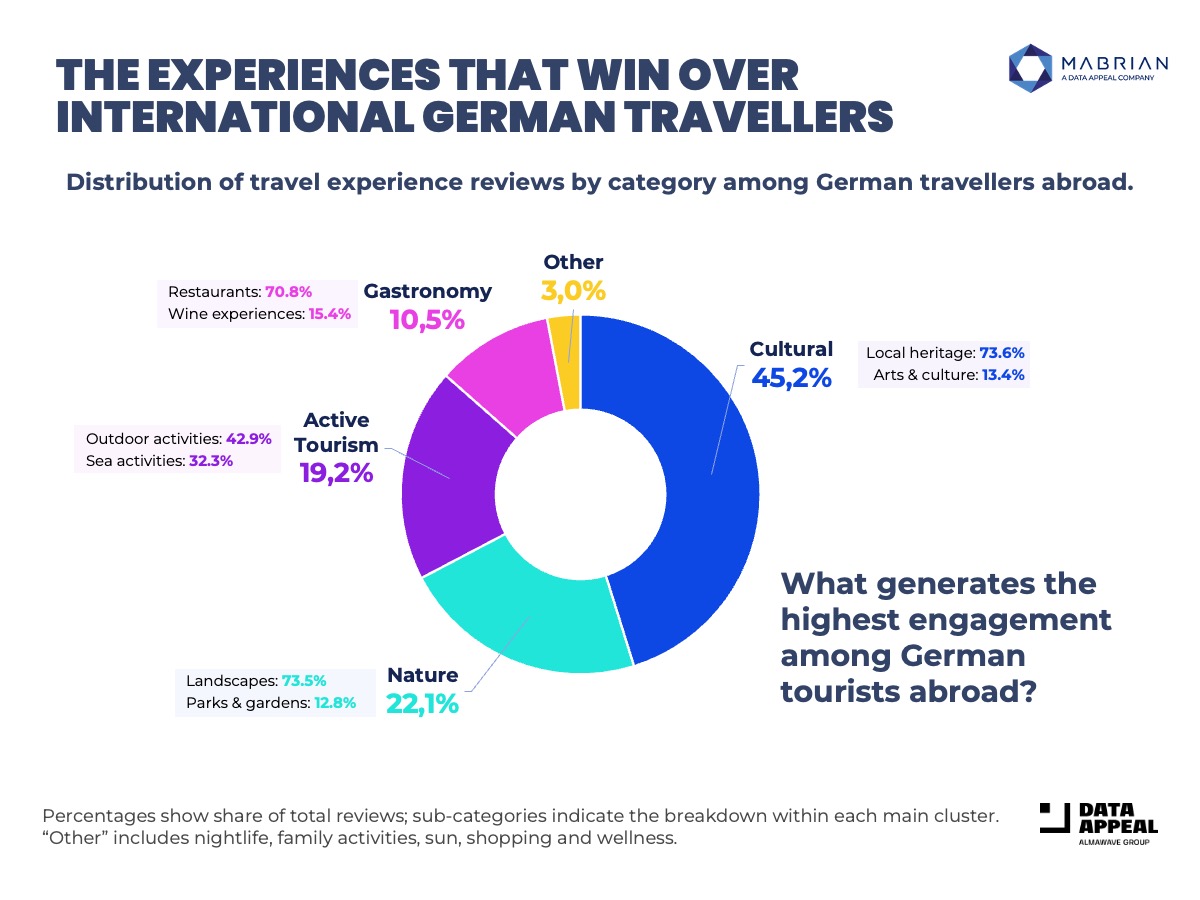
Experience-level data confirms that this geographic pattern is not coincidental. “Cultural activities account for 45.2% of total experience-related reviews, primarily linked to heritage sites, museums and the arts,” explains Carlos Cendra, Director of Marketing & Communications at Mabrian.
“Nature-based experiences follow with 22.1% of reviews, especially those centred on landscapes, outdoor and active tourism. Gastronomy accounts for 10.5% of reviews, reflecting continued interest in local cuisine and dining experiences. Together, these indicators point to a consistent preference for destinations capable of delivering cultural immersion alongside natural appeal.”
Six Italian Regions Capture Nearly One-Fifth of German Stays — Where Culture and Nature Achieve the Highest Satisfaction
Italy offers a clear example of this integrated positioning. Six Italian regions appear among the Top 20 most sought-after destinations in 2025—Veneto, Lombardy, Trentino-Alto Adige, Tuscany, Sicily and Lazio—together accounting for 19.4% of total German stays across the Top 50 international destinations.
Large-scale AI-driven semantic analysis of online reviews written by German travellers about their experiences in Italy last year provides a comprehensive view of visitor sentiment across regions and points of interest. The results confirm what destination rankings already suggest: regions that combine cultural heritage with high-quality natural environments consistently generate the strongest levels of appreciation.
Tuscany (87.3/100), Sicily (87.1/100), Lazio (86.5/100), Veneto (85.8/100) and Lombardy (84.4/100) emerge as the highest-rated and most reviewed Italian regions among German travellers. While the autonomous province of Alto Adige generates a lower volume of reviews, it records the highest overall sentiment score (88.8/100).
The points of interest generating the strongest engagement and satisfaction in these regions further illustrate this pattern. In Veneto, the Castello Scaligero di Sirmione achieves a sentiment score of 90/100, alongside the Arena di Verona (88/100). In Lombardy, the Duomo di Milano reaches 90/100, while the Lake Como area records 84.3/100, reflecting sustained appreciation for iconic cultural landmarks paired with scenic environments. In Alto Adige, nature-focused and heritage sites register particularly high levels of satisfaction, led by the Trauttmansdorff Botanical Gardens in Merano (96.8/100). Across these examples, cultural icons and natural settings emerge not as separate attractions, but as complementary components of the overall travel experience for Germans visiting Italy.
“The Italian regions and attractions that generate the highest number of reviews among German travellers—such as Trauttmansdorff Gardens—also record sentiment levels above 85 and even close to 97 out of 100,” adds Emilio J. Inés Villar, Head of International Tourism at Data Appeal. “This indicates that in these destinations experiences effectively align with travellers’ expectations and preferences.”
Download the full findings: www.datappeal.io/german-travellers-trends