

Event tourism is one of the fastest-growing phenomena globally today. Visibility, benefits for local operators and de-seasonalisation are just some of the advantages events can bring to destinations — provided they are well managed and organised. Drawing on a recent analysis of event tourism trends in Europe, we look at how destinations can anticipate the impact of events and turn them into a genuine growth engine.
Events have become a core asset for tourism destinations. Sporting competitions, music festivals, concerts and trade fairs can draw thousands of tourists from across the globe, generating growing opportunities for visibility and revenue.
They’re also becoming an occasion to travel and explore new destinations to experience places in a more immersive way, and to connect with local culture and communities.
And this generates social and economic ripple effects capable of transforming entire territories.
Event tourism: a steadily growing trend
According to an analysis conducted by our team using the Data Appeal Mabrian platform, this phenomenon is reshaping travel across Europe in particular, where event-driven tourism kept strong momentum in 2025, with overall tourist spending up +7% year on year.
Fortune Business Insights also confirms that last year Europe dominated the event tourism market, with a 39.90% share of the total. Globally, the event tourism market was valued at $1,538.30 billion in 2025, with a projected CAGR of 7.71% through 2034.
This trend isn’t confined to Europe: Phocuswright’s report “Online Travel Tracker: The Indie Stack” found that two-thirds of APAC travellers have travelled to attend concerts, and 66% would do so abroad. In South Korea, 72% are willing to travel to a remote city to see their favourite artists perform live.

A real use case: Sporting events and expos are Europe’s big tourism catalysts
The analysis Europe’s Event-Driven Tourism, conducted with our travel intelligence platform Data Appeal Mabrian, is the first European-wide study to examine event tourism trends from both an event-type and tourist-spend perspective.
To capture the real economic and tourism impact at continental level, we extended the analysis to twelve European countries — Austria, Belgium, France, Germany, Greece, Ireland, Italy, the Netherlands, the United Kingdom, Spain, Sweden and Switzerland — markets that together host the vast majority of world-class live experiences in Europe.
Among all the countries covered by the research, the UK, Germany and France held the largest share of event-related tourist spend in Europe in 2025.
Of all event types examined, sporting events account for 21.5% of the total, yet at the same time generate the largest share (41.4%) of incremental tourism economic impact — i.e. the spend generated by tourists who travelled specifically to attend the event.
Events such as the Giro d’Italia in Italy, the Tour de France in France and Formula 1 races held across Europe are historically among the highest-impact annual events in their respective countries.
At the same time, trade fairs (expos) recorded the most consistent growth in incremental tourism economic impact across Europe in 2025 (+6.2 percentage points year on year).
Planning and managing a well-calibrated events calendar: the benefits for DMOs
The impact generated by major events in Europe is the clearest evidence that event tourism is no longer a niche phenomenon, but a genuine structural line item for destinations, demanding the same analytical and monitoring tools already applied to other pillars of tourism demand.
Internationally significant events, if well planned and managed, can deliver several benefits for DMOs:
- Amplifying the destination’s international visibility.
- Distributing flows and spreading demand across the year: putting the spotlight on lesser-known areas with high tourism potential and attracting visitors during low season to ease pressure at peak times.
- Strengthening the destination’s positioning, helping the DMO speak to specific targets and market segments.
- Stimulating investment in new infrastructure and services.
- Fostering new partnerships in sectors such as sport and culture, opening up additional funding channels.
The same factors that make a major event an opportunity can turn into a critical issue if the destination isn’t prepared to manage its impact:
- Overcrowding and pressure on infrastructure: a concentrated influx over just a few days can overwhelm transport, accommodation and public services, directly affecting the quality of the visitor experience.
- Declining residents’ quality of life: rising prices, traffic, noise, litter and the occupation of public spaces can create tension between local communities and visitors.
- Lower visitor perception: queues, inflated prices or insufficient services risk turning an event designed to attract visitors into an experience that drives them away, reducing long-term perception and return intent.
- Investments that fail to deliver returns: without an accurate upfront estimate of attendance and spend, a destination can over-invest in temporary infrastructure or promotion for a lower-than-expected return.
The difference between the two outcomes — success or crisis — comes down to a destination’s ability to anticipate the real impact and act proactively to ensure it is well managed.
Anticipating and measuring: the foundation for turning events into a strategic growth tool
To capture the benefits of event tourism, destinations can’t rely on generic historical metrics alone. They need predictive intelligence that reveals which events will generate the most significant impact.
Having reliable, long-term data at hand makes it possible to turn events into powerful tools for attracting the right audience and investing in experiences that genuinely improve local wellbeing and economic resilience.
To help DMOs and institutions anticipate and measure the economic and tourism impact of events, the Data Appeal Mabrian integrated tourism intelligence platform includes a dedicated “Events Forecast” module.
The module offers a complete view of all past and future events in a destination, up to 12 months ahead. It analyses their distribution across time and territory, and estimates the incremental economic impact they generate.
Analysis by category
Destination events are classified by type — concerts, festivals, community events, expos and sport — to measure the percentage weight of each event category. Each category is linked to projected tourist spend—making it possible to calculate the weight of each category and individual event.
Map and calendar
The map makes it possible to visualise where events are concentrated across the territory, so pressure points can be identified at a glance. The calendar shows which dates are most affected by events.
Expected overall attendance
For each event, the module calculates the overall expected participants at the event, including both locals and visitors.
Incremental tourism economic impact
The module offers an estimate of the incremental tourism economic impact, generated by visitors travelling to the destination specifically to attend the event, excluding regular residents or people already present in the area, related to accommodation, hospitality, and transportation.
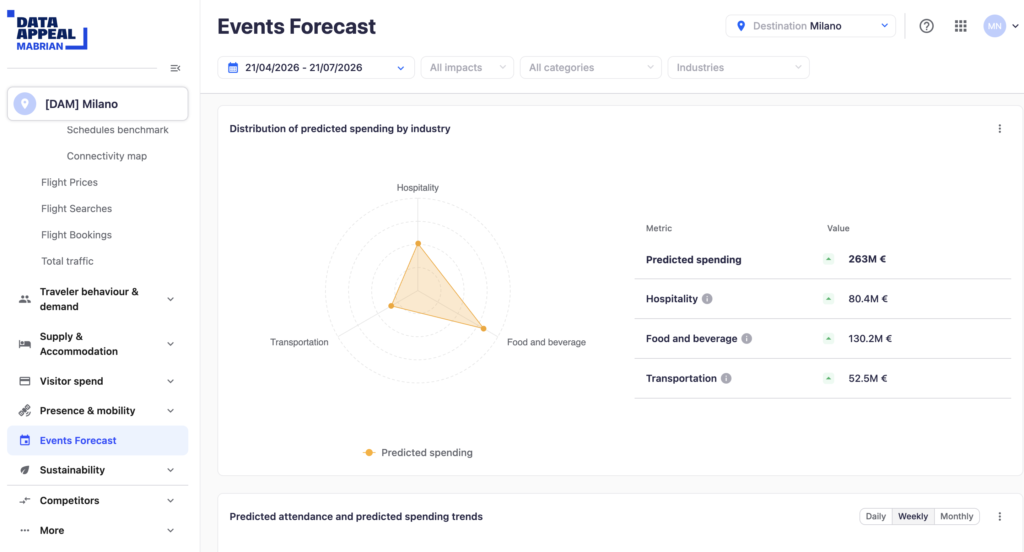
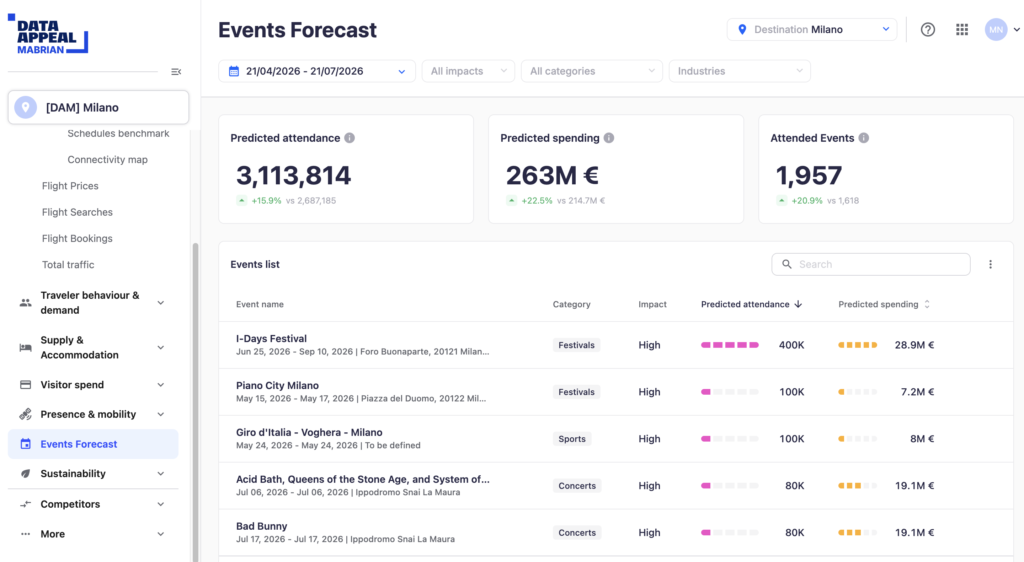
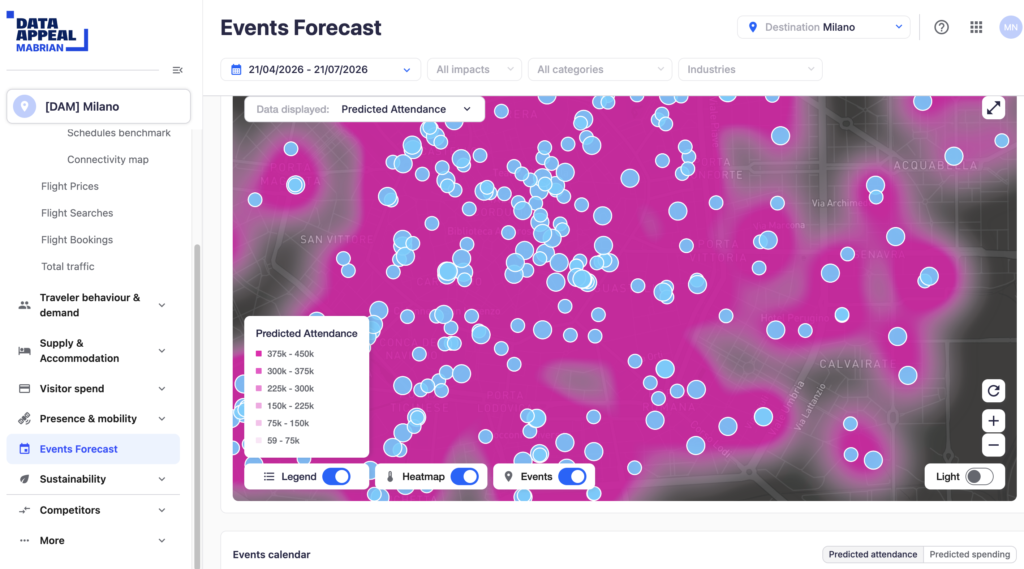
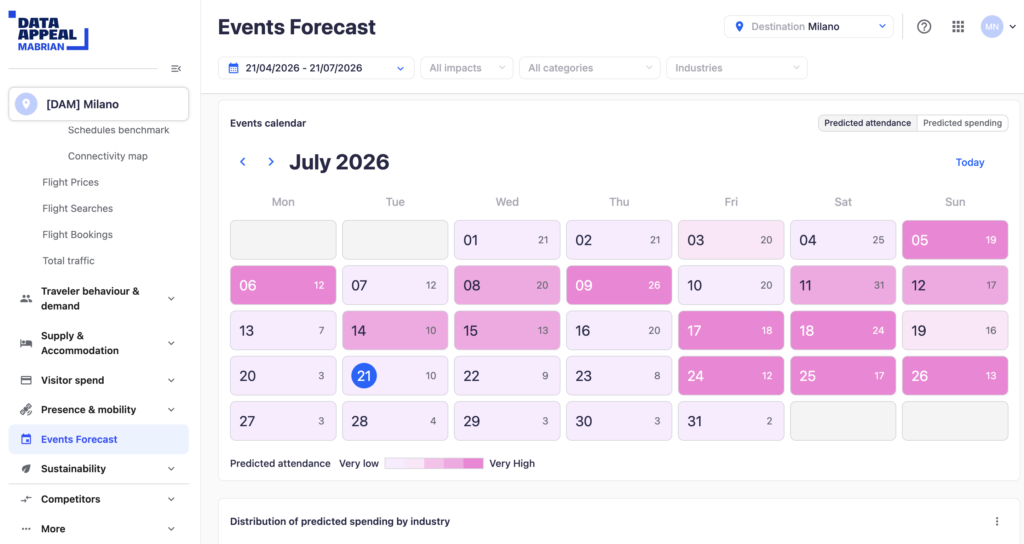
From a forecasting perspective, the Events Forecast module makes it possible to identify and prioritise the initiatives capable of generating real tourism growth. Not just knowing which events are scheduled, but understanding how much added value they generate for the territory and how they concretely affect flows at the geographic level.
This type of analysis offers destinations multiple advantages:
- Strategic optimisation: enables strategic coordination and optimisation of tourism impact thanks to full visibility of all upcoming events.
- De-seasonalising: supports strategies to counter seasonality.
- Estimating ROI: allows the incremental tourism economic impact of events to be quantified.
- Investment and sponsorship: supports investment and sponsorship decisions with objective data on expected returns.
- Benchmarking & event’s market intelligence: identifies opportunities through competitive analysis against other destinations.
- Positioning: refines the destination’s brand positioning and attracts specific segments.
The value of the module’s data grows further when read alongside other data available on the platform: air connectivity, accommodation demand, destination perception, visitor profiling, mobility, spend data and sustainability indices.
For example, through the semantic analysis of online reviews and the support of the Smart Insights AI module, it’s possible to query the platform directly on how event attendees perceived the destination online, identifying strengths and areas for improvement.
Event tourism: 4 recommendations for DMOs
Measuring the impact of events is the key to turning a calendar of appointments into a lever for structural, sustainable growth.
This means DMOs must:
- Identify the most valuable events to invest in by analyzing event performance and results across the market and other destinations, enabling more efficient event selection.
- Plan ahead: measuring the territorial impact of scheduled events with the right tools makes it possible to anticipate arrival peaks and allocate the right resources — transport, security, emergencies, accommodation and services — before pressure builds. This optimises the attendee experience while safeguarding residents.
- Measure real value: calculating the actual impact of events, in terms of attendance and incremental economic impact, makes it possible to identify the most profitable initiatives and plan future investment accordingly.
- Get the full picture: cross-referencing event impact data with contextual data — hotel rates, air connectivity and destination perception — gives DMOs a fuller picture, before and after the event, useful for measuring the real effectiveness of their initiatives.