

Instituto Costarricense de Turismo
Costa Rica
April, 2023
Unveiling concerning lodging density ratios to improve overall visitors satisfaction and spending
Context
Costa Rica has experienced sustained growth in the number of international visitors to the country. Since 2010, the country has added over one million visitors, reaching 3.14 million travelers in 2019 and 2.75 million visitors in 2023, following a full post-pandemic recovery.
This growth in arrivals poses challenges in planning, infrastructure, natural resource management, and balancing with local communities, all of which are extremely important for Costa Rica. This Central American destination is renowned for its policies to protect and actively promote its rich natural resources and its commitment to fostering a sustainable approach to travel and tourism development. Despite its small size, Costa Rica holds 5% of the world’s land-based biodiversity and 3.5% of its marine life; produces nearly 93% of its electricity from renewable resources; and has protected 30% of its territory as natural land. The increase in international arrivals has led to greater demand for services, including lodging options, which were expanding rapidly by 2019.
Key goals
By 2019, Costa Rica was experiencing a significant surge in demand for hotel expansion and construction, driven by its booming tourism industry. However, this growth raised concerns about the potential negative impacts of excessive tourism activity. To address these issues, Costa Rica’s tourism authorities sought to implement strategies to manage and mitigate the effects of high tourism density. Mabrian played a crucial role in this effort by mapping the density of hotels and holiday rentals across different regions of the country.
Approach
Mabrian helped Costa Rica to understand the scale of the problem and identifying areas with high concentration of tourist accommodations. The insights gained from this mapping were intended to inform a range of policy decisions, including project development and investment, resource and infrastructure planning, and urban space reorganization.
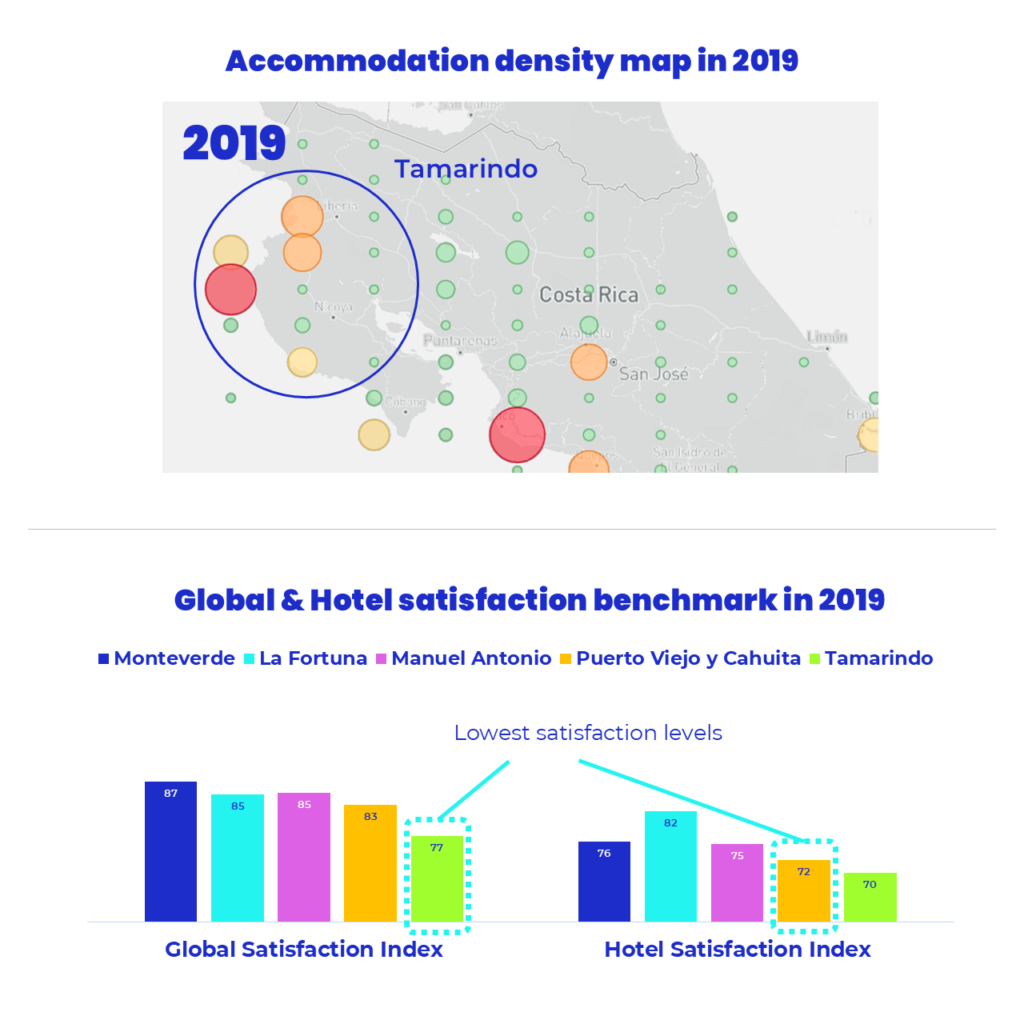
Mabrian geolocated every lodging option in the country (hotels and holiday rentals) and determined that the lodging density averaged 4.5 hotels and 5.5 holiday rental units per inhabited square kilometer, a globally balanced ratio for the entire territory. However, the analysis revealed that three areas—Tamarindo, San José Airport, and Jacó—had a density three times higher than the national average, indicating concerning saturation that local authorities wanted to address. Tamarindo, a popular sun-and-beach destination for travelers worldwide, was one of these saturated areas and was designated as a priority action area due to lower satisfaction levels with accommodation and destination experiences.
By managing tourism density effectively, the goal was not only to preserve the environment and local communities but also to enhance the overall experience for travelers, ensuring that Costa Rica remained an attractive and enjoyable destination for future visitors.
Results
By using data intelligence, Mabrian mapped the accommodation options in Tamarindo, providing a deeper understanding of the density levels in the context of local dynamics. This insight helped make decisions related to new project developments and holiday rental licensing, among other issues. In fact, Costa Rica’s authorities implemented a specific policy for new lodging facilities or permits while focusing on repositioning less dense zones in the region.
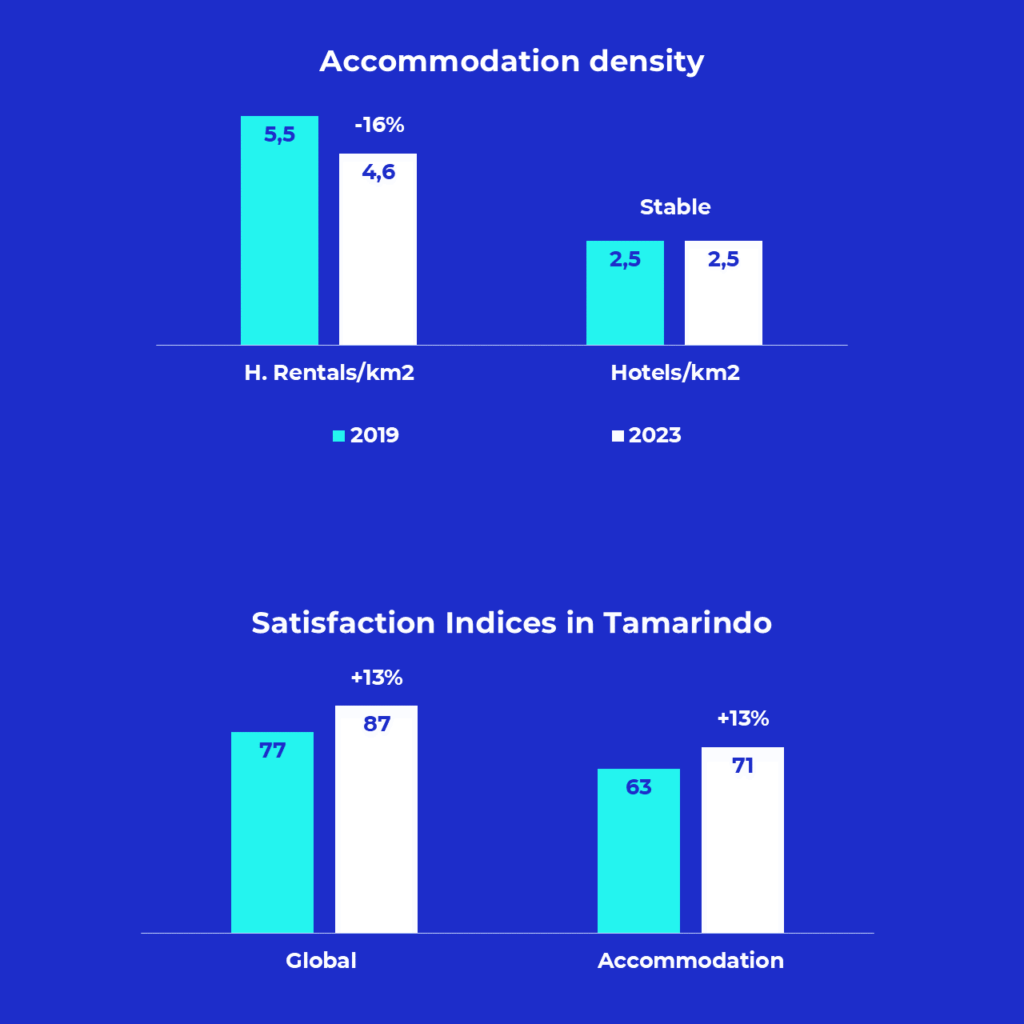
Thanks to this combined approach—integrating data insights with targeted policy-making—accommodation density for short-term rentals in Tamarindo decreased by over 16% within five years, while the destination’s Global Satisfaction Index increased by 10 points (from 77 points in 2019 to 87 in 2023). The Hotel Satisfaction Index also rose by 8 points (from 63 to 71 out of a possible 100). Moreover, Costa Rica’s Tourist Spend Distribution Index increased by up to 9%.