


These are the key findings of the Mabrian and Data Appeal study “Mexico Horizon 2030: Tourism Opportunities and Challenges Driven by Data Intelligence”, presented at 2026 Tianguis Turístico Aula Digital. The report also underlines the role of events and tourism experiences as strategic tools to maximise economic impact, better distribute tourism demand across Mexico, and support the development of emerging destinations.
Interregional connectivity, community-based tourism and high-value travel segments are set to play a defining role in shaping Mexico’s tourism sector over the coming decade. This is according to new analysis by Mabrian and Data Appeal, presented during the webinar “Mexico Horizon 2030: Tourism Opportunities and Challenges Driven by Data Intelligence”, held as part of the webinar series hosted by Tianguis Turístico 2026 show.
The session, led by Carlos Cendra, Marketing and Communications Director at Mabrian, outlined the report’s main conclusions, highlighting the opportunities Mexico can harness to evolve its tourism model. These include market diversification, more balanced territorial development, and a more strategic use of connectivity, alongside a stronger focus on experiences and events.
Drawing on advanced data intelligence, the study provides an in-depth analysis of the Mexican tourism value chain, from air connectivity and hotel supply to international demand trends, the evolution of tourism products, and the growing potential of experiences and events.
The outlook for connectivity in Mexico in 2026 is particularly strong. Total seat capacity is expected to increase by +2% year on year, reaching 111.8 million seats, with domestic capacity rising by +3.2%, despite a -2.7% decline in seats from the United States. Meanwhile, markets such as Canada (+7%), Colombia (+3.8%) and Spain (+12.3%) are gaining relevance, continuing trends observed over the past five years.
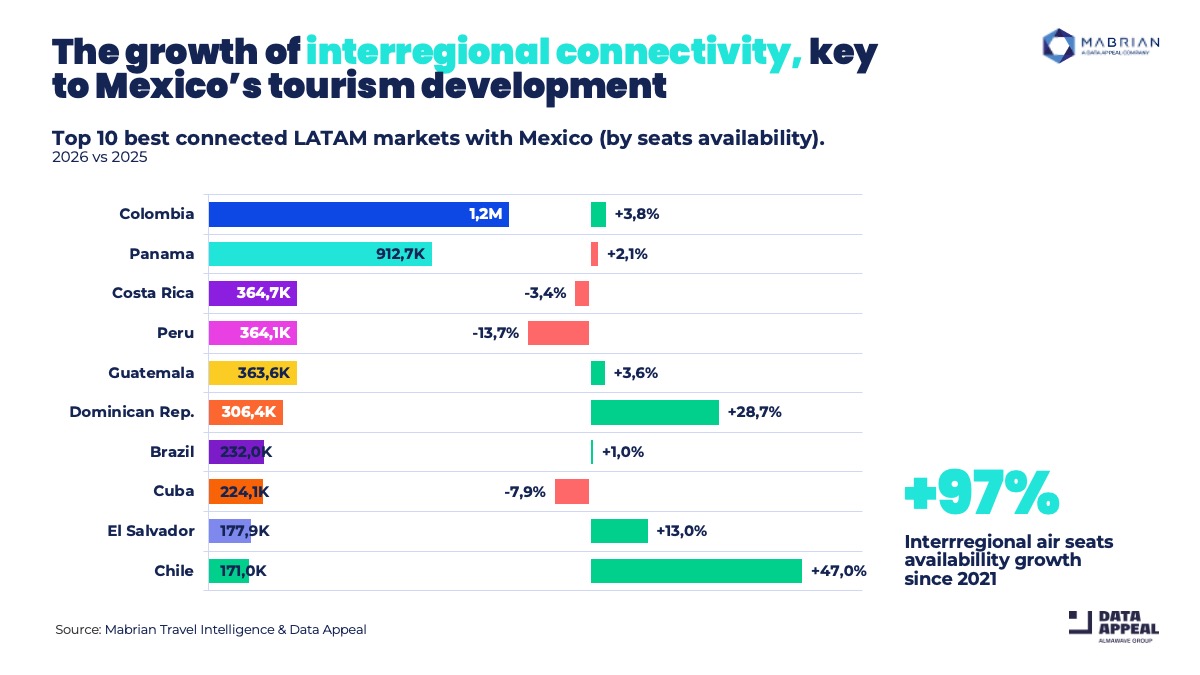
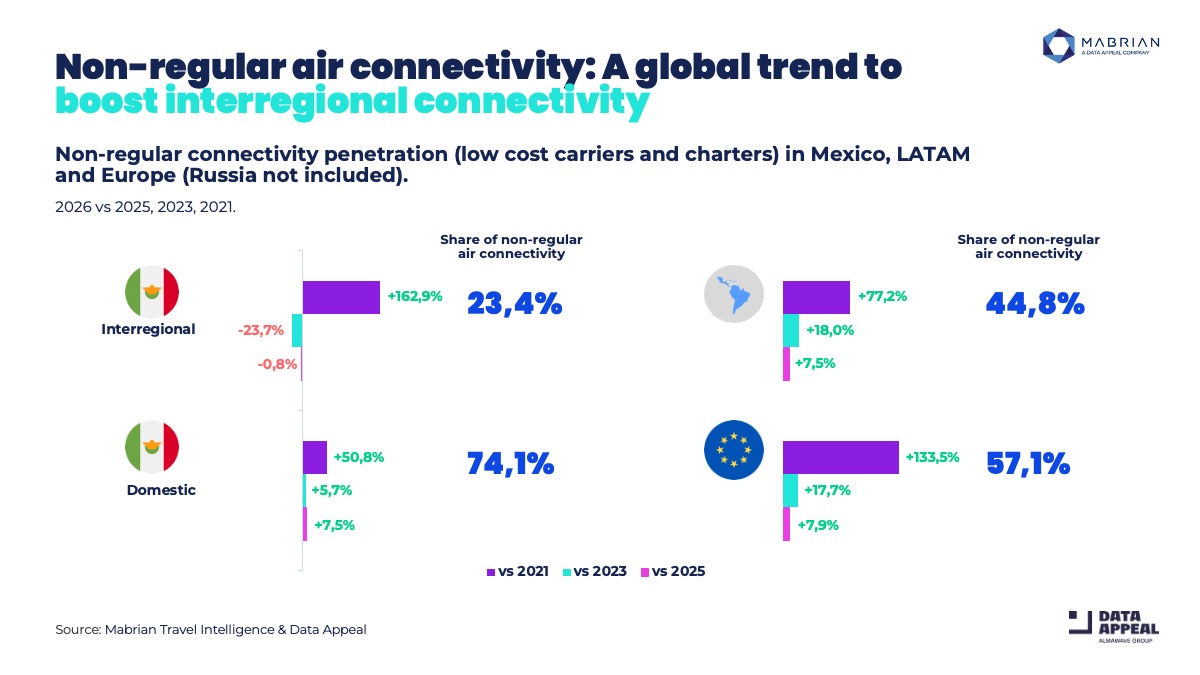
Two structural trends are also becoming more pronounced. Firstly, interregional connectivity within Latin America has nearly doubled since 2021, driven by both full-service airlines and low-cost and charter operators. Secondly, non-regular connectivity (including low-cost and charter flights) now accounts for 74% of domestic capacity and 23.4% of interregional connectivity, highlighting significant room for further growth in line with global benchmarks.
Demand trends: rising interest in local experiences and alternative lodging
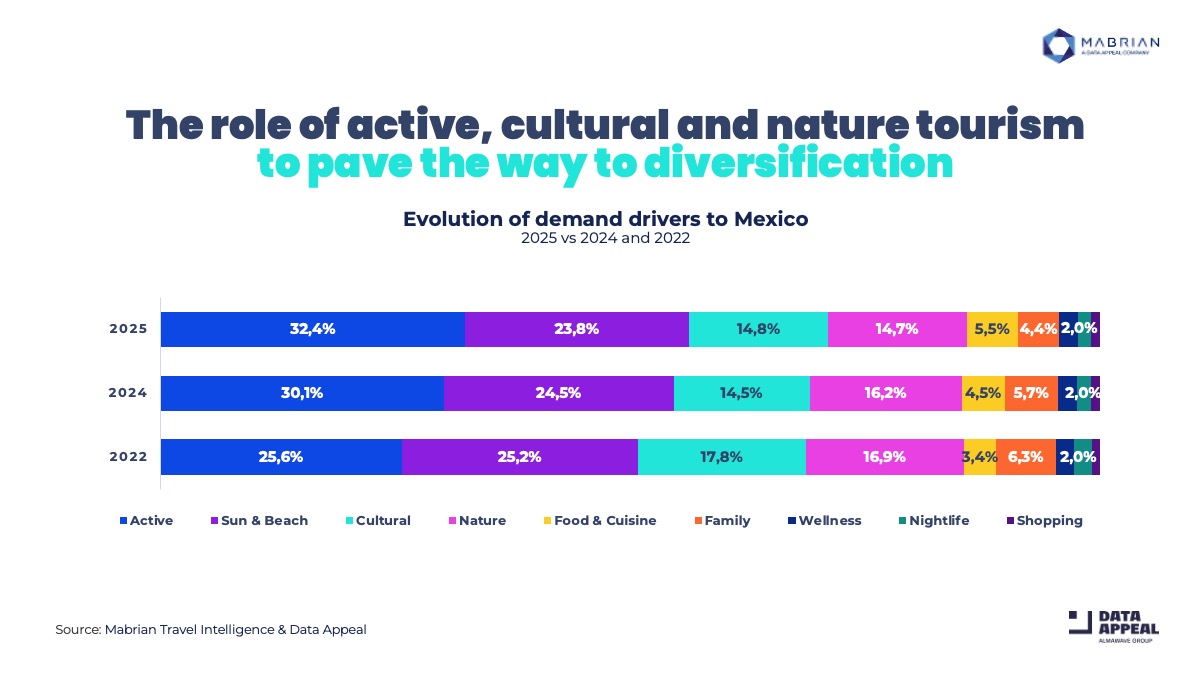
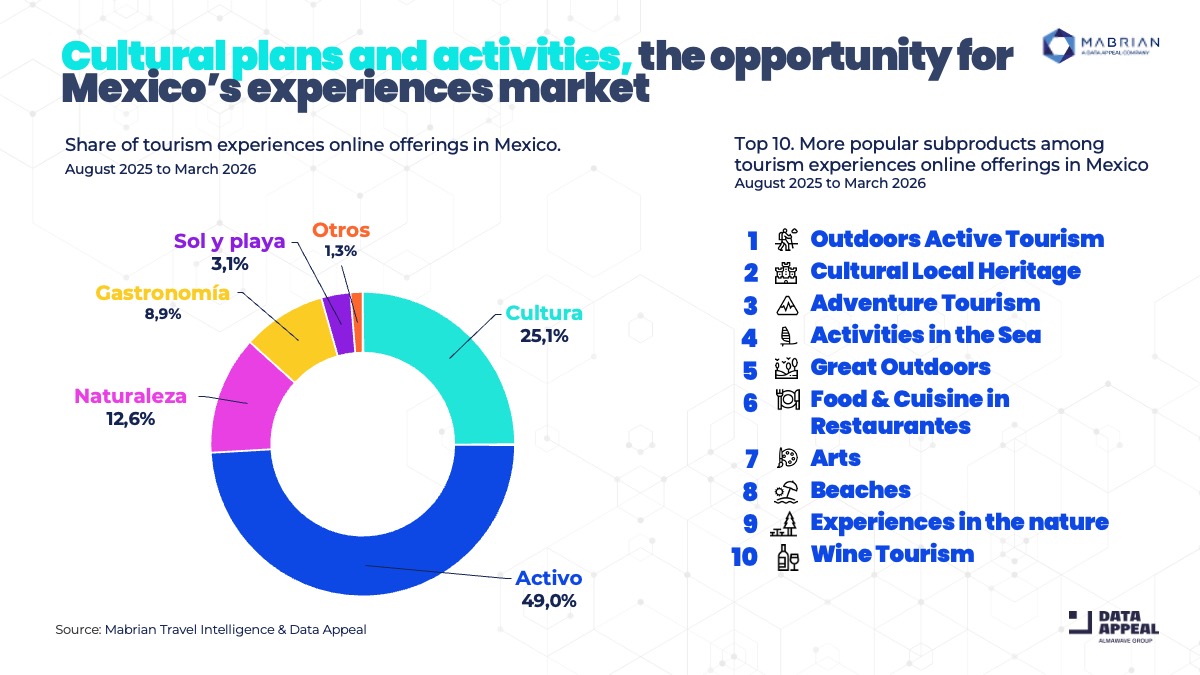
While sun-and-beach and active tourism continue to be key demand drivers for Mexico, travellers are increasingly seeking more authentic, local experiences. This creates opportunities to develop multi-product and multi-destination offerings, with community-based tourism playing a central role in responding to growing interest in gastronomy, culture and nature.
“To support the growth of community-based tourism, it is essential to enable a more balanced geographical distribution of demand by expanding accommodation capacity and strengthening development policies for emerging destinations,” says Cendra. According to the analysis, three key factors could support this shift.
The first is short-term rentals. While hotels remain the preferred choice for 88% of travellers to Mexico, alternative accommodation is gaining traction, particularly among international visitors. “With the right planning, short-term rentals can play a significant role in extending tourism beyond established destinations,” Mabrian expert explains.
The other two factors are events and experiences which, according to Mabrian, “help showcase local initiatives that connect visitors with the culture and everyday life of communities”. This approach “supports a more even distribution of tourism spending and generates direct economic benefits for less-visited destinations that are not typically part of mainstream travel itineraries”.
A nationwide strategy to develop events and experiences also plays an important role in attracting high-value and luxury travellers. Mexico, where the proportion of five-star hotels is twice that of other leading destinations, has seen a 46% increase in this type of accommodation since 2022. “This growth is key to attracting a segment of travellers who expect top-tier standards, while also valuing authentic experiences rooted in local identity,” adds the Mabrian spokesperson.
Regional planning: a strategy for events in Mexico
The report also highlights the role of events as a key tourism asset, identifying three distinct models in Mexico based on attendance levels and tourism economic impact: high-attendance, high-spend events such as sports and concerts; large-scale but less frequent events with strong profitability, such as festivals; and smaller-scale events with lower attendance but high per-visitor spend, such as exhibitions and trade fairs.
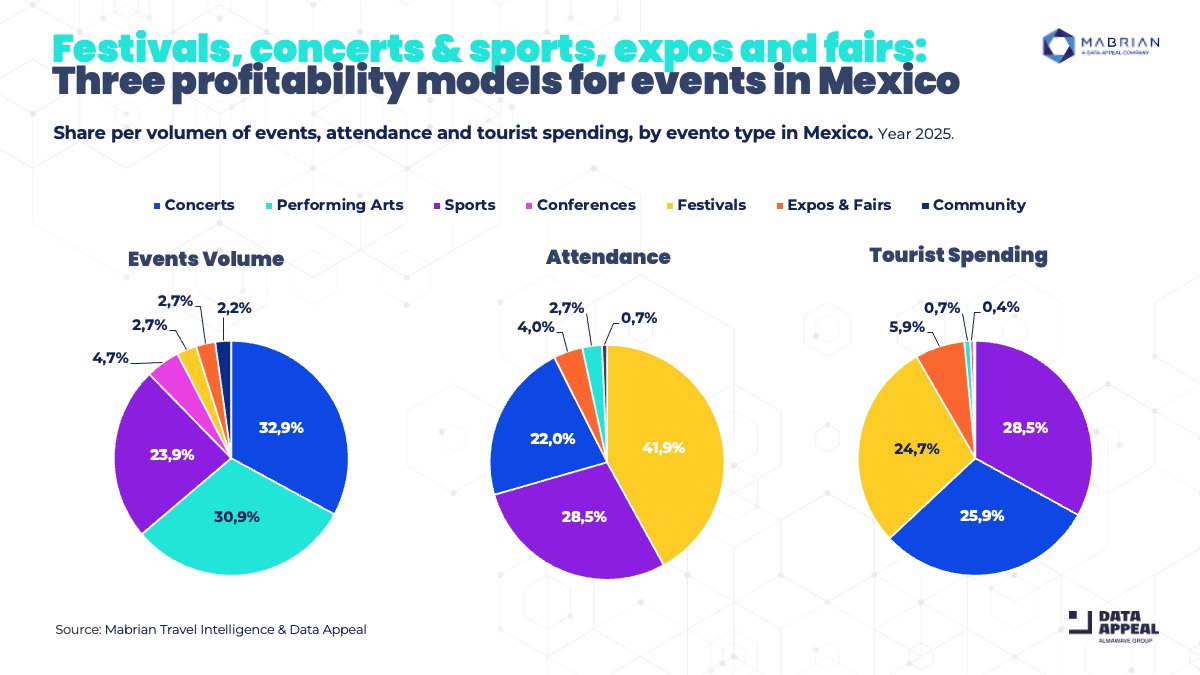
“A more strategic, regionally focused approach to event planning would help distribute visitor flows more evenly, ease pressure on saturated destinations, and maximise economic returns across different regions, in line with their specific needs and capabilities,” says Cendra.
Major global events such as the 2026 FIFA World Cup should also be integrated into this long-term territorial strategy. In Cendra’s view, “while such events significantly boost the visibility of host cities, they also create an opportunity to promote alternative destinations and develop complementary itineraries and experiences across the country”.
The full report “Mexico Horizon 2030: Tourism Opportunities and Challenges Driven by Data Intelligence” is available to download and offers detailed insights and strategic recommendations to help stakeholders capitalise on evolving demand patterns, connectivity trends, tourism supply and regional development opportunities across Mexico.
Download the report
Stay up-to-date with the latest news tailored to your industry!
Subscribe to our newsletter to receive the report.