

The analysis by Mabrian and Data Appeal confirms the consolidation of Argentina as a strategic destination for Spanish travellers, particularly high-impact visitors, supported by improved connectivity, greater diversification of destinations, and an evolution towards more experiential and higher-spending tourism.
Interest among Spanish travellers in Argentina continues to rise, consolidating its position as a high-value strategic market for this South American destination, according to an analysis by Mabrian and Data Appeal on the Spanish market, presented during Destination Argentina Roadshow in Europe, held in Barcelona at the end of April. The event was attended by around 20 high-end sector companies and organizations from Argentina, including Visit Buenos Aires and Visit Argentina.
The data, presented by Carlos Cendra, Marketing and Communication Director at Mabrian during the event, highlights the role of increased air connectivity between Spain and Argentina as a key driver of demand growth. In fact, between 2023 and 2025, the number of airline seats between Spain and Argentina has increased by +30%.
The Madrid–Buenos Aires route is the most significant in terms of seat capacity (nearly 684,000 seats) and growth (+31.7% since 2023), although connectivity is becoming increasingly diversified. From Barcelona Airport, nearly 111,000 seats to Argentina were operated in 2025, an increase of +20.8% compared with 2023. While Buenos Aires–Ezeiza remains the main entry point, with growth of +25.3% over the same period, the Córdoba route has also expanded significantly, recording a +147% increase in seat capacity since 2023.
Air connectivity forecasts between May and October 2026 point to a further increase of +14.9% compared with the previous year, with the vast majority of capacity (94.2%) operated by traditional airlines. As a major development, October 2026 will see the addition of two new low-cost carriers, Plus Ultra and World 2 Fly, launching new direct routes to Ezeiza and Rosario respectively.
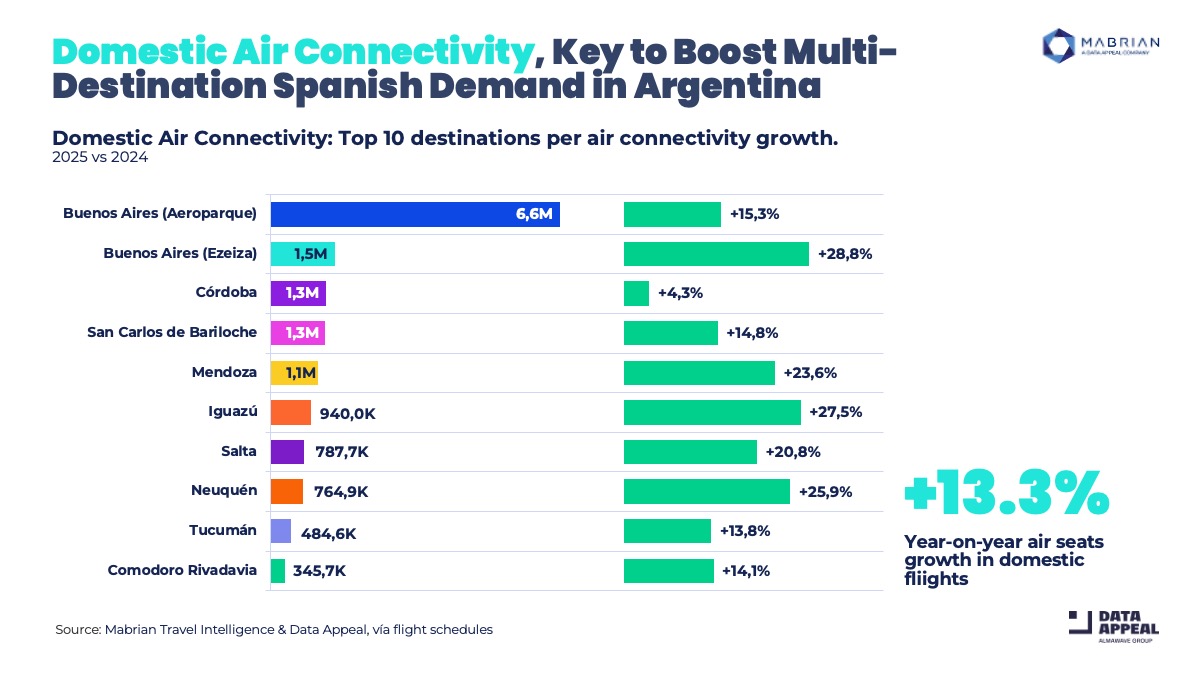
“In this context, the growth of domestic connectivity is very important for the Spanish market, which combines multiple destinations within Argentina, with stays averaging around four days in each location visited,” says Cendra. Data shows that domestic air capacity in Argentina increased by +13.3% year-on-year in 2025, following the introduction of the ‘open skies’ policy in July 2024, formalised under Government Decree 599/2024.
Daniel Manzella, president of Destino Argentina Chamber, emphasised that “this growth is paralleled by the advancement of initiatives such as Argentina On Tour, the international platform spearheaded by the entity, which convenes the country’s primary high-end inbound tourism companies. This initiative facilitates the promotion of an authentic and meticulously curated selection of the Argentine tourism offering across various markets, thereby creating opportunities for interaction between the local industry and key stakeholders in global tourism.”
Itineraries to discover the essence of Argentina: a key attraction for high-impact Spanish travellers
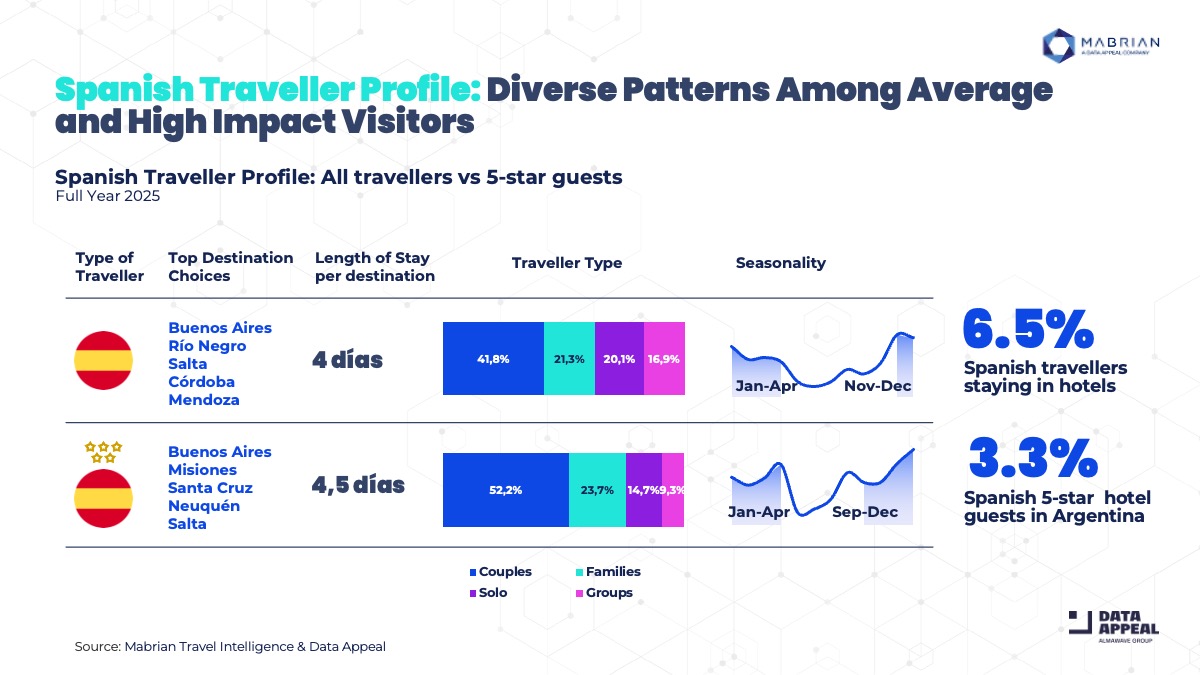
Overall, Mabrian data shows that active tourism has been the fastest-growing demand driver in recent years and, together with culture and gastronomy, represents one of the most important motivators for Spanish travellers. These visitors mainly travel as couples (41.8%), with 69.5% staying in hotels, and tend to visit during the austral summer, taking advantage of Argentina’s favourable weather compared with the European winter.
Of the total Spanish visitors, 3.3% choose five-star accommodation, forming a high-impact profile that travels either as a couple (52.2%) or with family (almost one in four), with an average stay of 4.5 days per destination. Their preferred destinations, beyond Buenos Aires, include the provinces of Misiones, Santa Cruz, Neuquén and Salta. However, the strongest growth within this segment is seen in Mendoza and Córdoba, where Spanish travellers staying in five-star hotels have quadrupled since 2023.
As highlighted by Destino Argentina, “the Argentine capital plays a key role as a gateway and tourism hub for the Spanish market, not only for its outstanding cultural and gastronomic offer, but also as the experiential platform from which Spanish travellers discover the country’s wider diversity.”
The expansion of the four- and five-star hotel segment, which according to the Mabrian report has grown by +18.8% and +25.4% respectively in terms of establishments since 2023, is essential to further consolidating high-impact Spanish demand. In this regard, the Mabrian expert stresses the importance of “strengthening accommodation, experiences and tourism services for the luxury segment in both emerging and non-traditional destinations, capitalising on travellers’ appetite to explore places that represent the essence of Argentina, as well as destinations not yet included in mainstream itineraries.”
Another opportunity lies in the development of exclusive and innovative tourism products and experiences, aligned with the austral winter and spring seasons in Argentina, in order to attract Spanish demand during Europe’s longest holiday periods (July, August and even September), encouraging new itineraries, discovery of emerging destinations, and tapping into high-impact niche demand, particularly in active tourism, adventure and sports-related travel.
“Consolidating high-impact Spanish demand is the natural evolution of our commitment to this source market, which is so important for Argentina,” says Manzella. “Our offer of nature, culture and gastronomy, together with a growing and improving tourism infrastructure, as the data clearly shows, creates a strong competitive advantage to attract this segment of Spanish demand, which seeks authentic experiences, territorial diversity and high-quality offerings.”