The forecast analysis on the main urban tourism capitals in Spain indicates that these cities are diversifying their value proposition to expand their markets, as they deal with challenge of extending the duration of stays by offering more diverse experiences and more connections with medium and long-distance markets.
Renowned global destinations, Spanish cities are beginning 2025 by fortifying their air connectivity. The goal is to attract greater international demand while still accommodating the needs of the domestic market, essential for achieving a balance among experiences, tourism products, and accommodation offerings. Average rates for accommodations, particularly three- and four-star hotels, are expected to rise.
This forecast delves into key points and trends for six urban destinations (Madrid, Barcelona, Valencia, Malaga, Seville, and Bilbao) were addressed, based on a comparative study of scheduled air capacity, hotel demand, demand drivers, and traveller profiles between the first half of 2025 and the same period in 2024.
Medium Haul Connectivity to Urban Destinations, on the rise
- Air connectivity is increasing in the six destinations that were analysed. This growth is driven by connections operated by traditional airlines for all destinations except Barcelona, which has more seats on low-cost airlines. Low-cost airline seats are also increasing in Valencia and Malaga, and to a lesser extent in Seville and Bilbao. Madrid has seen a +34% year-over-year decrease in low-cost airline seats as the city strengthens its connectivity on traditional airlines.
- The commitment to enhancing direct connectivity with medium-haul markets is evident, particularly in Seville, Valencia, and Malaga (with increases of +14.5%, +11.3%, and +10.3% year-over-year, respectively). Notably, Seville is introducing new routes from Istanbul, Dublin, Dusseldorf, and Stuttgart, as well as from London and Edinburgh; and it is also augmenting capacity from its established markets. Similarly, Madrid, Barcelona, and Bilbao are launching new medium-haul routes.
- Regarding long-haul, seat availability has risen by +27.6% in Malaga, which, while not adding new routes, is bolstering its connections with New York and Montreal (North America) and with the capitals of the Arab Gulf (Qatar, Kuwait, and Abu Dhabi). In the case of Madrid (up +7.7% year-over-year), in addition to increasing seats on long-haul routes with Asia, America, and the Middle East, it is initiating new routes to China, the USA, and Uzbekistan. Barcelona, which is increasing seats on long-haul flights by +8.4%, is also expanding its traditional routes and adding flights to Seoul and Lima. Valencia and Bilbao are also inaugurating long-haul routes in the first half of 2025, to Canada in the case of Valencial, and to New York in the case of Bilbao.
Domestic Market Demand Remains Relevant, As Urban Destinations Also Target Medium-Haul Source Markets
- Spanish travelers will continue to be essential in the demand mix for Spanish urban destinations. These destinations have a more diverse demand and are less reliant on their three primary markets of origin. For example, 42% of air seats to Madrid come from its three main issuing markets, 46% in the case of Barcelona, and 48% in the case of Malaga (whose main market by air capacity is the United Kingdom). This percentage increases to 50% for Valencia, 68% for Seville, and reaches 75% for Bilbao.
- Italy is among the five international markets with the highest growth in all the destinations analysed, with increases ranging between +7% and +9%, except in Bilbao, where it has grown by around +21% year-on-year.
- France is also among the markets with the highest growth in air capacity, particularly in Barcelona, Madrid, and Valencia; while Ireland is growing in Malaga (+13%) and especially in Seville (+56%), and Switzerland is increasing its connectivity with Valencia (+19.8%) and Bilbao (+21.4%).
- Other markets that are important to observe due to their significant increases in air seats to these destinations are Portugal (+8.8%) for Barcelona; Colombia (+11.8%) for Madrid; Belgium (+27.3%) for Valencia; and Germany (+27.5%) for Seville.
- Regarding the relevant long-haul markets, the United States is growing very slowly in Barcelona and to a lesser extent in Madrid. Demand from Latin American markets (particularly Brazil, Colombia, and Mexico) to Madrid is increasing, which is also reflected in terms of air capacity, particularly from Colombia and Mexico.
Seasonal activity for urban destinations is balanced, except for locally differentiated peaks
- Data on Spanish urban destinations do not indicate significant seasonality; on the contrary, seasonality is low, as the concentration of tourist activity in the summer months (May to September) averages 48% across the analysed destinations.
- The data do reveal months with more intense peaks of demand in a specific season. For example, spring demonstrates peaks in Barcelona, Seville, and Madrid (particularly in May), while summer demonstrates peaks in Valencia, Malaga, and Bilbao (especially in August).
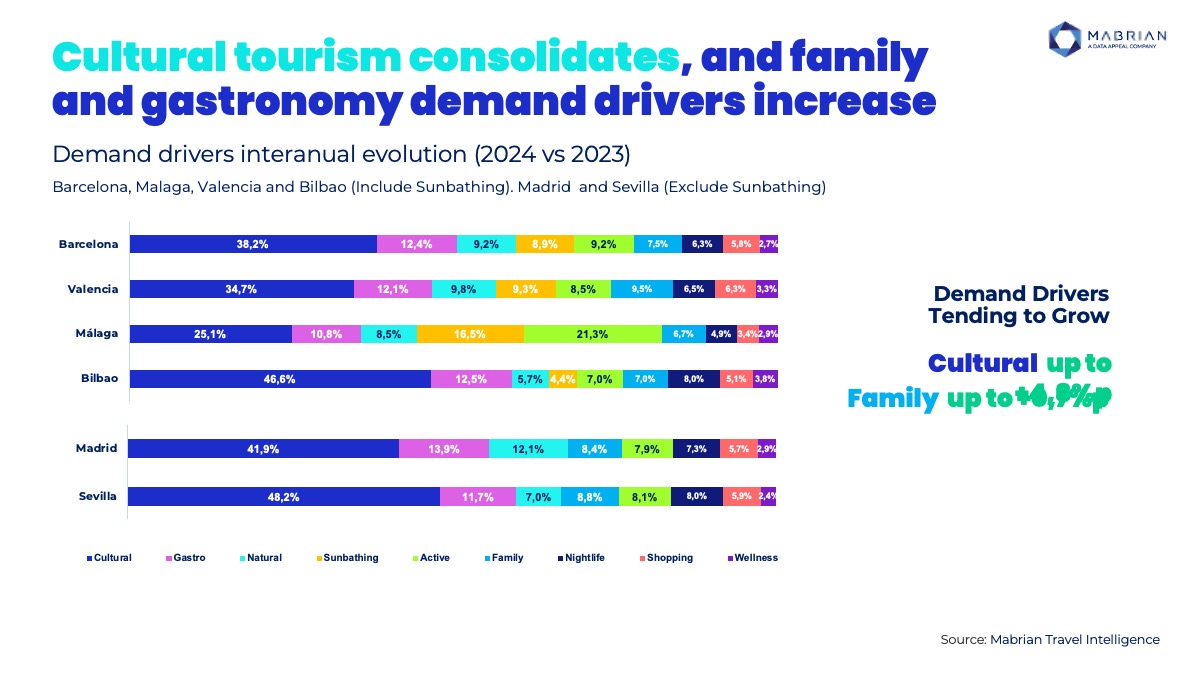
Cultural tourism is the strongest driver, and family and gastronomic tourism grow
- The distribution of demand drivers shows that the destinations are implementing strategies to increase and diversify the cultural offerings, which is gaining traction in line with the efforts to position these cities as cultural destinations of international relevance.
- The top 3 demand drivers reveal the different approaches in the diversification strategies that, in the case of Malaga or Barcelona, involve strengthening the active tourism product; and in the case of Madrid or Valencia, promoting nature tourism; and in all destinations, capitalising on the potential of gastronomic tourism.
- Gastronomic tourism is also another traditionally strong demand driver, and is among the three main demand drivers in all the destinations analysed (except in Malaga, where it is fourth).
- Also of note is the evolution of family tourism, which is increasing in all the destinations analysed, and the decline in nightlife (stronger in Madrid, Seville, and Malaga) and shopping as drivers of urban demand.
- On the other hand, the case of Valencia is noteworthy because it demonstrates the success of a more heterogeneous diversification strategy, with the demand drivers (gastronomy, family, shopping and well-being) growing, complementing the main product (culture) to attract more diverse segments.
Spanish cities stand out for short couple or family breaks
- The majority of travellers visit these Spanish cities as a couple, and one-third do so as a family. The Italian market also sees these cities as destinations for travelling with friends, especially Barcelona, Malaga, Valencia, and Seville. Proportionally, there is less demand for solo travel, although this type of traveller represents, for example, 23% of the American demand for Madrid.
- The length of stay is short, less than two days among Spanish travellers and around three among foreigners; except for Malaga, where stays are longer in both cases.
- Regarding accommodation preferences, there are three common scenarios among the destinations analysed: Hotels are the majority option in Barcelona (56.6% prefer hotels compared to 15% for tourist rentals), Bilbao (51% vs 17.5%), and Valencia (46% vs 32%); while in Malaga, tourist rentals are the preferred alternative for 50.4% of travellers (on average), versus 32.6% choose hotels, a percentage that increases depending on the market of origin.
- Madrid and Seville, on the other hand, show a more equal demand: In the case of Madrid, accommodation preferences are virtually divided into thirds, among hotels, tourist rentals, and other types of accommodation (B&B, hostels, etc.), although hotels continue to have more weight in travelers’ preferences. As regards Seville, travelers choose hotels and tourist rentals equally (around 40% in each case), although key international markets for the destination continue to prefer staying in hotels.
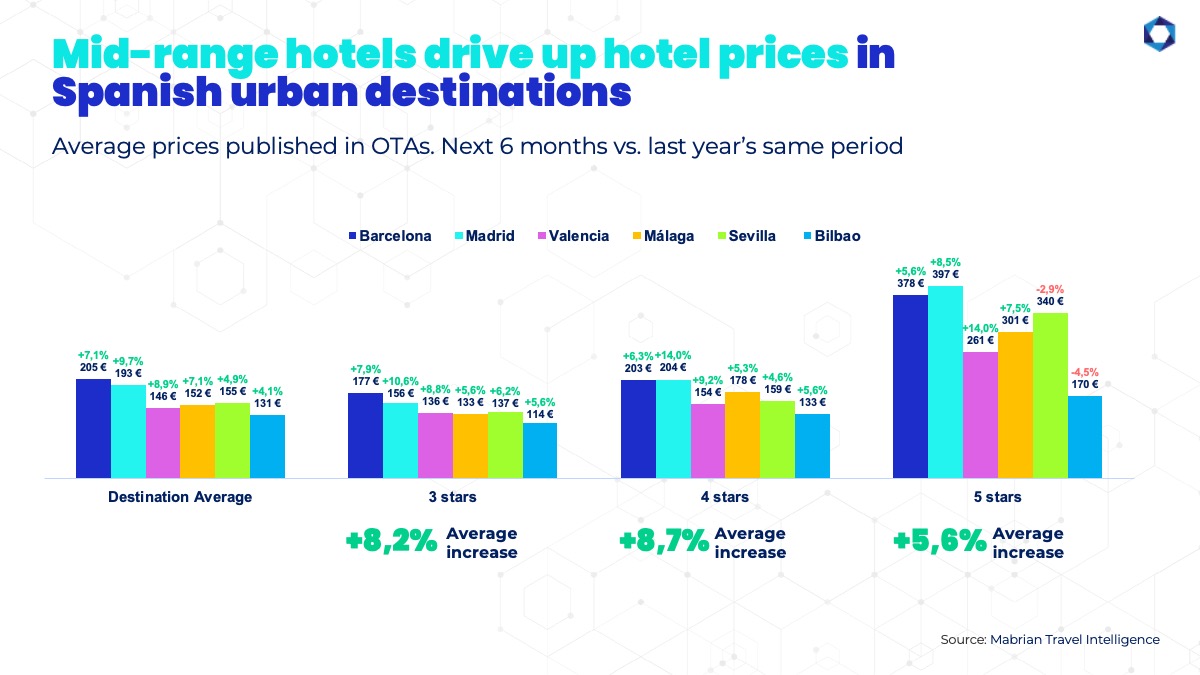
OTAs rates increase in Spanish urban destinations is driven by mid-range category hotels
- Overall, the most substantial rate increases are evident in three- and four-star hotels, with Madrid exhibiting the highest rates across all categories.
- Rates for three-star hotels will increase in all analysed urban destinations, with an average increase of +8.2%. Madrid (+10.6%), Barcelona (+7.9%), and Valencia (+8.8%) will experience the most significant increases.
- Four-star hotels will also experience an average rate increase of +8.7%, with Madrid again showing the highest increase (+14%). This slightly surpasses the average rate in Barcelona, which increased by 6.3%. These cities are the only two destinations analysed that exceeded the average rate of 200 euros.
- Five-star hotels will experience a more moderate average increase of +5.6%, with Valencia and Malaga leading these increases. Seville and Bilbao will see adjustments in their five-star rates downward. Barcelona hotel prices will rise by +5.6% to almost 380 euros on average, and Madrid to almost 400 euros on average due to an increase of +8.5%. This positions Madrid as the destination with the highest average rate in this category.