Our data intelligence suggests that the main Spanish coastal destinations will have a promising first six months of the year. Air connectivity, hotel rates, and opportunities for new demand markets and segments can contribute to increasing arrivals and reducing seasonal dependence.
During the first half of 2025, Spanish coastal destinations will experience significant growth in air seats, particularly with traditional airlines, reinforcing medium and long-distance connectivity, in parallel with a strategy of diversifying source markets to beat seasonality, which remains a challenge. In addition, Spanish coastal destinations will also have the opportunity to take advantage of the boom in tourist demand related to the wellness and family segments, and the upward trend in hotel rates in the mid-range categories.
As follows, Mabrian dives deep into the trends that will mark the first half of 2025 for five Spanish coastal destinations: the Canary Islands, the Balearic Islands, Costa del Sol, Costa Blanca and Costa Brava.
The primary conclusions for this forecast were ascertained through cross-analysis of scheduled air capacity, hotel demand, demand drivers, and traveller profiles, comparing the first half of 2025 with the same period in 2024.
Air capacity grows, reinforcing medium-haul connectivity
- The five destinations analysed will experience an increase in air connectivity over the next six months. This growth is driven by seats in legacy airlines, such as the +7.7% increase (14.82M seats) in seats on traditional airlines to the Canary Islands, a +2.3% increase (11.39M seats) to the Balearic Islands, a +9.3% increase (7.03M seats) to Costa del Sol, and a +10.7% increase (5.15M seats) to Costa Blanca. Costa Brava will see a +19.7% increase and is the only coastal region analysed in which the greatest availability of air seats comes from low-cost airlines (+10% on low-cost airlines).
- Additionally, there has been a substantial increase in long-distance connectivity to Costa del Sol (+27.6%) and the Balearic Islands (+37.5%). The Balearic Islands are also strengthening their medium-haul routes, with increases of +3.5%, in a similar fashion as the rest of the destinations are doing: +8.9% in the Canary Islands, +10.4% on Costa del Sol, and +11.7% on Costa Blanca.
Two air capacity scenarios that reflect different levels of dependence on origins
- The analysis of flight and air seat scheduling reveals that the islands (the Canary Islands and the Balearic Islands) are more reliant (up to 75%) on their three primary markets (Spain, the United Kingdom, and Germany). Conversely, the three main issuers on the peninsular coasts (Costa Blanca, Costa del Sol, Costa Brava) have a more diverse customer base, representing around 50% of the demand.
- These same data also indicate emerging markets: for the peninsular coasts, Belgium stands out, and especially Italy, which increases its air capacity by +12.3% year-on-year to Costa Blanca, +11.3% to the Costa del Sol, and +41.5% to Costa Brava. Poland and France are exhibiting growth in air-seat connectivity to Costa Blanca, Ireland is increasing its connectivity with Costa del Sol, and Costa Brava is doing so with the Netherlands.
- Demand from France, Switzerland, the Netherlands, and Belgium to the Balearic Islands shows an upward trend, averaging +10%; while in the Canary Islands connectivity is increasing from Spain (+3%), the United Kingdom (+9.8%), and Germany (+14%).
The Spanish coast continues to experience challenges with seasonality, with the exception of the Canary Islands
- The Mabrian Summer Activity Rate reveals that the Balearic Islands and Costa Brava are the coastal destinations with the highest seasonality, with 70.3% and 70.7% of tourist activity concentrated during the summer months (May to September, inclusive), respectively.
- Costa Blanca and Costa del Sol have achieved a more balanced distribution of tourist activity throughout the year, with 57.8% and 54.8% of tourist activity occurring in the summer months, respectively. The Canary Islands have the lowest seasonal demand, with only 40.4% of tourist activity concentrated in the summer months.
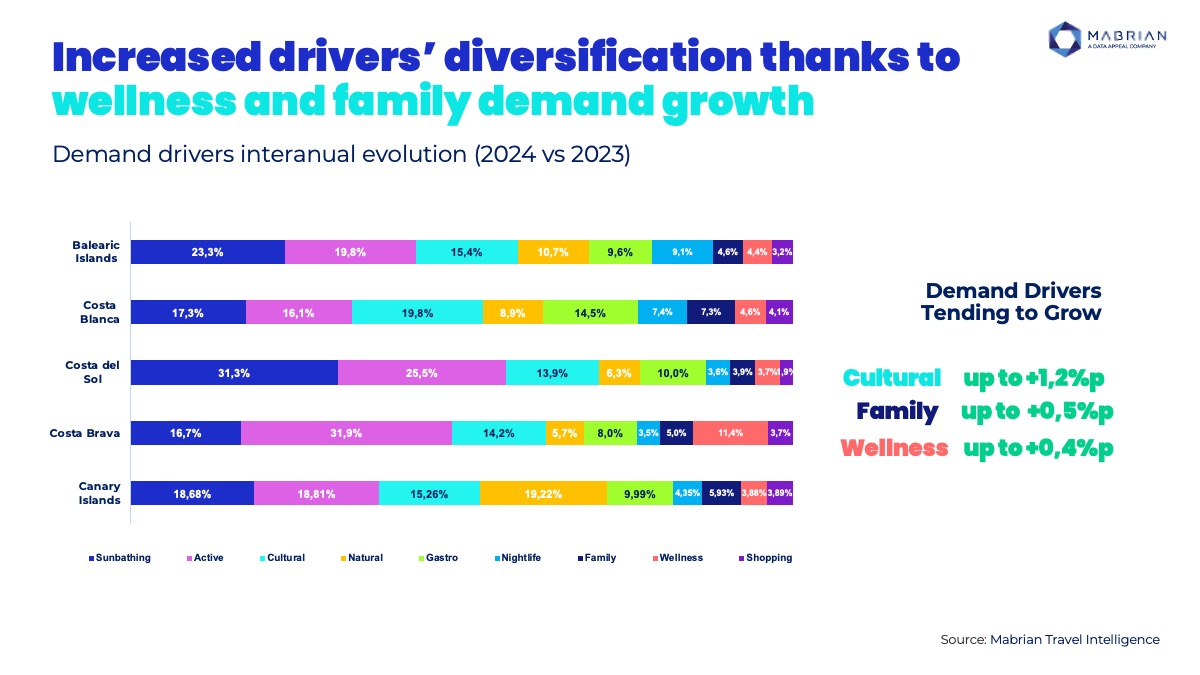
The demand for family and wellness tourism on the Spanish coast is increasing
- Good weather conditions are and will continue to be a significant motivator for travel to the Spanish coast. However, evolving demand presents new opportunities for destinations.
- Cultural tourism is experiencing an increase in traditional sun and beach destinations, particularly on Costa del Sol, the Canary Islands, and Costa Brava.
- Motivations associated with well-being and wellness experiences are notably increasing on Costa del Sol and Costa Blanca, while family tourism is gaining traction among travellers visiting the Balearic Islands, Costa Brava, Costa Blanca, and the Canary Islands.
- Active tourism on Costa Brava is also experiencing significant growth. It is the primary demand driver in this destination and currently comprises nearly a third of the total demand.
While hotels remain the favored option for travellers, there is a growing demand for holiday rentals
- In the majority of the destinations analysed along the Spanish coast, travellers exhibit a preference for hotels, although an increasing preference for apartments and holiday rentals has been noted.
- The average length of stay fluctuates based on the source market. British and German travellers typically stay longer (approximately 4-5 days on average), whereas Spanish travellers opt for shorter stays (approximately 2-3 days). Stays in destinations such as the Canary Islands tend to be longer, while Costa Brava and Costa Blanca have shorter stays.
- France, Italy, Poland, and, to a lesser extent, the Netherlands, are demonstrating growth in air capacity, although the Spanish coastal destinations still exhibit a common dependence on traditional European markets.
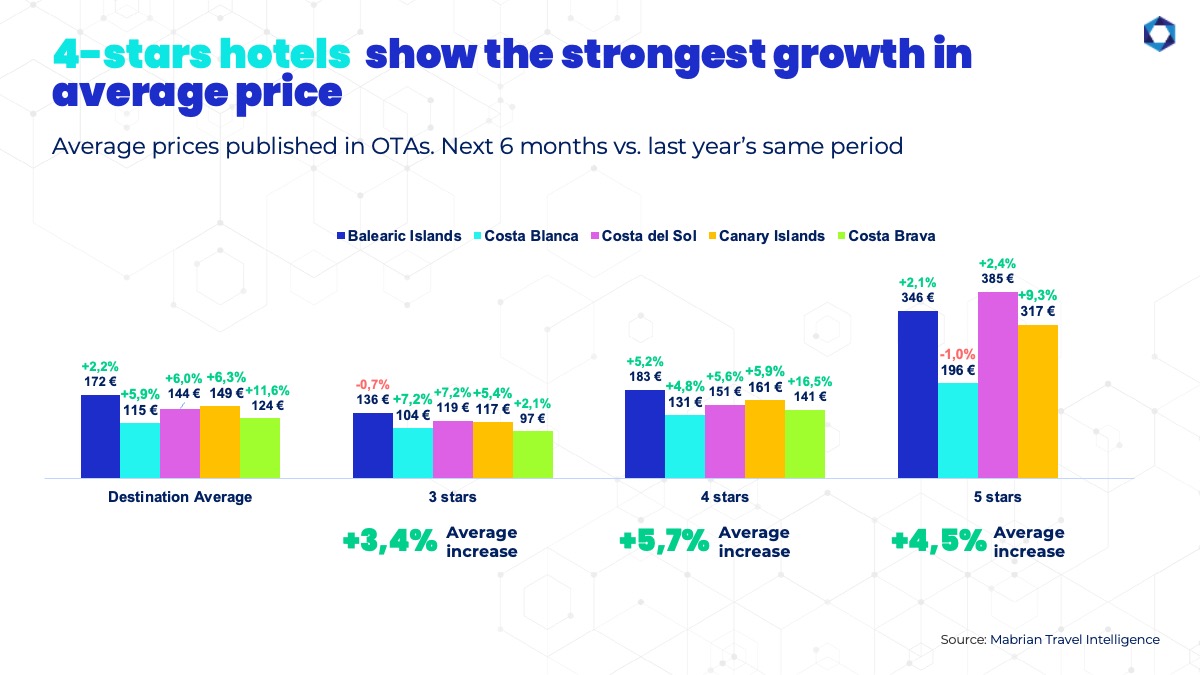
Four-star hotels account for the largest increase in average rates on OTAs
- The increase in rates for the next six months is mainly attributed to mid-range hotels. The rates of 3-star hotels are set to rise by +3.4% year-on-year for all the regions analysed. This increase was marginal in the Balearic Islands, reaching average rates of 136 euros. In Costa Brava, rates increased by +2.1%, with an average rate of 97 euros. In the Canary Islands, the rates remained above 110 euros after rising +5.4% year-on-year, while Costa Blanca and Costa del Sol rose by +7.2%.
- Four-star hotels demonstrate the greatest margin of growth in their rates, with a +5.6% year-on-year increase in the five destinations analysed. Costa Brava shows the most notable increase, of +16.5%, reaching 141 euros; while the rest of the destinations remain within similar margins: a 6% increase in the Canary Islands (161 euros average rate), +5.6% in Costa del Sol (151 euros), +5.2% in the Balearic Islands (183 euros), and +4.8% in Costa Blanca (131 euros).
- The Canary Islands is the region that sees the greatest increase in rates for five-star hotels (+9.3%, with rates of 317 euros). On Costa del Sol are set to rise by +2.4%, reaching 385 euros, and in the Balearic Islands by +2.1%, to reach an average rate of 346 euros. Only on Costa Blanca will the average rate fall slightly, to 196 euros. Overall, in the five destinations analysed, five-star hotels have increased by +4.5% on average.
- Costa Brava is the destination (among the ones analysed) that increases its hotel rates the most overall, by +11.6%; an increase driven by four-star hotels. Costa del Sol and Costa Blanca (+6% in both destinations), as well as the Canary Islands (+6.3%), see similar increases, and only the Balearic Islands will experience a more modest growth, +2.2%, due to the slight drop in three-star hotels.