
International travel intent to Barcelona shows a slight decrease, although the city maintains its appeal for European and long-haul travellers. According to the latest data from Mabrian, short-term opportunities for the Catalan capital lie in fine-tuning its pricing and hotel promotion strategy in mid-range categories, and in developing an integral strategy for designing and segmenting activities and experiences, that responds to the demand of priority markets, reflecting authenticity and local attractions.
We shared this insight during “Expedia Barcelona Partner Event 2025”, an event organised by Expedia Group, in a round table joined by Mateu Hernández, general director of Turisme de Barcelona; Walter Lo Faro, Senior Director – Market Management Southern Europe at Expedia Group, and Cristina Panizo, .Head of Insights & Tourism Advisory at Mabrian.
Barcelona’s international travel intent moderately decreases
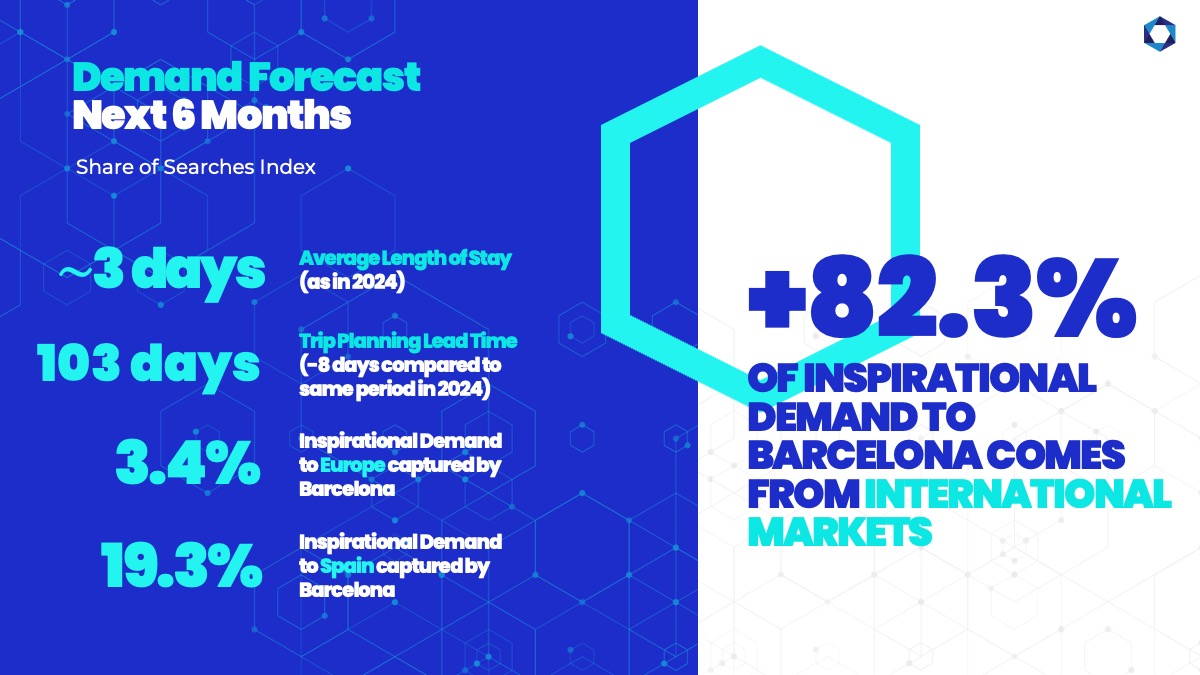
Barcelona manages to capture 3.4% of the total inspirational demand for destinations in Europe, slightly increasing compared to last year. 82.3% of this inspirational demand comes from international markets, a ratio that moderately decreases, -1.4 percentage points compared to the same period last year.
In the next semester, inspirational demand from the domestic market grows, as well as from Germany, France, and Portugal, in addition to long-haul markets such as Canada, UAE, and China. On the contrary, travel intent to Barcelona from the United States, Italy, and the United Kingdom falls compared to the same period last year.
Travellers who are considering Barcelona as a destination to visit during the next semester have slightly shortened the booking lead time compared to the same period last year, with 104 days in advance, 8 days less than the previous year, for average stays of three days. Travellers from Germany (3.4 days), the United Kingdom (3 days), and Italy (2.9 days) have the longest average stays in the city.
The Crucial Role of 3 and 4-star hotels to Pull Demand to Barcelona
Mabrian’s Traveller Profile data for Barcelona indicates that hotels remain the primary accommodation choice, particularly among British (64.5%), French (58.8%), and German (57.2%) visitors. The remaining visitors opt for tourist rentals, guesthouses, and hostels. Italians (17.8%), British (15.8%), and Germans (15%) are most inclined to choose tourist rentals when visiting Barcelona among all source markets analysed.
Among hotel guests, 3 and 4-star hotels are the most popular choices. Demand for 4-star hotels is highest among British (43%), French (36%), and German (34%) visitors. Spaniards also prefer 4-star hotels when staying in Barcelona, though to a slightly lesser extent (30%), whereas Italians are unique in their preference for 3-star hotels, which dominate their market demand (27%). For 5-star accommodations, demand is considerably lower across all nationalities studied: 4% for British visitors, 3% for French and Germans, 2% for Spaniards, and 1% for Italians.
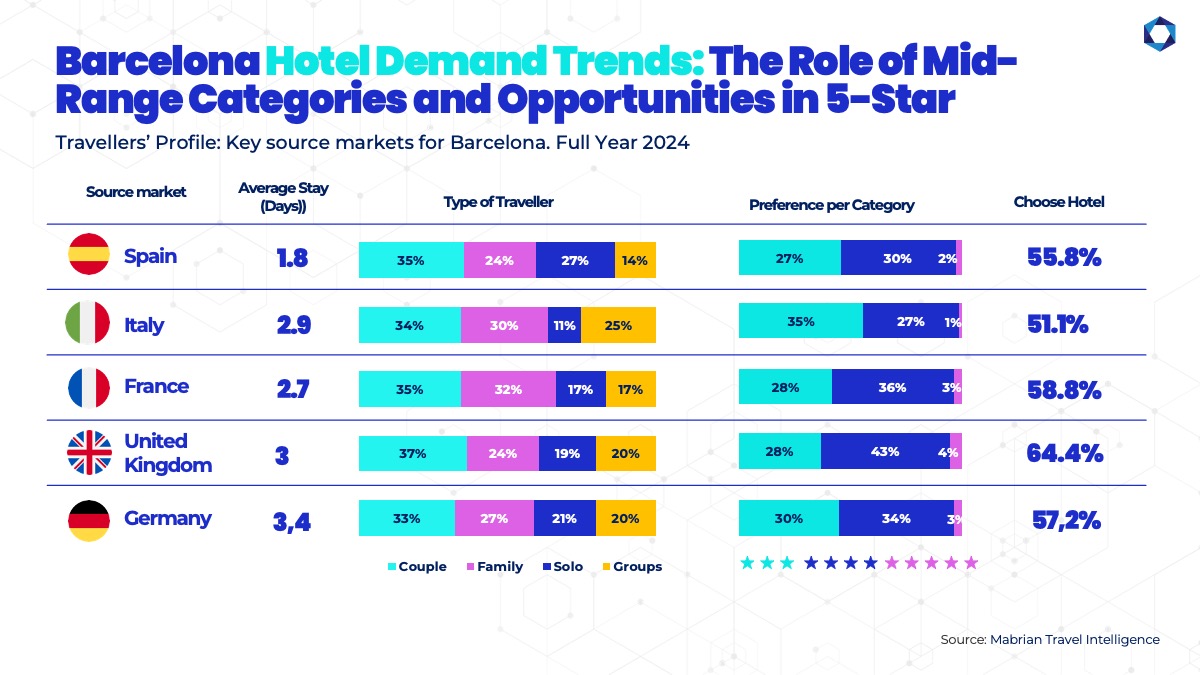
Barcelona’s visitors predominantly consist of couples, accounting for 33% to 37% of total visitors; and families follow, representing 24% to 32%, with groups and solo travelers making up the remainder. However, these proportions fluctuate based on the market of origin: For instance, Spanish travellers show a higher percentage of solo travelers (27%) than families, largely due to business travel. Italian visitors have the highest proportion of group travellers (25%), while British lead in couple-based visits to Barcelona, with 37%.
Mabrian’s analysis of US travellers to Barcelona reveals similar patterns to these key markets, yet with some distinct characteristics. Among US visitors, couples constitute the largest segment at 39%, trailed by families (28%), solo travelers (17%), and groups (16%). The majority (56.8%) opt for hotel stays, while 15.3% choose tourist rentals, and 25.2% stay in guesthouses and hostels. The average stay for US travellers is 3.1 days long and, for those staying in hotels, 4-star establishments are preferred, with 34.2% choosing them, compared to 29.2% for 3-star hotels and 2.5% for 5-star accommodations.
Enhancing Barcelona Stays: An Analysis of the City’s Experiences Market
A significant aspect of any leisure trip involves the activities and plans travellers enjoy in the destination, particularly in urban settings where they are crucial for extending stays and adding value. Mabrian’s data on the tourism experiences market reveals that while Barcelona generally shows an alignment between the supply and demand for activities, there are clear opportunities to attract specific traveller segments and diversify the city’s offerings.
Cultural activities form the largest part of Barcelona’s experience offerings, making up 52.9%. This is supplemented by nature (17.7%), gastronomy (17.7%), and active tourism (10.4%) activities. Experiences related to sun and beach, family, shopping, and nightlife are, overall, less prominent.
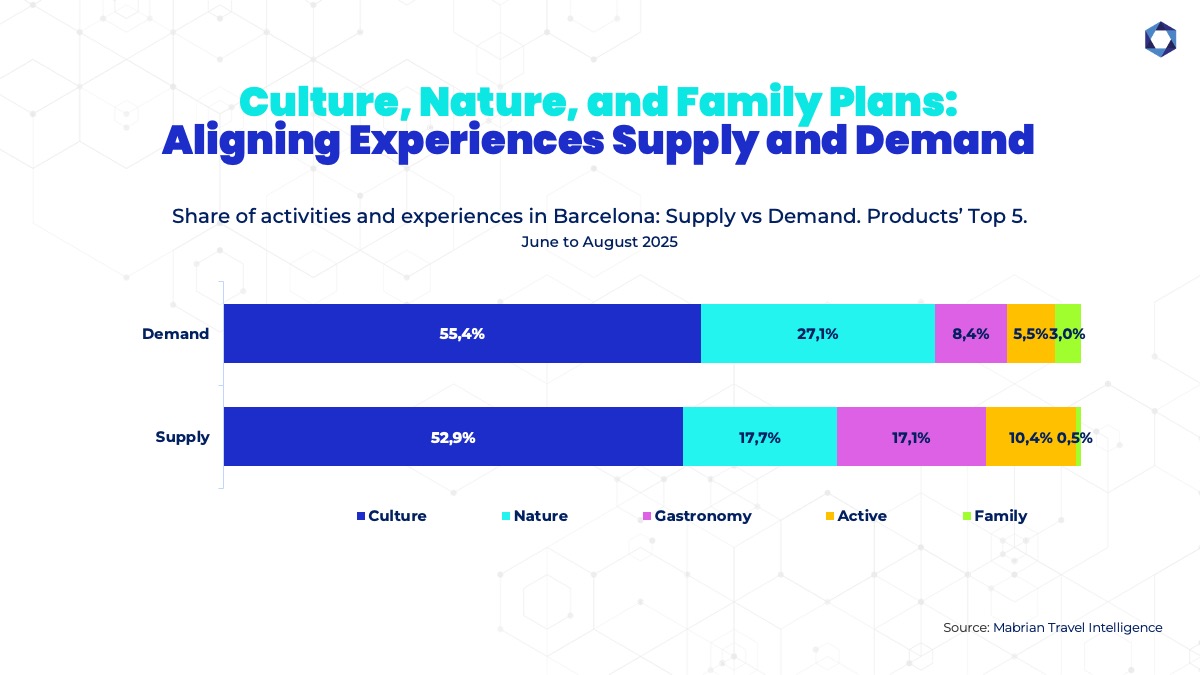
Analysing the experiences offered against demand from Barcelona’s main source markets reveals key areas to bolster the city’s value. Specifically, there is a need to enhance nature-based and family-oriented experiences. Additionally, existing gastronomic and active tourism offerings should be reevaluated to ensure they genuinely meet traveller expectations, especially given that these areas represent double the demand share.
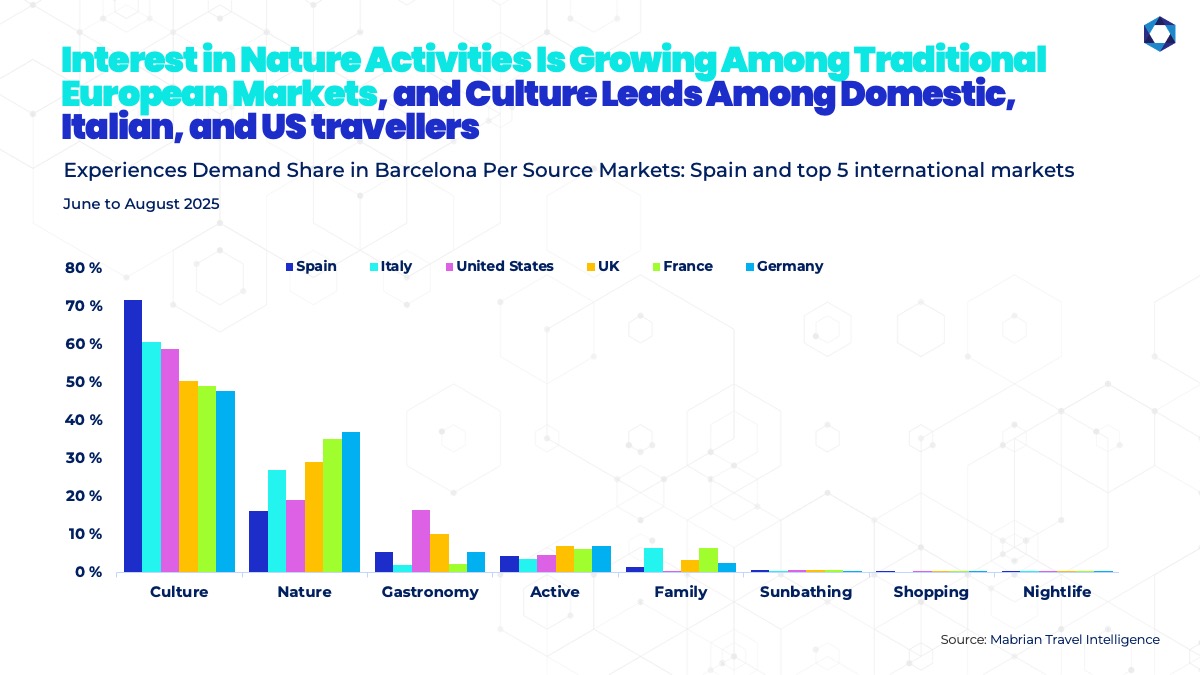
This is especially relevant when studying activities demanded by each source market, which offers clues on how to customise experiences considering very specific segments per origin: that is why Mabrian examined the experiences demand patterns from the domestic market as well as key international markets, including Italy, France, the United Kingdom, Germany, and the United States. Data shows that nature experiences are increasingly popular in traditional European markets; in contrast, cultural activities are favoured by domestic, Italian, and United States travellers. British and American tourists show interest in gastronomic experiences, while French and Italian travellers do so for family-oriented activities.
Barcelona’s Hotel Landscape: The Crucial Role of Mid-Range Offerings
Given the vital role of hotels in Barcelona visitors’ accommodation choices, ensuring guest satisfaction with their hotel experiences is paramount. Mabrian’s Hotel Satisfaction Index (HSI) data shows that traveller perception of Barcelona hotel stays has improved over the last 12 months, reaching 74.3 out of 100, which is 3.1 points higher than the previous year.
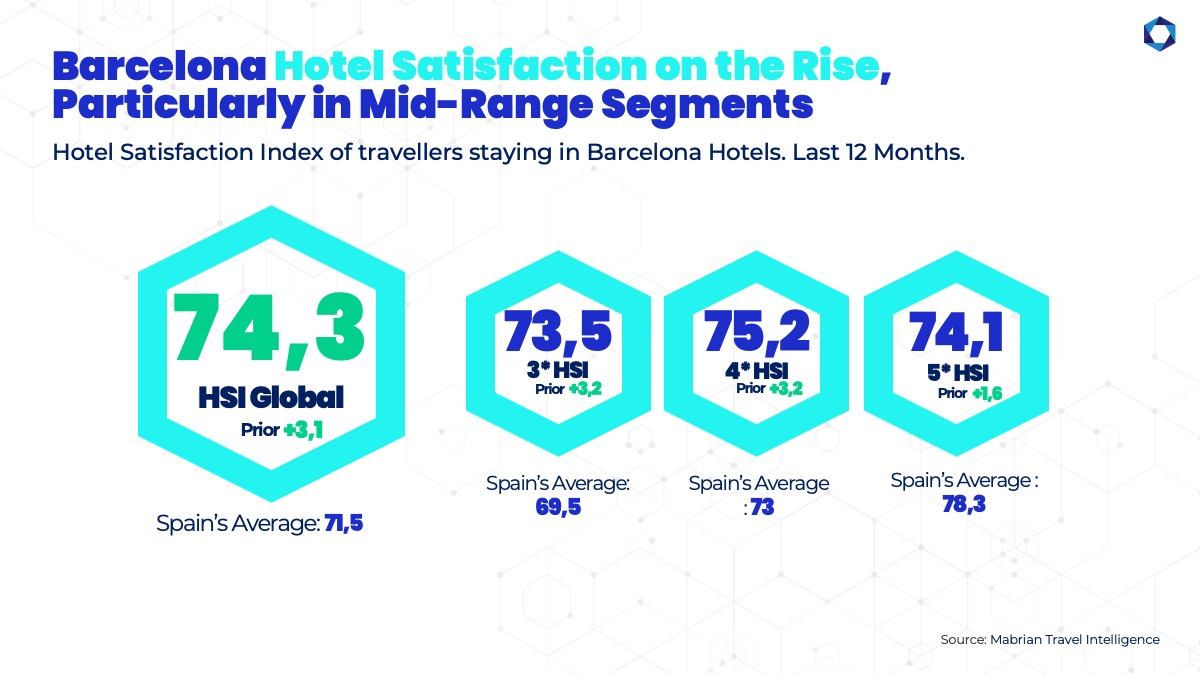
Three-star (73.5) and 4-star (75.2) accommodations saw their HSI improve by 3.2 points compared to last year. Notably, the Catalan capital surpasses the Spanish average for these categories. While 5-star hotels also improved their HSI by 1.6 points to 74.1, they remain 4.2 points below the Spanish average for this category.
Considering the satisfaction with hotel stays and future price forecasts for Barcelona, mid-range hotels play a vital role. Over the next six months, 3 and 4-star hotel rates are expected to increase slightly, whereas 5-star hotels anticipate a minor downward adjustment.
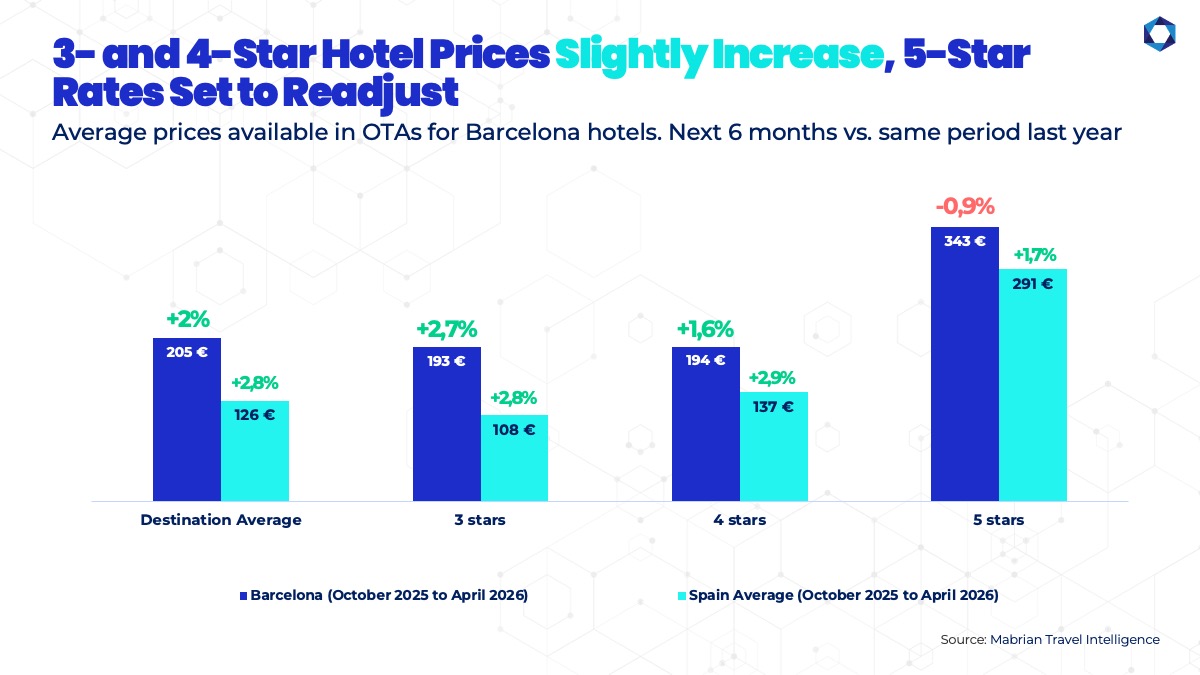
While 3-star and 4-star accommodations are projected to see average increases of +2.7% and +1.6% respectively, aligning with national trends, 5-star hotels are expected to experience a slight decrease of -0.9%. This contrasts with a +1.7% increase observed in 5-star accommodations across the rest of Spain.
Compared to the previous year, when a +9% average increase was forecasted for late 2024 to early 2026 (a forecast that was generally met or exceeded), this year’s projections are more conservative. The anticipated +2% increase for the next semester reflects a more cautious approach to rate planning.