


Phocuswright
Barcelona
June, 2023
Determining Feasibility and Environmental Impact of Alternative High-Speed Rail Options to Meet Commuting Demand Between Madrid and Barcelona
Context
Since the rise of flight shame or flygskam, the social movement originated in 2018 in Sweden that discourages air travel due to its environmental impact, many analyses have been made to understand the travel mobility impact, and in particular, what destinations can do to address the issue in a pragmatic, realistic way. In parallel, European authorities and national governments began assessing the impacts of rail and air travel in 2020. According to the European Environment Agency, both modes of transport are significant parts of Europe’s passenger transport sector, with aviation having a much higher emission impact on a passenger-kilometre basis compared to other means of transportation.
While the travel industry explores more sustainable approaches to energy consumption, destinations are also turning to domestic mobility. Understanding these dynamics could be a crucial first step toward reducing the carbon footprint of travel and tourism. A report developed in collaboration with travel research specialists, Phocuswright, highlights that for destinations like Spain, the potential for improvement is enormous. Since the liberalization of Spanish rail services in December 2020, more alternatives, competitive fares, and additional seats have become available on train lines.
Key goals
The report examines the potential impact of a hypothetical ban on short-haul domestic flights, similar to the one implemented by France in Spring 2023. It focuses on the Barcelona-Madrid air shuttle to explore more sustainable mobility alternatives between these destinations. The goal is to provide insights that could lead to resource reallocation or investment planning to promote more sustainable connectivity.
Approach
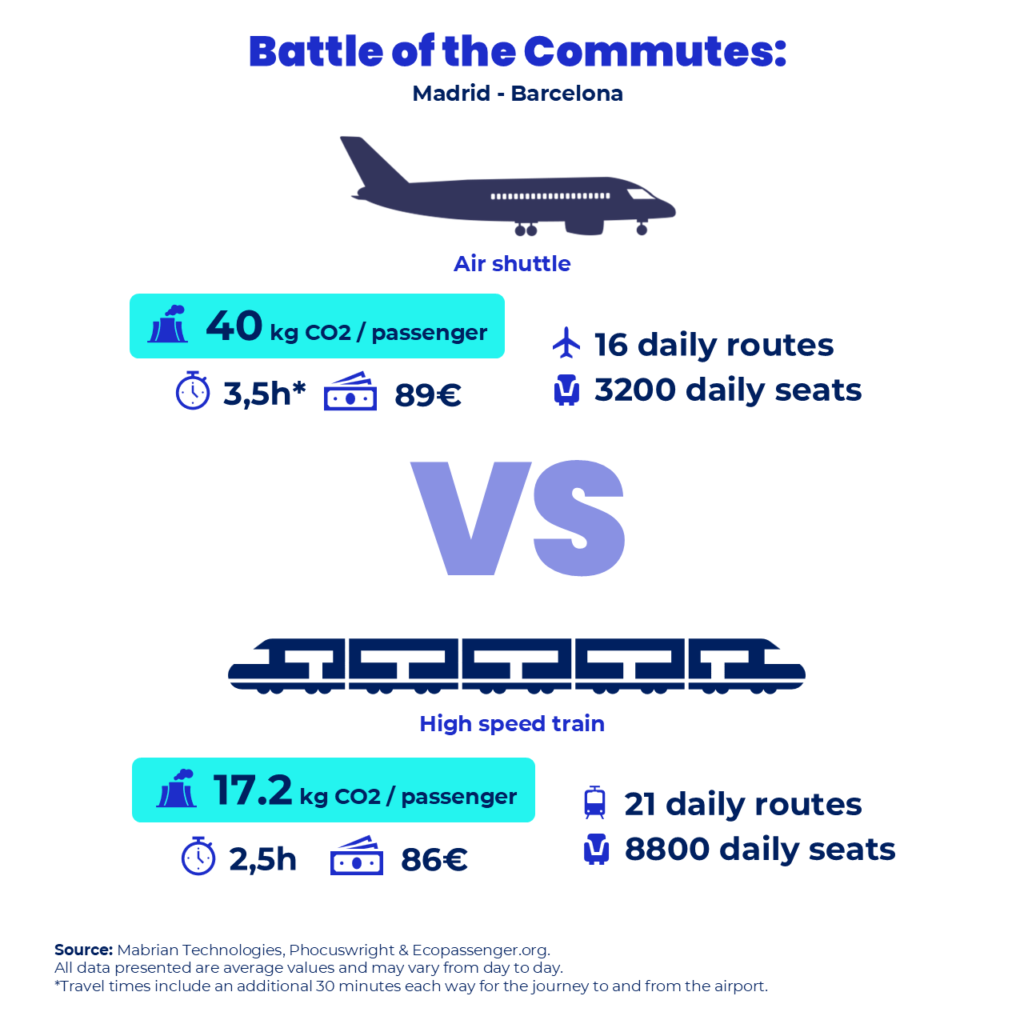
Data revealed that air passengers generate more than double the carbon footprint compared to high-speed rail for the same 630-kilometre route. Additionally, the study indicated that in the 12 months prior to the analysis, 5,744 flights connected the two cities, totaling 1.17 million seats. This number was projected to grow by 10% year over year in 2023, despite being below pre-pandemic levels.
By analyzing platform insights and data from Ecopassenger.org and UIF, we determined that the carbon footprint of the 21 high-speed train routes is half that of air travel, which offers 16 flights on this route daily.
In terms of ticket fares, prices are quite similar for both modes of transportation, fluctuating with demand. While air travel is faster, train stations are more conveniently located in city centers, reducing the total travel time between the two cities.
Results
The study, which provides insights for mobility policy-making, concludes that the existing high-speed rail network could meet 100% of the year-round mobility demand between Madrid and Barcelona. This shift would result in a 50% reduction in carbon emissions within just one year. Additionally, demand will not be hampered by train transportation rates, as the difference between plane and train tickets is minimal, with train fares being approximately 3% cheaper.