
At Turium’s first Strategic Advisory Council meeting of 2025, Mabrian emphasised that data intelligence is essential for implementing targeted strategies to strengthen Spain’s positioning as top destination for high-impact tourism, and shared insights on demand trends in markets that show strong potential to grow this segment.
The challenges and opportunities to consolidate tourism of excellence and high impact in Spain were at the core of Turium’s first Strategic Advisory Council meeting of 2025 held in Canalejas Gallery in Madrid. Mabrian’s team attended the meeting and shared an analysis of this segment focused on the Spanish market, highlighting priorities, motivations and trends that can be leveraged by the entire value chain of Spanish tourism to attract this type of traveller.
Turium, a think tank comprised of experts in tourism, communication, branding, consulting, and trend research, endeavors to anticipate the evolution of the tourism market and contribute to the redefinition of Spain’s positioning as a high-impact destination. The entity, promoted by the Vocento Group and chaired by Ignacio Ybarra, includes an Advisory Board with representatives from prominent companies such as Iberia, Banco Santander, Les Roches, McKinsey & Company, Marugal, Abadía Retuerta, and Makro, as well as destinations such as Castilla-La Mancha, Santander, and Murcia.
During the session, Mabrian reviewed the key factors that shape the behavior of high-impact travellers in Spain. For this analysis, several strategic medium- and long-haul markets were identified based on their potential to grow high-impact arrivals, focusing on the ones that, globally, increased their spending at the destination by over 20% year-on-year in 2024: Brazil and Mexico in Latin America; Saudi Arabia and the United Arab Emirates in the Middle East; and Germany, France, and Italy in Europe.
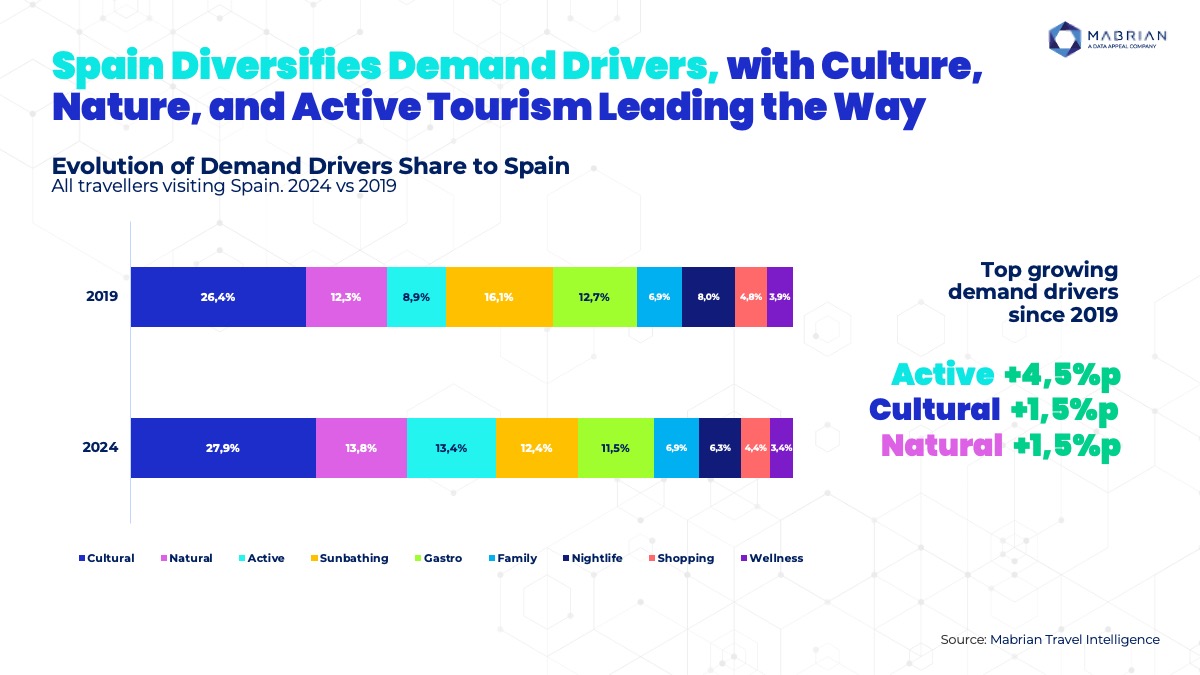
- Spain is continuing to diversify its demand drivers, with culture, nature, and active tourism leading the way. This diversification trend has become more established in the past five years, with 28% of travellers choosing Spain for its cultural offerings. Nature and active tourism, along with culture, are the three primary attractions, with the first two growing by +1.5% and active tourism increasing by +4.5%, making it the fastest-growing segment since 2019. “This development demonstrates a positive redistribution of demand, promoting the diversification of markets and segments, as well as contributing to beat seasonality; key elements to develop high-impact tourism in Spain”, according to Carlos Cendra, partner and director of Marketing and Communication at Mabrian.
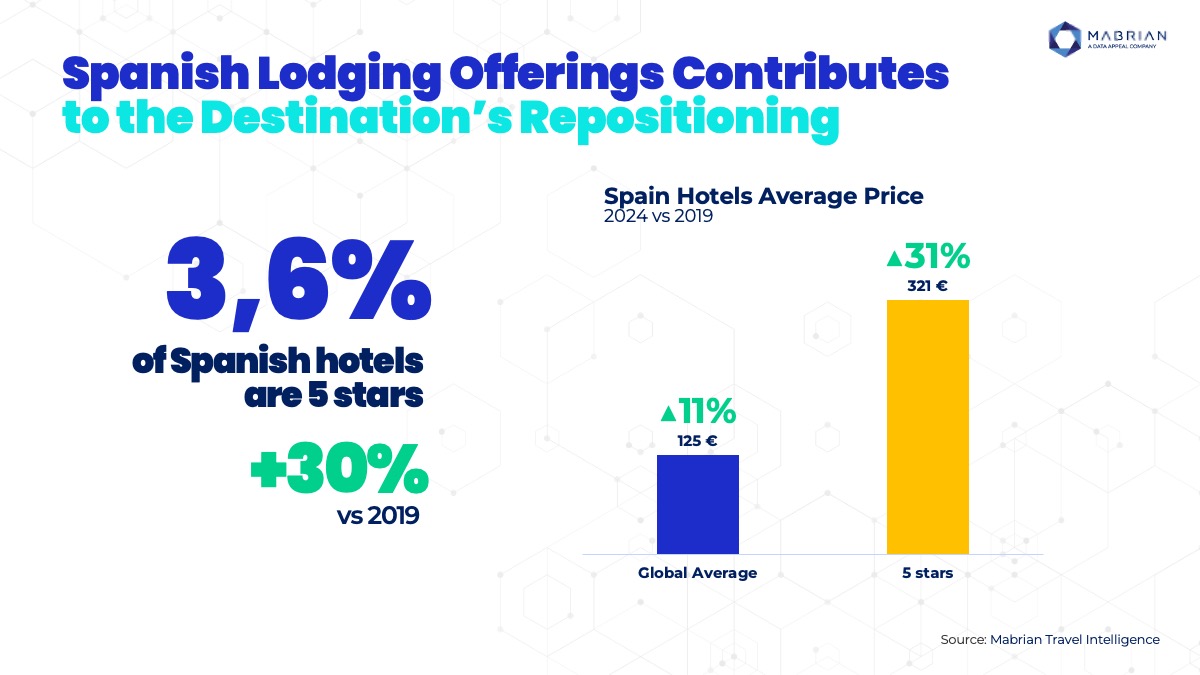
- The evolution of Spain’s lodging value proposition reinforces the destination’s repositioning strategies. Spain continues to establish itself as a key destination for hotel investment in Europe, with over 3 billion euro allocated to hotel operations in 2024. Although this figure is 25% lower than in previous years, the strategy in the last five years has focused on strengthening the urban and holiday offerings, especially in the highest and luxury categories. Our data demonstrate the effects of hotel investment in the last five years: five-star hotels have grown by +30% since 2019 and represent 3.6% of the total. Additionally, their average rate has increased by +31% since 2019, reaching 321 euro, which is 2.5 times the global hotels’ average rate in Spain. As Mabrian’s spokesperson explains, “as top tier hotels grow, the next challenge will be to adapt the luxury hotel experience to the expectations of high-impact travellers, which will contribute to improving satisfaction and enhancing the perception of Spain as a destination that caters their needs.”
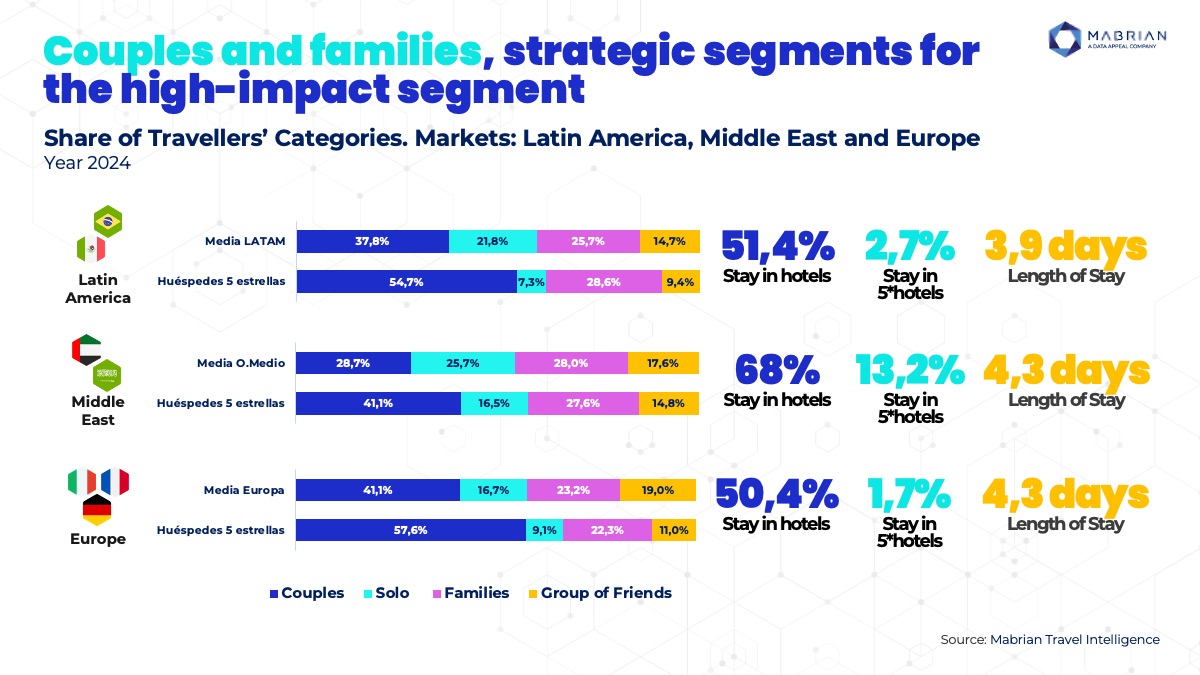
- Couples and families are strategic segments for the high-impact market. In the Latin American, Middle Eastern, and European markets analysed, two categories of travellers stand out. Firstly, couples that represent 57.6% of total European guests in five-star hotels, 54.7% of Latin American guests, and 41.1% of Middle Eastern travellers. Second, family travel holds significant weight, especially for Latin American (28.6%) and Middle Eastern (27.6%) tourists. “Data suggests how important it is for hotels to have facilities, services and experiences that meet the needs of these travellers,” explains the Mabrian spokesperson. Concierge services, for example, “are of utmost importance for this group of travellers”.
- Latin American travellers, satisfied with Spain’s 5-star experience and show potential to increase spending. Globally, spending by travellers from Brazil and Mexico has grown considerably, concentrating on shopping, accommodation, and dining; these are key areas for spending growth. To achieve this objective, in addition to developing products and services aligned with their interests, it is essential to maintain high levels of satisfaction in the Hotel Satisfaction Index (HSI). Generally, Mexican tourists (85.2 points out of 100) and Brazilian tourists (86.6 points out of 100) rate the 5-star hotel experience in Spain more than 9 points above the average (77.2 out of 100), while their satisfaction with national hotel offerings exceeds 80 points out of 100 in this indicator. “A positive perception of the accommodation experience is a determining factor in attracting more travellers from these markets, especially those with a high spending profile,” points out the Mabrian expert.
- Improving accommodation and destination experiences is key for Middle Eastern markets. In contrast, the quality perceived by Middle Eastern markets is the primary challenge, despite their significant potential in high-impact tourism. 13.2% of travelers from the United Arab Emirates and Saudi Arabia choose five-star hotels for their stays in Spain, a figure considerably higher than the 2.7% in Latin America and the 1.7% in the European markets analysed. However, the Hotel Satisfaction Index (HSI) of these hotels concerning these markets is 11 points below the national average (66.4 for Emiratis and 68.9 for Saudis), indicating lower satisfaction with the five-star accommodation offerings in Spain. Moreover, nearly half of these tourists’ expenditures are on shopping and dining, while accommodation constitutes only one-fifth of the total spending at the destination. Cendra highlights that “to enhance this performance, elevating the service standards in luxury hotels is essential, encompassing both guest service and the quality of the facilities.”
- The challenge of enhancing European travellers’ experience to increase spending in the destination. For German, French and Italian travellers, Spain is a close and familiar destination, so the surprise factor plays a key role in capturing the attention of high-impact tourists. Therefore, crafting differentiated experiences based on culture, gastronomy, and active tourism can be crucial. For instance, urban musical tourism or nautical tourism on the coast illustrates the potential of this strategy. However, to ensure these initiatives are effective in developing and promoting more segmented and exclusive products, they “must be accompanied by an improvement in hotel satisfaction in five-star accommodations,” says Cendra. Although moderately positive, particularly among Italians (82 points out of 100), there is still room for improvement, as shown by the Hotel Satisfaction Index (HSI) that Germans (73.6 out of 100 possible points) and French (72.1) assign to Spanish five-star hotels.