According to a study conducted by our analysis team and the Ministry of Tourism of Ecuador, presented at FITUR 2025, Ecuador captured 2.2% of total European leisure tourism in Latin America during 2024. In this context, Spain plays a very relevant role as a connectivity hub and as a market of opportunity.
Ecuador is positioning Spain as a key gateway to the European market, according to the latest report published by the global travel intelligence platform Mabrian in collaboration with the Ministry of Tourism of Ecuador. The report’s findings, presented at FITUR 2025, highlight Spain’s significant role in this growth for Ecuador, as it accounts for 71% of European reservations to the country.
The “Report on European Markets in Latin America and Ecuador” reveals the trends set to shape European tourism demand in the coming months, with a focus on Ecuador’s positioning relative to its main competitors, Peru and Colombia. The findings were presented at FITUR 2025 during a workshop led by Santiago Granda, Deputy Secretary General of Promotion at the Ministry of Tourism of Ecuador, and Marouan Charef, Senior Analyst at Mabrian.
This study was developed using Ecuador’s tourism intelligence system, powered by Mabrian’s data ecosystem, part of The Data Appeal Company-Almawave Group. Since its implementation, this platform has become a strategic tool to enhance competitiveness, to foster tourism development with sustainability and profitability in mind, and to optimize the planning and management of the country’s tourism resources.
“The importance of having strategic data intelligence as a core axis for effective decision-making in tourism promotion and development. Through our collaboration with Mabrian, our strategic partner, we have gained access to key insights on European market trends and preferences, allowing us to design personalized campaigns, identify emerging market niches, and optimize promotional investments. This partnership strengthens our ability to anticipate travellers’ demands, maximising Ecuador’s competitiveness as a tourist destination while ensuring evidence-based, real-time strategies. Integrating data into our decision-making not only drives growth but also supports more sustainable and efficient management of tourism resources.”
Santiago Granda, Deputy Secretary of Promotion at the Ministry of Tourism of Ecuador
Part of Ecuador’s strategy involves leveraging its air connectivity network and its connections with other Latin American countries. Mabrian’s data shows that 1.6% of international air seats scheduled from Europe between November 2024 and April 2025 connected with Latin American destinations, totalling 6.8 million seats. Of these, 2.3% connect Europe with Ecuador.
Spain accounts for 42.8% of the scheduled air seats from Europe to Latin America, with year-on-year growth of +8%. “Spain serves as a natural bridge for European connectivity to Latin America, not only for other continental markets but also for long-haul connections,” said Marouan Charef, senior analyst at Mabrian.
For Ecuador, this means that 71% of flight reservations from Europe originate in Spain, which is solidified as the primary hub for connectivity to the country. “The Ecuadorian diaspora in Spain has played a key role in maintaining these strategic routes, offering Ecuador exceptional accessibility from Europe,” noted Charef.
Spain, Germany, and Switzerland: Opportunity Markets for Ecuador
Data on hotel bookings for leisure travel (excluding Ecuadorians living abroad) indicates that France, Spain, Germany, and the UK are the top European markets sending tourists to the region. This same data shows that Ecuador captured 2.2% of total European leisure tourism to Latin America, ranking 11th among destinations, in a list led by Mexico, Brazil, Colombia, Costa Rica, and Peru.
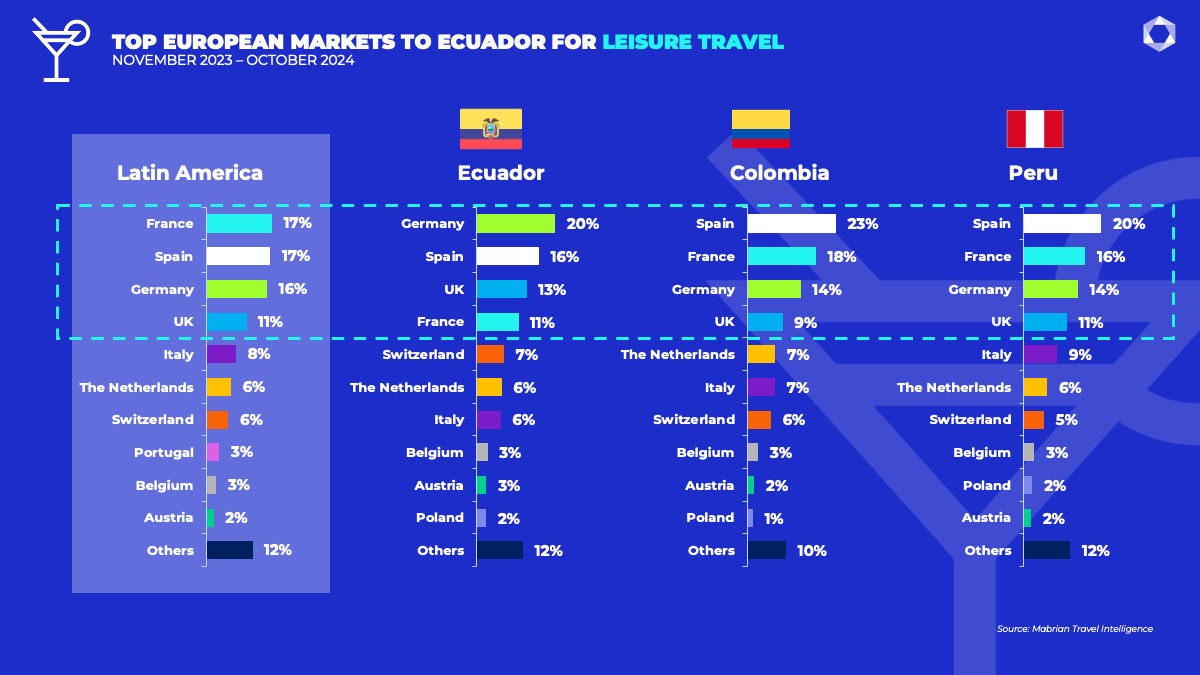
A cross-analysis of hotel bookings and air capacity between Europe and Latin America show two trends: first, an increase in air seats from France; and second, and the strengthening of routes from key source markets such as Germany, Italy, and Switzerland. Although Ecuador lacks direct connections with these markets, this country can capitalize on these trends to attract more European travellers.
Data suggest that “the relative importance of the German market is growing compared to other European markets, turning Germany, along with Switzerland, an interesting market for Ecuador,” explained Charef. He added, “Spain, Germany, Switzerland, and France represent significant opportunities for Ecuador, especially when considering their spending potential and average length of stay.”
Spaniards visiting Ecuador stay an average of 13.4 days, similar to German and Dutch travellers (13.5 and 14.1 days, respectively). French tourists average 12-days stays, comparable to British and Italian visitors.
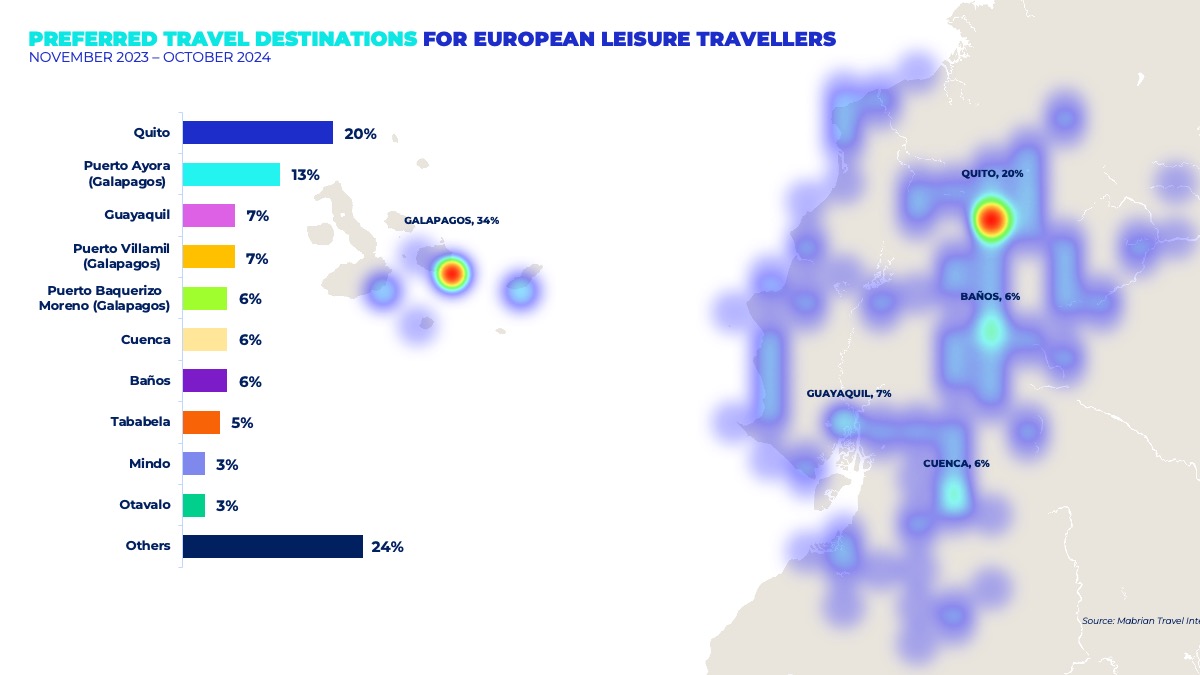
European tourists are primarily drawn to the Galapagos Islands (34% of visits) and Quito, the capital (20%). Other popular destinations include Guayaquil, Baños, and Cuenca. Additionally, “Ecuador is gaining traction as a business destination, ranking ninth among Latin American countries, presenting opportunities for the bleisure segment.”
Attracting European Spring and Summer Demand
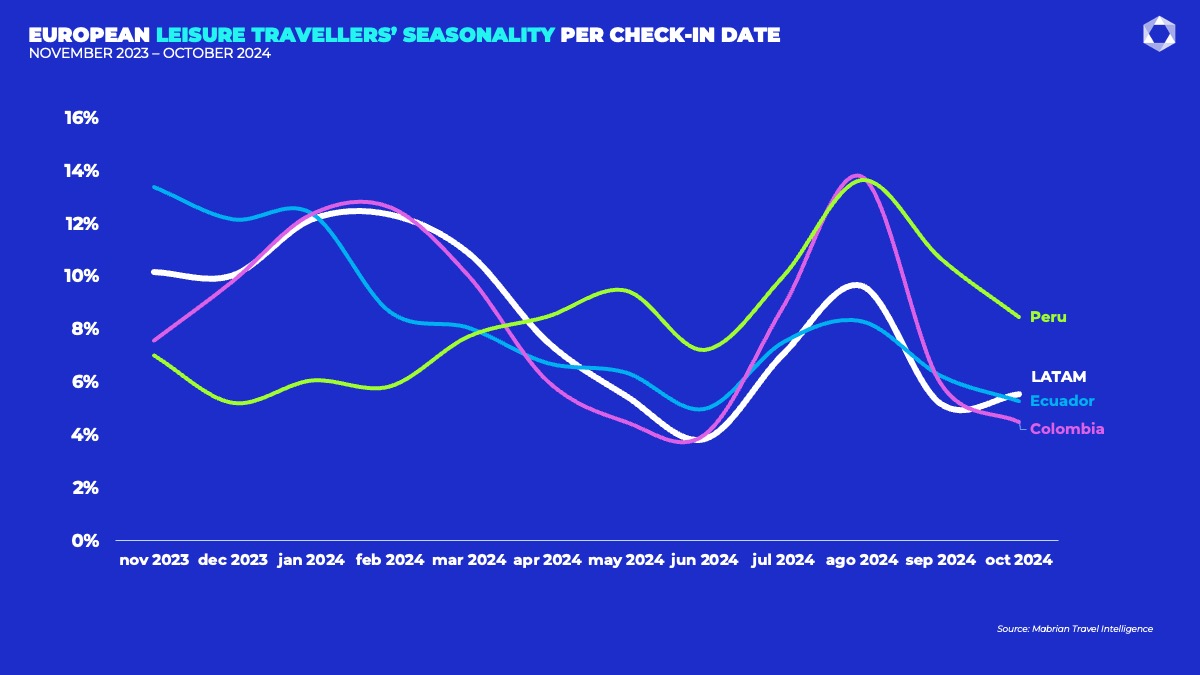
European demand for Latin America is highly seasonal, peaking from winter to Easter (March/April) and again in August. While other destinations like Colombia experience higher demand in summer, similarly as Peru, also peaking in May, Ecuador’s performance is below the regional average in February, March, April, and August. “This gap presents a valuable opportunity for Ecuador to strengthen its positioning during these key months to capture more European travellers,” emphasised Mabrian’s expert.
Using Mabrian’s data intelligence, Ecuador can identify opportunities by segmenting markets based on factors like air connectivity, destination branding, and demand trends. The country can leverage its rich cultural identity, a major driver of European tourism to Latin America, and its strong offerings in natural and active tourism.
Other opportunities include promoting family-friendly travel, solo travel, and couples’ tourism, including honeymooners, which account for 45–48% of visitors in Peru, Colombia, and Ecuador, leader in this segment.
For the Ministry of Tourism of Ecuador, travel intelligence has become essential for transforming tourism and positioning the country competitively in global markets like Europe. “Our partnership with Mabrian has enabled us to adopt an evidence-based approach that fosters innovation, optimizes resources, and ensures alignment with traveller expectations,” stated Granda. He concluded, “This commitment to informed decision-making not only strengthens our destination’s promotion but also lays the foundation for sustainable, resilient tourism development that can adapt to the dynamic global environment.”
Download report
Stay up-to-date with the latest news tailored to your industry!
Subscribe to our newsletter to receive the report.